Labour’s war of words
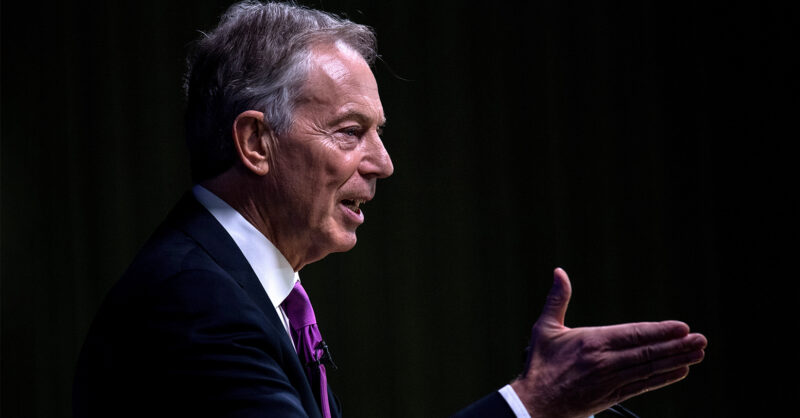
Labour’s war of words has entered its third day. After Tony Blair made a major intervention on Wednesday with almost 6,000 words of warning for the Labour Party, Andy Burnham, Keir Starmer and Wes Streeting have all set out their own versions of a riposte. Labour’s “battle of ideas” has certainly begun.
Streeting was first out of the blocks, sharing his response to the former prime minister in the Guardian on Wednesday evening. Of the three men, Streeting’s politics are closest to Blairism. The former health secretary is a darling of Progress, the think tank founded in 1996 to support Blair’s leadership. Streeting announced his intention to run for the Labour leadership at the group’s conference in the City of London on 18 May.
But though they hail from the same Labour tradition, Streeting was deeply critical of Blair in his response. He wrote of a “striking weakness” at the heart of the former leader’s argument: though Blair addressed the challenges posed by changing technology, geopolitics and political strategy, “the defining issue of our age is barely confronted at all”. Inequality and the cost-of-living crisis, Streeting argued, were conspicuously absent from Blair’s tirade.
He pushed back against Blair’s argument for the radical centre, reiterating his call for the UK eventually to rejoin the EU and added that the centre-left “cannot answer populism merely with managerial competence or technological optimism”.
Subscribe to the New Statesman for £1 a week
Andy Burnham – who characteristically announced his decision to respond to Blair on X – followed Streeting with an intervention of his own. In an essay for the Times, Burnham hit back at his former cabinet colleague and the record of the government in which the two men served together. “The Labour government in which I was proud to serve did many great things,” Burnham wrote. “It did not, however, take us off the direction set by Thatcher.”
He described Blair’s calls for further deregulation to kick-start the UK economy as “retro-thinking”, and warned that unless Britain is lifted out of its current rut, it risks becoming trapped in “a toxic, divisive politics like the US”.
The Manchester mayor’s decision to respond to Blair was seen by some of his supporters as a bold move. One Labour source sympathetic to Burnham told me on Wednesday that they worried it could backfire, with resources being devoted to battling Blair rather than focusing on winning in Makerfield. But in responding to his former boss, Burnham has also been given an opportunity to defend – and shape – his platform in public.
About an hour after Burnham’s response was published, Keir Starmer released his own. In a 3,000-word Substack post, the Prime Minister threw the argument back at Tony Blair. “It will come as no surprise to hear that I do not agree with everything Tony says about Britain or the government,” Starmer wrote. Pushing back against Blair’s analysis, the Prime Minister acknowledged some of the mistakes his government has made, such as the decision to cut the winter fuel payment. But he added that the economic situation his government inherited – unlike Blair’s in 1997 – was the worst the country had faced since 1979.
Blair had furthered his argument on the Today programme, in which he said he did not think “one political party is going to have the exclusive capability in deciding the right answer”. Starmer responded to this on his Substack, predictably insisting that only Labour can fix the problems facing the country. “Britain does need Labour values; it has needed Labour values for a while. Our plan is guided by them,” the Prime Minister wrote.
It is generally a good thing that senior Labour politicians are discussing and debating these issues in public. The UK – as Tom writes in this week’s New Statesman cover story – has chosen delusion over reality, unable to grapple with the very real decline we are experiencing.
But these arguments should have been aired years ago, when the party was in opposition and had the time and space to do so. Keir Starmer’s Labour Party is now two years into government, staring down the barrel of a leadership contest and, after that, a tooth-and-nail fight against the rising threat of Reform.
Has this long-awaited battle of ideas simply come too late?
[Further reading: One million Neets are a statistic, but every Neet is a tragedy]
Content from our partners
Related