The Boys limped through its last season, but made up for it with the finale
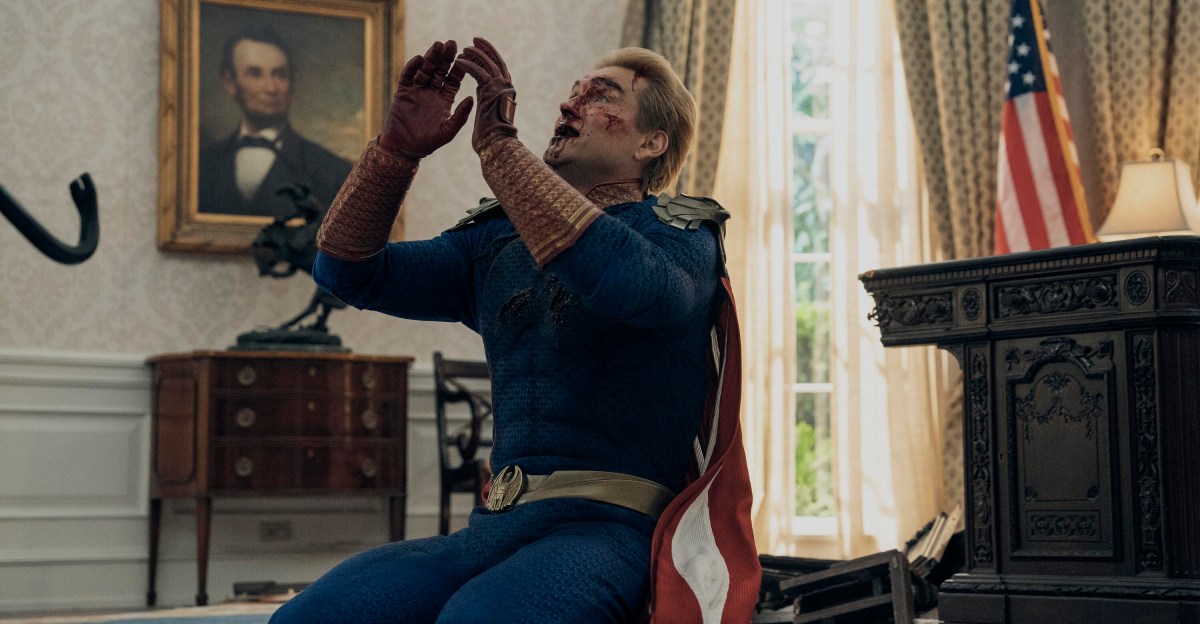
It’s hard existing in a world seemingly designed for the undeservingly powerful and painfully boring few. They have been gifted what many of us only dream of: the ability to effectively do whatever they like, free from everyday concerns like money, housing, and health. But instead of living in quiet serenity, many choose to use their gifts to set the world aflame, then complain about the fire and our attempts to put it out. They wield their wealth loudly on our screens, spout old-timey racism on newly created social media, clog the arteries of creativity by dominating media, and don the robes of lawmakers to avoid the rule of law. They are incapable of being quiet, being unseen, being anything other than extravagant, excessive… in other words, “super.”This narcissism is precisely what every superhero character demonstrates in Amazon Prime’s The Boys, which concluded this week with its series finale. While it succeeded in the final episode, the season as a whole felt unnecessarily long, with meandering plotlines and often little payoff. But, in the end, the satisfying conclusion brought the show back to its strengths.Spoiler warning for all of The Boys, including the final episode.The show started off very strong, adhering to Garth Ennis and Darick Robertson’s original comic. The titular group of ragtag ruffians has always had one goal: destroy superhero supremacy. Superheroes wear multiple hats — real-life celebrities, actual heroes helping people, Dionysian egotists indulging in every sick whim and sexual vice — and their powers seemingly prevent any human from intervening. This is where the Boys come in, each of whom has suffered loss by superheroes. Led by the boisterous Billy Butcher (Karl Urban doing his best-worst Cockney accent), we primarily follow the journey of Hughie Campbell (Jack Quaid), the world’s most unremarkable man, who is now in a battle against the remarkable.Image: AmazonWhat makes the show compelling is that these normal humans are fighting what are basically gods, so they must use their individual skills and collective ingenuity to defeat bulletproof, highly destructive people that move faster than lightning. (This central imbalance is not in the comics, where the Boys have permanent superpowers too.)The show dealt quite directly with contemporary themes not in the source material. The Boys’ writers seemed to emulate South Park by taking a topic still fresh in the headlines and making it a point of contention. The final season, written before Donald Trump’s second term in office, features many events we are still seeing in US news stories, from the rise of the manosphere to locking up political opponents in prison camps to AI dominating creative fields. Some scenes from The Boys feel indistinguishable from what we see discussed and reported today.This season begins with Homelander (Antony Starr giving his all) having taken control of the entirety of the executive branch of the United States government. Some members of the Boys are imprisoned, while Starlight (Erin Moriarty) and her supporters have been doing what they can to dismantle Homelander’s control. All their efforts come up short. Homelander controls vast media and law enforcement apparatuses, while Starlight is fighting the most powerful enemy: belief.Homelander’s supporters worship him and his MAGA-lite regime, lapping up nonsense about immigrants destroying the US and opponents being pedophiles. His lackeys and supporters use “woke” as an undefined pejorative. Starlight herself confronts this when she meets her stepbrother, who consumes only manosphere podcasts and Homelander-controlled news networks. To the show’s credit, it has always been excellent at showcasing how propaganda is created and perpetuated.But the entire season feels like it should’ve been a few episodes or one long movie, as opposed to eight episodes. This is because there is little upward mobility for Homelander’s evil. Yes, he takes control of the US administration, but having already taken control of Vought — the most powerful corporation that effectively created supes — there is little difference in what he is now able to achieve. The show itself likes to blur the lines between corporation and government, without stating with its full chest that the US has always been a corporatocracy.Image: AmazonBut the show dragged itself to the finale. One episode grinds the season to a full stop to show us a dog’s perspective of humping a Homelander toy and petty grievances between two rival superhero podcasting bros. There are some notable deaths, but these characters’ presence has little impact on the overarching plot in this season.The Boys’ writers tried to focus on the idea of Homelander becoming immortal through taking a drug utilized by his father (Soldier Boy, played by Jensen Ackles), while our “good guys” tried to create a virus that would wipe out all superheroes. Both of these fail: Homelander’s immortality does not enhance his powers or evil, and the virus becomes merely a focus for arguments between the team. Despite the amount of time and energy spent on these threads, none of this plays into the finale or helps end Homelander.Instead, it comes down to Kimiko (Karen Fukuhara), a character we’ve known from the beginning, who is able to withstand punishing radiation treatment, granting her the ability to remove superheroes’ powers. All the Boys needed to do in the end was get her in the same room as Homelander. All the hemming and hawing over immortality and viruses was a waste of time.Where the season did succeed was in showcasing Homelander. Throughout the show’s run, we have watched Homelander’s mental decline alongside his rise in power. Homelander is one of TV’s greatest villains precisely because he is so pathetic and yet so powerful; the show hints that it’s this disconnect that has him scrambling for “more,” yearning for adoration. But because he suffers a poverty of personality, his hunger for wholeness ends up consuming everything — including the world. It’s refreshing seeing characters confront Homelander and point out that, without his powers, he’s nothing more than an entitled, whiny child.This is, I think, the show’s best lesson: Almost no one in a position of government or corporate power got there through moral means. Thinking on the many powerful men in the real world, I realized that they’re the same as Homelander. They cannot live lives of quiet serenity because they cannot escape themselves, their endless hunger, and their narcissism. And because they cannot escape, neither can we.Homelander may have laser eyes and flight, but when he’s finally stripped of these in the finale, he can’t even throw a punch at Butcher. Homelander has never had to learn fighting techniques because his powers made him immortal. Butcher, a trained soldier, easily overpowers him.When Homelander was finally beaten and easily killed, stripped of his powers, I felt elated. It was cathartic to watch him reduced to this whiny, mewling sack of nothing — this was especially true knowing the same thing would happen in the real world. The finale certainly seemed to have annoyed Elon.The meandering final season doesn’t negate what The Boys as a whole accomplished. This gory, bloody mess has heart, and it’s justifiably angry and ready to beat you over the head with its messaging.Follow topics and authors from this story to see more like this in your personalized homepage feed and to receive email updates.Tauriq MoosaCloseTauriq MoosaPosts from this author will be added to your daily email digest and your homepage feed.See All by Tauriq MoosaEntertainmentCloseEntertainmentPosts from this topic will be added to your daily email digest and your homepage feed.See All EntertainmentTV Show ReviewsCloseTV Show ReviewsPosts from this topic will be added to your daily email digest and your homepage feed.See All TV Show ReviewsTV ShowsCloseTV ShowsPosts from this topic will be added to your daily email digest and your homepage feed.See All TV Shows