American energy sector to invest $100B in battery storage by 2030 [update]
Last year, the smart money had the American energy sector investing a cool $100 billion (with a “b”) in battery storage for sustainable energy. Today, those batteries aren’t just supporting wind and solar, they’re propping up AI data centers – and the investments are just getting bigger.
Whether you love AI (wrong) or hate AI (correct), it’s probably here to stay – with some estimates indicating that AI data centers could represent 17% of total US energy consumption by 2030. (!) That has huge implications for the battery energy storage system (BESS) market, and the original $100 billion estimate we covered last year? That’s looking pretty conservative now.
That’s because the ACP estimate focused on building a domestic battery manufacturing base, with companies like LG planning to build out more than 16 GWh of capacity annually from its existing production lines in Holland, Michigan.
Today, analysts at Benchmark expect the US to deploy more than 600 GWh of energy storage by 2030, with annual installations nearly doubling again as AI-driven power demand continues to accelerate. Advertisement - scroll for more content
“At the end of 2025, the US had 137 GWh of utility-scale storage, 19 GWh commercial and industrial, and 9 GWh residential,” writes Power Systems Technology.
Doing the math, that’s taking us from 156 total GWh of energy storage in the US today and nearly quadrupling it by 2030 – and that’s just taking us to 600 GWh. The Solar Energy Industries Association (SEIA) is aiming for up to 700 GWh in their new whitepaper.
“Expanding energy storage capacity is a crucial means of ensuring our nation’s energy security and resilience,” said SEIA president and CEO Abigail Ross Hopper. “As demand for energy soars, storage helps turn quick-to-build, low-cost solar generation into clean, dispatchable power, ensuring our grid can adapt to challenges, support critical infrastructure, and deliver reliable power to every community.”
You can read the original 2025 article, below, for some additional context, then let us know what you think of this mass-scale battery deployment in the comments.
ORIGINALLY PUBLISHED 10MAY2025
Reid Gardner battery energy storage system.
Executives from the American Clean Power Association (ACP) and several utility company representatives said Tuesday that they were committed to a fivefold increase in active investments that could, according to the Association, lead to 100% American-made BESS projects – but that vision depends on both a streamlined permitting environment and predictable tax and trade policy, the ACP said.
This commitments “demonstrate what success can look like,” said ACP CEO Jason Grumet, adding that many industry players have been waiting in a sort of holding pattern until some long-term clarity develops around Trump’s tariff and trade policies. “There is a remarkable tension right now between probably the best fundamentals for investment in the energy sector that we’ve seen in a generation and the greatest amount of uncertainty that we’ve seen in a generation.”
Those fundamentals involve rapidly dropping battery costs with increasing density – and that efficiency improvement is coming with reliability, too, Hyundai joining Tesla (and others) in delivering batteries good for hundreds of thousands of miles of driving. The tension, of course, comes from the fact that most batteries, today, are made in Asia.
Form Energy CEO Mateo Jaramillo says his company sources more than 80% of its battery content in the US and much of the rest from Europe and “non-China Asia.” And, while they’re working to re-shore even more, they remain exposed to heavily tariffed Chinese-made inputs.
Form eventually hopes to source raw iron from US mines in Michigan and Minnesota – and they’re not alone. Executives from other companies spoke up as well:
COVID-era disruptions across the global battery supply chain convinced Fluence that an energy storage market as robust as the United States’ needed a stronger domestic manufacturing base, Fluence Americas President John Zurancik said in the press briefing. The company’s U.S. investments are now bearing fruit as it expects to deliver its first U.S.-made lithium-iron-phosphate, or LFP, batteries this week for deployment later this year, he said.
Like Fluence, LG Energy Solution Vertech expects to significantly expand its U.S. manufacturing operations in 2025 and 2026. The South Korean battery powerhouse will adapt existing production lines at its Holland, Michigan, factory to deliver 16.5 GWh of stationary storage batteries this year and add 11 GWh of new capacity in 2026, its CEO said in a statement provided by ACP.
UTILITY DIVE
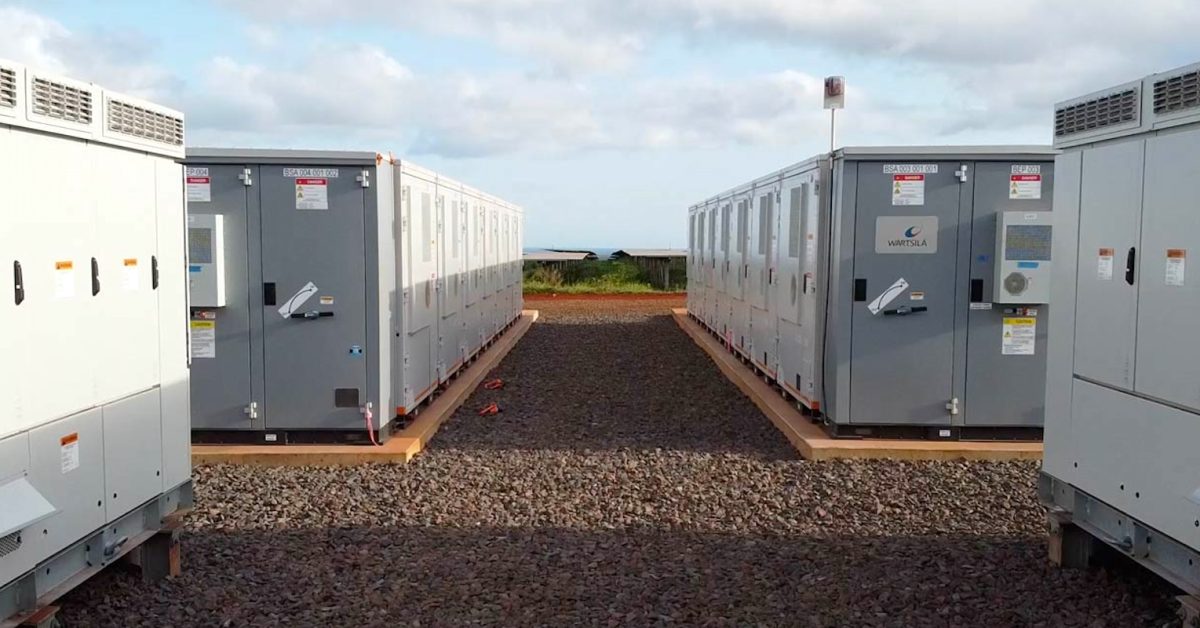
Even industry stalwarts like Wärtsilä have begun sourcing components for the container-based Quantum 3 BESS system we covered last summer from a geographically diverse set of suppliers, with manufacturing capacity across different regions of North America, Asia, and Europe. This should enable the company’s customers to take advantage of any local tax incentives while avoiding the kind of tariffs impacting global battery markets.
The ACP’s announcement adds about $85 billion to a set of “active investments” worth $10 billion to $15 billion, executives with the trade group said in a press briefing.
250 MW Sierra Estrella BESS project in Avondale, AZ; via SRP.
Battery energy storage just makes sense – and it’s being leveraged in smart ways by companies like Zenobē, who are using smart BESS deployments to help hold down ratepayer costs while improving grid resilience and reliability. Volvo, too, is working to develop rapidly deployable BESS solutions that can support temporary job sites and disaster relief efforts.
Then there’s the rich people. Located in Abu Dhabi, the world’s largest storage project will feature a 5.2 GW solar PV plant coupled with a 19 gigawatt-hour (GWh) BESS. You can check that out here, then let us know what you think of all these projects in the comments.
SOURCE: Utility Dive; featured image via Wärtsilä.
If you’re considering going solar, it’s always a good idea to get quotes from a few installers. To make sure you find a trusted, reliable solar installer near you that offers competitive pricing, check out EnergySage, a free service that makes it easy for you to go solar. It has hundreds of pre-vetted solar installers competing for your business, ensuring you get high-quality solutions and save 20-30% compared to going it alone. Plus, it’s free to use, and you won’t get sales calls until you select an installer and share your phone number with them.
Your personalized solar quotes are easy to compare online and you’ll get access to unbiased Energy Advisors to help you every step of the way. Get started here.
FTC: We use income earning auto affiliate links. More.