Carney downplays Washington's decision to pause bilateral defence board
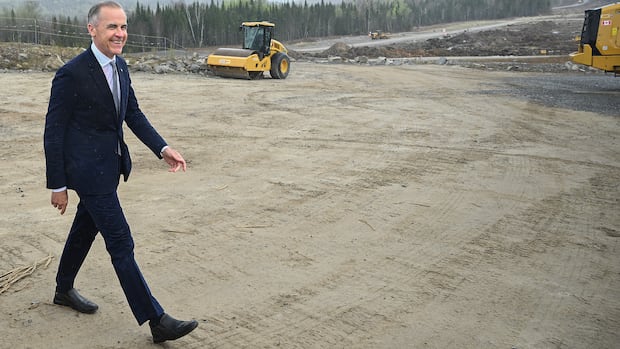
Listen to this articleEstimated 4 minutesThe audio version of this article is generated by AI-based technology. Mispronunciations can occur. We are working with our partners to continually review and improve the results.Prime Minister Mark Carney showed no signs on Tuesday of flinching over a decision by the United States to abruptly pause a long-standing bilateral defence board and put its future under review."It has a long heritage but I wouldn't overplay the importance of this," Carney told a news conference in Quebec when asked about the development. "We have many aspects of very close defence co-operation with the United States."The Permanent Joint Board on Defense, which hasn't met since 2024, was established in 1940 as an advisory body for U.S.-Canada bilateral defence co-operation.On Monday, U.S. Undersecretary of War Elbridge Colby announced that the Pentagon is "pausing" participation in the bilateral board."Only by investing in our own defense capabilities will Americans and Canadians be safe, secure, and prosperous," Colby wrote in a series of posts on X. "Unfortunately, Canada has failed to make credible progress on its defense commitments."WATCH | Carney responds to U.S. leaving joint defence board:Prime Minister Mark Carney said Canada will continue to co-ordinate with the U.S. but will also be 'diversifying our defence co-operation' with other NATO partners and Ukraine in response to the Pentagon 'pausing' participation in the Permanent Joint Board on Defence. 'I wouldn’t overplay the importance of this,' Carney said.While its suspension does not affect joint military operations, it does deal a symbolic blow at a time when Canada and the U.S. are locked in a trade dispute and bilateral tensions remain elevated.Colby's posts implicitly lay some blame for the U.S. move on Prime Minister Mark Carney's frequent statements about making alliances with countries other than the U.S., in the wake of U.S. President Donald Trump's trade war and his calls for making Canada the 51st state."We can no longer avoid the gaps between rhetoric and reality. Real powers must sustain our rhetoric with shared defense and security responsibilities," Colby wrote in a post linked to a transcript of Carney's headline-grabbing speech at this year's World Economic Forum in Davos. The prime minister said Tuesday there's a lot of co-operation between Canada and the United States and that will continue, but Ottawa will also reach out to other allies to diversify defence co-operation.Carney said Canada will step up in critical areas such as support for Ukraine's defence against Russia. While Ukraine does not fall directly under NATO's defence responsibilities, Carney said aiding its defence is "consistent with our values" and those of a "vast number of our partners.""Ukraine is going to triumph and we're going to be on the right side of history for that," he said.The prime minister also vowed Tuesday to continue increasing defence spending, and pointed to projects such as the NORAD upgrades that will cost tens of billions of dollars.Ottawa and NATO announced this spring that estimates suggested Canada met its alliance defence spending target of two per cent of GDP for the first time over the past year.Carney said that figure is currently tracking at 2.1 per cent.In a Toronto Star editorial on Monday, former parliamentary budget officer Kevin Page criticized Ottawa for failing to publicly reconcile the cost of elevated defence spending with the need for new revenue.Page wrote it is "indefensible" that the federal government has not yet produced a clear financial plan for achieving the newer NATO defence spending target of 3.5 per cent of GDP by 2035.When The Canadian Press asked about that criticism, Carney replied that it would be premature to project that far out at this point."There's a couple of reasons why we don't immediately specify that," he said. "The core reason is we want to spend the money well."The prime minister said modern warfare is undergoing rapid changes through technological advances in drone technology and artificial intelligence, as seen throughout the war in Ukraine."If we had sat down even in June of last year and mapped out [how] the Armed Forces would have thought how they would have spent 1.5 per cent of GDP on defence, it would have looked a lot like how they would have answered that question five years ago," Carney said."We're not going to do that."The prime minister also pointed out that the NATO spending targets are up for review in 2030.