Meet The Bizzarrini Kjara, The Diesel Sports Car That Never Was
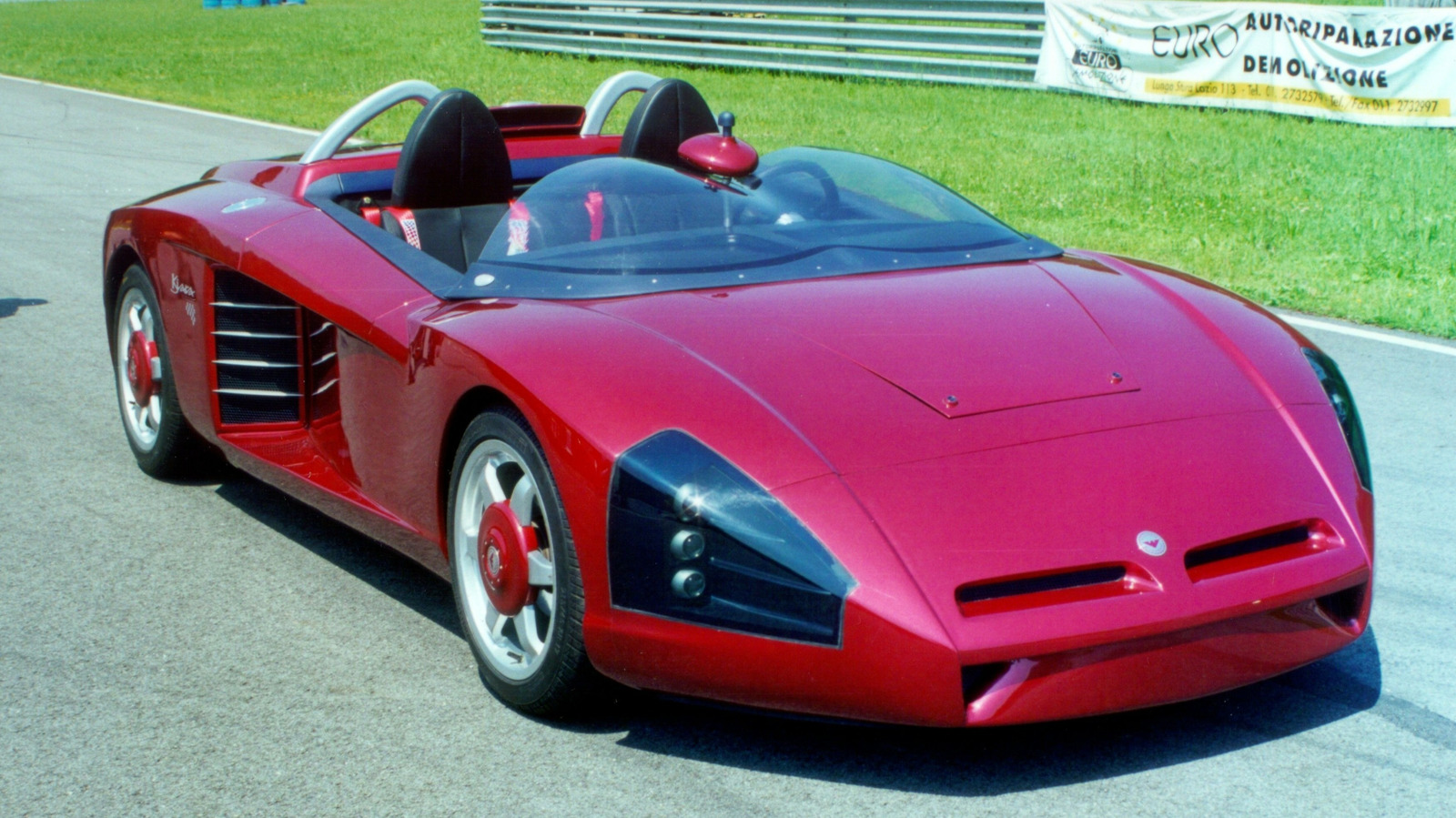
Giotto Bizzarrini was a famed Italian artist whose creations often rose to the level of masterpieces. His road-going works of art include the likes of the Ferrari 250 GTO, Lamborghini's first-ever V-12, and, beginning in 1964, his own line of sports cars. One of his wildest creations, however, was inarguably the Bizzarrini Kjara.
This one-off concept premiered at the Turin Auto Show in Italy in 2000, where it flaunted a sleek wedge-style exterior highlighted by massive side vents, a central single-tip exhaust at the back, and distinctive triangle stampings on the rear deck. Bizzarrini further distinguished the Kjara with its drivetrain — but not by installing a screaming V-12 engine. Instead, the car looked to the future with turbodiesel-hybrid technology that included electric motors at all four corners. Nor was the engine itself a conventional mill: Bizzarrini borrowed a 2.4-liter JTD turbodiesel inline-five from Lancia. Interestingly, despite being a hybrid, the Kjara featured three pedals and a manual transmission.
Five-cylinder engines are extremely rare in the industry, and the same 2.4-liter JTD made 132 hp in Lancias at the time. However, it's hard to guess what kind of real-world performance numbers the Kjara was capable of, as it was engineered from the ground up as more of a design study than a daily driver. Still, according to Gallery Aaldering, which listed a Kjara with about 767 miles on the odometer for sale in 2022, the inline-five still ran — although it was disconnected from the hybrid system.
Bizzarrini never followed through on the Kjara's innovative diesel sports car approach, but other companies tried. Perhaps the main player in the diesel performance car game in the early 2000s was Volkswagen. In 2005, the company introduced the EcoRacer concept featuring a carbon fiber body and a 1.5-liter four-cylinder diesel engine making 134 hp and 184 lb-ft of torque. With a curb weight of only around 1,875 lbs, the EcoRacer could run a 6.3-second sprint to 62 mph and hit roughly 143 mph. It could also achieve more than 69 mpg.
The Volkswagen Group also improved on Bizzarrini's diesel-hybrid idea with a new powertrain for Audi's Le Mans race car. Fitted with a 3.7-liter turbodiesel V-6 driving the rear wheels, and the motor generator on the front axle, the R18 e-tron Quattro won Le Mans three straight years in a row between 2012 and 2014.