UK warned adversaries may doubt NATO nuclear deterrent without US
Britain must leave its adversaries in no doubt that NATO would retain a nuclear deterrent even if the United States chose to stay on the sidelines in a future crisis, according to a new report urging a significant strengthening of the UK’s nuclear posture.
The analysis calls for senior ministers, including the Prime Minister, Defence Secretary, and Home Secretary, to participate in “large-scale nuclear exercises” alongside military forces to reinforce Britain’s credibility as a nuclear-armed state within the alliance.
The report argues the UK should be prepared to assume a leading role among European NATO members in the event of American disengagement during a major security crisis.
It has been endorsed in part by Franklin Miller, a former special adviser on nuclear policy to President George W. Bush and ex-official at the US Department of Defence, who warns that both Russia and China have significantly expanded and modernised their nuclear capabilities while Western attention waned after the Cold War.
Mr Miller writes that Western experts who guided NATO through the Cold War “took an intellectual holiday” following the Soviet collapse, while Moscow and Beijing continued long-term nuclear expansion programmes.
He highlights Vladimir Putin’s “massive modernisation” of Russia’s intercontinental and shorter-range nuclear systems from the early 2010s, alongside what he describes as a “breathtaking” build-up of Chinese nuclear forces under Xi Jinping.
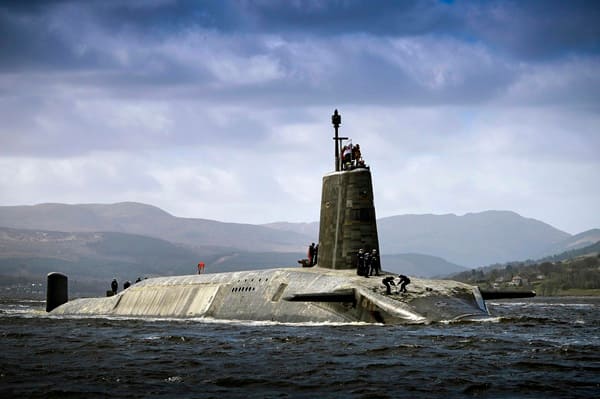
The report warns that Britain’s current efforts to modernise its submarine fleet and maintain the Atomic Weapons Establishment are “not enough”, arguing that “much more needs to be done” to ensure a credible deterrent.
It also acknowledges what it describes as “unsteadiness in America’s commitment to NATO”, calling on the UK to assume a greater leadership role within the alliance and to make clear to adversaries that NATO retains nuclear capability under all circumstances.
A central question raised is whether Britain should invest in a “sovereign mid-range nuclear system” of its own, amid what the authors describe as growing uncertainty over future US strategic posture.
The report’s author, Daniel Skeffington of the Policy Exchange think tank, argues that credible deterrence would require “large-scale nuclear exercises involving senior politicians” actively rehearsing nuclear decision-making alongside military commanders.
He also calls for investment in upgrading and dispersing airfields capable of supporting conventional and nuclear-capable aircraft in a crisis, describing this as an “absolute necessity” for Britain’s deterrent posture.
“This must be a priority for the Government, and funding must be given to stand this up quickly,” he said.
Shadow Defence Secretary James Cartlidge said the report highlighted the importance of deterrence credibility, warning that adversaries must believe Britain has both the capability and political will to act.
He criticised Labour’s defence policy, arguing that there was “no Defence Investment Plan” and calling for increased defence spending, including cuts to welfare and net zero programmes to fund military expansion.
A Ministry of Defence spokesperson said: “Our commitment to Britain’s nuclear deterrent is absolute. It protects us every moment of every day.
“As we face an increasingly volatile world, our nuclear deterrent is more important than ever. Following the Strategic Defence Review, we are investing £15billion in the UK’s sovereign nuclear warhead programme, significantly expanding our nuclear-powered submarine fleet, building up to 12 attack submarines as part of AUKUS programme, and procuring 12 nuclear capable F35-As in response to the rapidly increasing threats. We are a leader in the alliance – committing our nuclear deterrent in full to the defence of NATO, and we will join NATO’s dual capable aircraft mission, keeping Britain safe at home and strong abroad.”