Scania demonstrates fully electric concrete transport solution
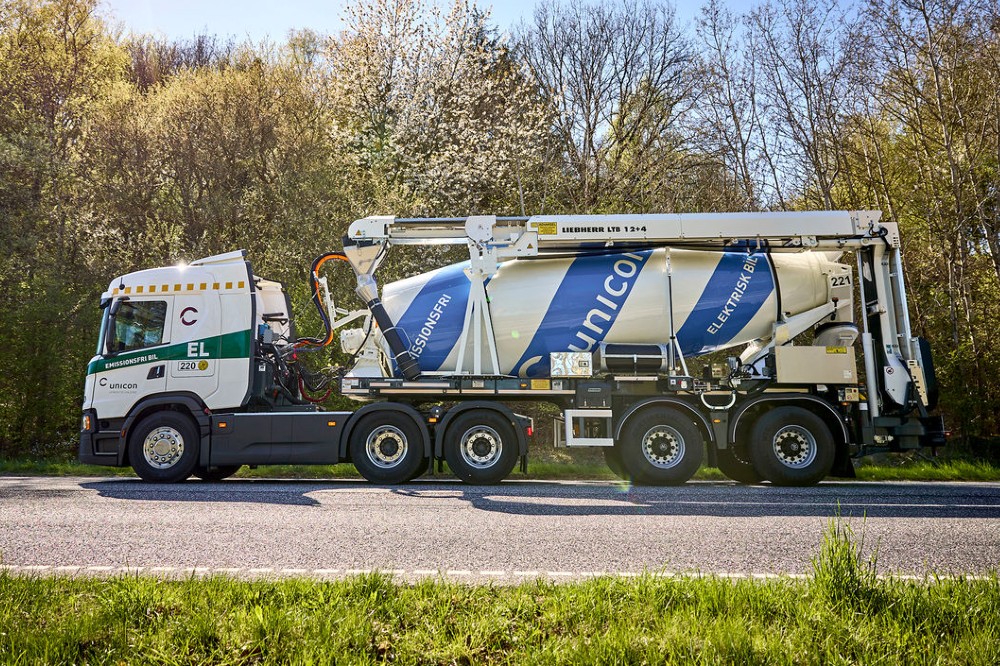
Truck manufacturer Scania has long maintained close ties with the construction industry and includes a wide range of vehicles suitable for construction sites in its portfolio. In collaboration with Unicon, a major producer and supplier of ready-mix concrete in Denmark, and Liebherr-Mischtechnik GmbH, the Swedish commercial vehicle manufacturer is now presenting a fully electric solution for concrete transport. A key component of this solution is the electric power take-off (ePTO) integrated into the electric truck, which drives the concrete mixing drum directly using the vehicle’s battery system.The stakeholders emphasise that this solution demonstrates that even one of the most energy-intensive and complex transport applications can be electrified in real-world operations— paving the way for scalable deployment. The partners say their efforts represent a significant advancement for the construction segment.Concrete transport is considered particularly challenging to decarbonise due to its high energy demands and the need for continuous mixing equipment. The vehicles must also perform reliably both on- and off-road while ensuring uninterrupted mixing operations. Scania highlights its holistic systems approach, considering the vehicle, application, and energy consumption together from the outset. The development took three years.“This project shows that electrification is not limited to standard applications. It can be applied where it matters most,” says Tobias Ejderhamn, Global Manager, Transformation & New Business, Scania. “By combining our modular electric platform with deep application expertise and close customer collaboration, we are demonstrating a viable path towards zero-emission transport, even in the most demanding use cases.”The partners identify the fully integrated electric power take-off (ePTO) as a critical component, as it supplies energy directly to the concrete drum via the truck’s battery system. This creates a fully electric end-to-end solution tailored specifically to the requirements of concrete transport. The Scania truck is equipped with a 400 kWh battery and, according to the developers, has a range of around 200 kilometres. The battery configuration was “optimised using route simulations and energy models to ensure performance and efficiency in daily operations,” they explain.For Unicon, the deployment of the prototype marks a decisive step towards scaling zero-emission transport. “This is not a pilot, it is a solution designed for daily operations and future scale,” says Christian Elleby, Supply Chain & Procurement Director at Unicon. “We are taking solid steps to reduce emissions in construction logistics, and this collaboration shows what is possible when the right partners and technologies come together.”Scania and Unicon are already preparing to expand the deployment. Ten additional electric vehicles have been ordered and are set to enter service in the coming years. By 2027, Unicon aims to operate a significantly larger electric fleet, as the company’s long-term goal is to offer exclusively zero-emission concrete transport by 2035.Meanwhile, other manufacturers are also making initial strides in electrifying concrete transport: Renault Trucks presented a five-axle Renault E-Tech C at Bauma 2025 in collaboration with German concrete transport specialist Schwing Stetter. The vehicle is equipped with a fully electric mixer and can transport up to ten cubic metres of concrete. Additionally, in 2023, Volvo Trucks delivered its first fully electric ready-mix concrete truck. The Volvo FMX Electric was supplied to building materials manufacturer Cemex, which in the same year also integrated the first electric concrete mixer units from Putzmeister.scania.com