Hope for Britain’s Ash trees thanks to scientific ‘eureka’ moment
11 May 2026
Alex Thomson
Chief Correspondent
Scientists at the John Innes Centre in Norwich have found a way to speed up the germination of seeds, allowing disease-resistant Ash trees to grow, writes Alex Thomson.
If you go down to the woods today… you’re certainly in for a big surprise. And not in a good way.
If it’s your average deciduous British woodland you’re going down to, then you will notice quite a lot of dead trees.
The skeletal stag-headed crowns of once green Ash trees bereft of leaves, dead and jabbing starkly into the sky as they await the inevitable: falling and rotting.
In excess of 80 million trees are now dying from the Ash Dieback fungal disease. Yet again, the cause was inadvertent importation to this country of alien plants. In this case they think it was Ash saplings carrying the disease from East Asia.
‘Vital part of natural fabric’
Trees out there have resistance to the fungus. But not here. And the effect is devastating to our woods, which support close to 1,000 species, from mammals through to invertebrates and micro-organisms beyond that. But scores of species depend solely on the Ash.
The Ash fills a vital part of our natural fabric, our biosphere – Hornbeam, Elm, Oak and Ash are the very linchpins of the UK’s deciduous plant ecosystem.
You may recall that already the mighty Elm has all but disappeared due to Dutch Elm disease, and now the greater part of our Ash population appeared to be going the same way.
But what’s that “appeared”? Past tense?
‘Scientific eureka moment’
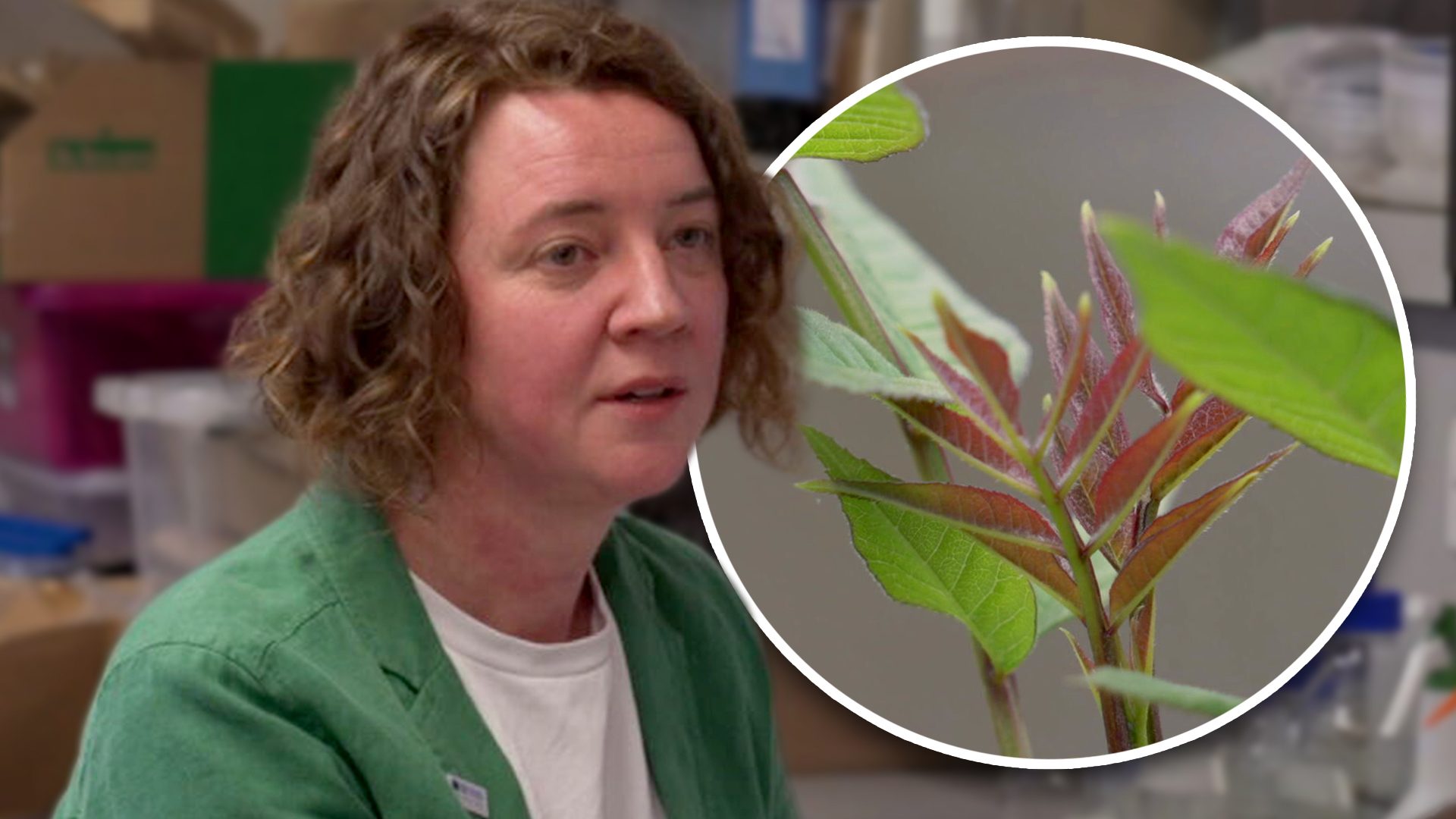
Well, yes indeed. For a group of women scientists based at the John Innes Centre in Norwich reckon they’ve had a breakthrough. It is a genuine scientific eureka moment.
For they have managed to germinate new Ash saplings in around seven days. This is a stunning discovery because the peculiarity of the Ash as a species is that its seeds like to sit around for two to three years before they germinate.
And there’s much more…
What they’ve done is use simple everyday chemicals to replicate the changes that the dormant seed would go through in two to three years. No alarming genetics. No alien chemical process.
They just started in the lab with the petri dishes and basically thought they’d be throwing them out after a few weeks. Then in around a week they found their seeds were germinating. They couldn’t believe what they were seeing.
The lifeline here is that a small percentage of Ash trees somehow remain immune to the fatal effects of Ash Dieback.
So, take the immune seed embryo from those trees with tweezers, scalpel and a steady hand, pop them in your dish, apply simple chemicals and in a few days, lo and behold!
New disease-resistant saplings without having to wait several years. Indeed the science is so simple, the ingredients so ubiquitous, that the next stage is to put out a simple recipe that you, me and all of us can perform on the kitchen table.
Turning a tragedy around
Once that citizen science operation takes hold across the UK you can see the capacity to produce new healthy saplings at this lightning speed will be huge. The potential is enormous, exciting and accessible to us all to play a part.
It cannot come soon enough because if you do go down to the woods today it isn’t just the once great canopy-dominating adult Ash trees that are dying before your eyes.
Young saplings too, naturally regenerating, are surviving the ravages of deer herds and other nibblers, only for their young leaves to shrivel and succumb when the new trees are still well short of a metre high.
It is hoped the recipe is coming and coming soon for us all from the breakthrough science in Norwich, and then we can all play a small and meaningful part in turning a national arboreal tragedy right around.
It’s not every day this one comes along. What an opportunity!
Correspondent: Alex ThomsonProducer: Nanette van der LaanCamera: James BetteridgeEditor: Sophie Larkin-Tannetta
Thanks for reading the latest edition of our newsletter. Subscribe below to keep up to date with Channel 4 News on Substack.









Comments (0)