India has room to see through global energy shock as inflation stays within band, says IMF's Krishna...
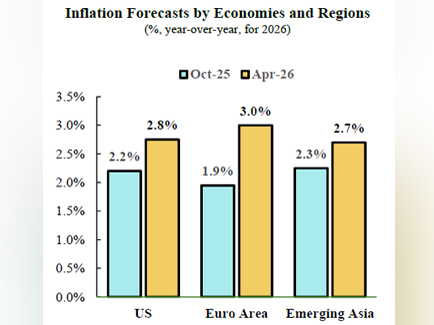
New Delhi [India], May 5 : India has some policy space to navigate the ongoing global energy shock, supported by stable inflation and calibrated fiscal measures, Krishna Srinivasan, Director, Asia and Pacific Department at the International Monetary Fund, said today."They have cut excise taxes on oil. They provide some subsidies, fertilizers. This can continue for some time, not much more in terms of fiscal space. At some point in time, you have to allow price signals to start to flow. And that's something which is true for India," he said during an event held by NCAER."In terms of monetary policy, inflation is within the tolerance band. And so you have some time to see through the shock," he added. "The shock is one where you have prices going up and there are shortages... you can have significant non-linearities which could affect economic activity across many countries," Srinivasan said while referring to the ongoing energy-driven global disruption impacting Asia and other regions.He said Asia entered 2026 on a relatively strong footing despite earlier trade disruptions and tariff shocks, which were partly offset by policy support and improving financial conditions."If you look at 2025, despite the tariff shock and uncertainty, Asian economies did better than we had predicted... growth held up very well," he noted.Srinivasan added that the IMF's reference scenario projects global growth at 3.1 per cent, while Asia is expected to expand by 4.4 per cent in 2026 and 4.2 per cent in 2027. IMF revised down China's growth forecast by 0.1 percentage point and, it revised up India's forecast by 0.1 percentage point." ... that's partly reflected in the fact that the tariff levels have come down from 50% in our previous forecast to 10%,," he added while giving the reason for India's upward revision. However, he warned that the energy shock is now the dominant risk factor."This resilience is being tested by the energy shock... the closing of the Strait of Hormuz and serious damage to critical facilities in the region's central global energy supply triggered an abrupt energy price surge," he said.He explained that Asia is structurally vulnerable due to its high dependence on imported energy. "Energy density in Asia is about 4 per cent... and most of the region's energy demand is met by imports," he said.Srinivasan highlighted that IMF scenario analysis shows a wide range of risks depending on oil price trajectories. In a reference case, crude prices stabilise, but in an adverse case they rise sharply, and in a severe case they remain elevated."In the severe scenario, oil prices could be above $100 in 2026 and even exceed $120," he said, adding that such outcomes could reduce global growth by up to two percentage points and Asia's growth by one to two percentage points cumulatively by 2027.On India specifically, Srinivasan said the country remains relatively better placed due to stable inflation and fiscal flexibility. "Inflation is within target... and India has some fiscal space to provide support to the economy," he said in a related discussion on macro resilience.On monetary policy, he said central banks in the region, including India, have room to respond flexibly. "You can look through the shock if inflation is within target... but if inflation rises rapidly or expectations become unanchored, you have to be agile," he said.Srinivasan stressed that headline inflation remains the key anchor for policy. "Headline CPI is the appropriate target... it is more closely linked with expectations and easier to communicate," he said, noting that food and fuel shocks still play a major role in inflation dynamics in emerging markets like India.He added that financial conditions, which were earlier supportive, are now tightening with rising bond yields and capital outflows from emerging markets.Srinivasan also pointed to structural challenges, including weak domestic demand in parts of Asia, rising youth unemployment, and uneven preparedness for artificial intelligence adoption, which could widen disparities across countries.He said that while India and parts of Asia have resilience, the evolving energy shock, combined with global financial tightening and structural transitions, will test policy frameworks in the coming years. Disclaimer: This post has been auto-published from an agency feed without any modifications to the text and has not been reviewed by an editorOpen in app