Global inflation concerns reignited as the U.S. 30-year Treasury bond yield surpassed the 5% range, ..
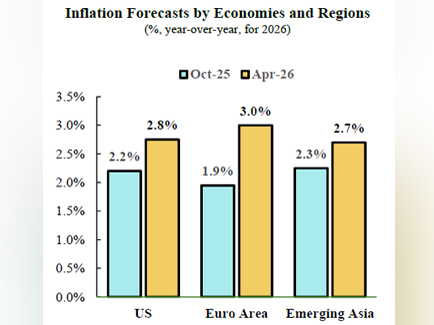
U.S. 30-year interest rates have topped 5% in a yearCentral banks are sending signs of tighteningCentral banks are concerned about continuing inflation in the second half of the yearThe growth rate of 韓n will drop by 0.9%pAI·semiconductor cycle is the only supportADB "stagflation will not come" U.S. Dollar (made with AI) Global inflation concerns reignited as the U.S. 30-year Treasury bond yield surpassed the 5% range, which is called the "door to destruction." As soaring energy prices drive up global bond rates, there are predictions that central banks around the world may be shifting to tight monetary policy.According to the global financial platform Investing.COM on the 5th, the U.S. 30-year Treasury bond rate closed at 5.01% on the 4th (local time). It is the first time in about a year that the 30-year Treasury bond rate has entered the 5% range since May 18, 2025.As the U.S. embarked on a "liberation project" to induce ships trapped in the Strait of Hormuz, concerns about a military confrontation with Iran raised their heads, stimulating international oil prices. Rising energy prices immediately raised inflation expectations, which led to a long-term surge in interest rates. Michael Harnett, chief investment strategist at Bank of America, said, "The 30-year interest rate of 5% is the Maginot Line," adding, "If it exceeds this level, it could open a door to doom in the market."The reason why the 30-year interest rate of 5% in the market is called the "gate of the wave" is that it raises the threshold for investment. Stocks or real estate, which are risky assets, must yield much higher returns to generate investment value. In addition, since the 30-year-old is directly related to the interest rate on mortgage loans, it can sharply reduce disposable income of households, causing a slowdown in consumption. It could also put marginal companies with huge debts on the verge of bankruptcy.Interest rates on three-year government bonds, such as "real economic blood pressure," are also on the rise. The three-year U.K. government bond rose 0.9 percentage points to 4.43 percent from just before the outbreak of the Middle East war. Europe, South Korea and Australia also saw their three-year Treasury yields rise by 0.45 to 0.6 percentage points over the same period. The market is paying attention to the central bank's move. This is because monetary policy can shift rapidly to a tightening mode.Yoo Sang-dae, vice president of the Bank of Korea, previously signaled a shift in austerity, saying, "It's time to stop cutting interest rates and think about raising interest rates." However, the prevailing voice is that it will not enter the so-called "stagflation," in which only prices rise amid slowing growth. This is because huge investments in AI and semiconductors are supporting the economy.ECB President Christine Lagarde recently said, "The 1970s were a period of high prices, high unemployment, and stagnation in growth at the same time, but now the situation is different. We do not apply the term stagflation to the current situation." In fact, the U.S. recorded 2.0% growth in the first quarter of this year. China recorded 5.0% growth in the first quarter, exceeding expectations. South Korea and Taiwan, which benefited from the semiconductor boom, also recorded explosive growth beyond expectations. Taiwan's growth rate in the first quarter was 13.69% year-on-year and 2.84% quarter-on-quarter. South Korea grew 3.6 percent year-on-year and 1.7 percent quarter-on-quarter. The investment cycle centered on AI and semiconductors is absorbing some of the high oil price shocks.At the ADB's annual meeting held in Samarkand, Uzbekistan on the 4th (local time), Albert Park, chief economist and general secretary of ADB, said, "Korea will see slow growth due to the Middle East war, but it will show relatively solid growth due to the impact of the semiconductor cycle." The ADB predicted that Korea's growth rate will fall by 0.9 percentage points and 0.5 percentage points this year and next year, respectively, reflecting rising oil prices, but added that the semiconductor boom is likely to continue for a while.









Comments (0)