Oil prices slide as new attacks in Strait of Hormuz threaten fragile U.S.-Iran ceasefire
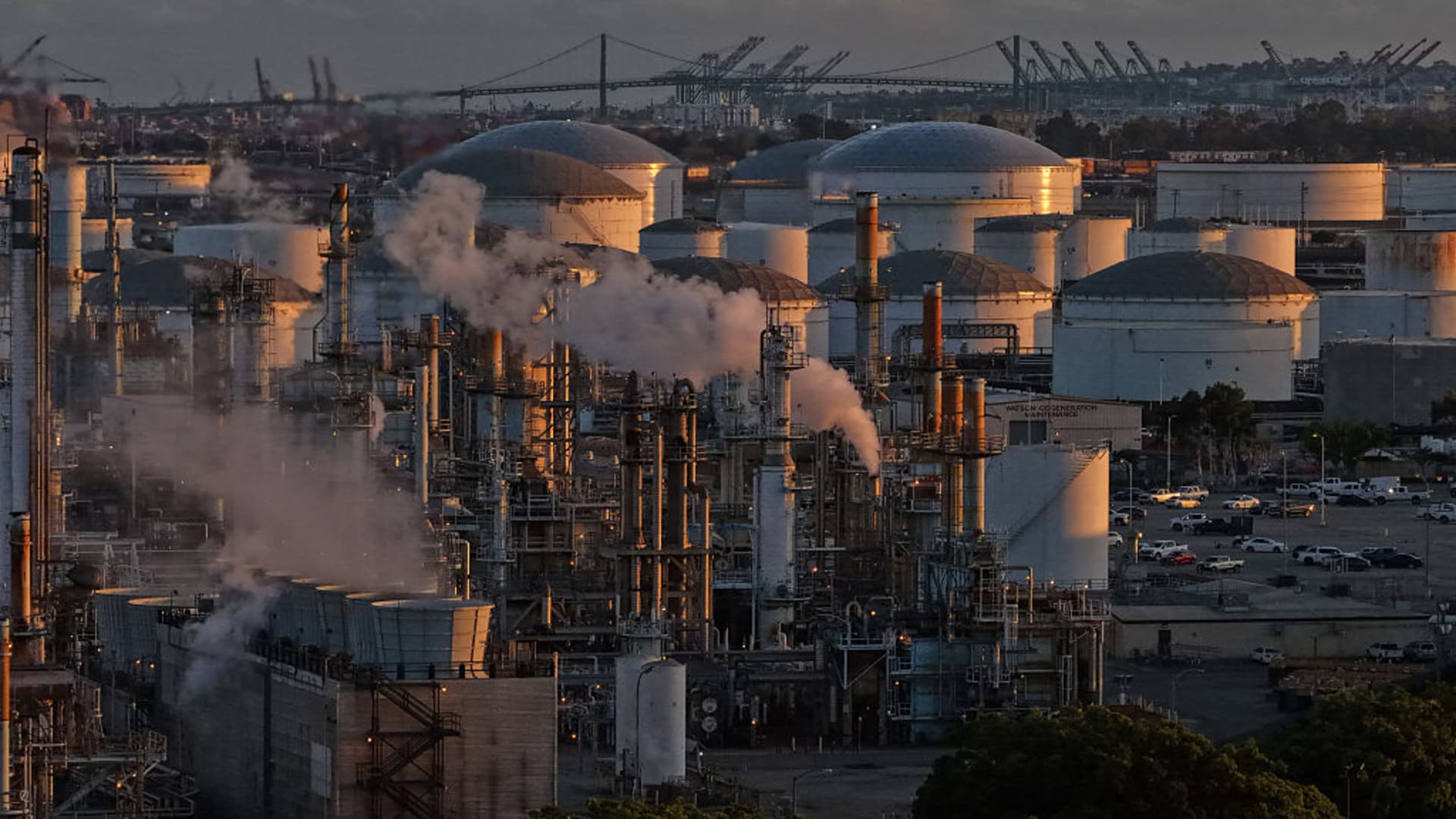
In an aerial view, the Marathon Petroleum Corp's Los Angeles Refinery is seen on April 2, 2026 in Carson, California.Justin Sullivan | Getty ImagesOil prices declined on Tuesday as traders assessed the risk of immediate supply disruptions amid renewed tensions between the U.S. and Iran.International benchmark Brent crude futures dipped 1.6% to $112.67 per barrel at 6:00 a.m. ET, while U.S. West Texas Intermediate futures fell 2.2% to trade at $104.05. Brent and WTI settled 6% and 4% higher, respectively, on Monday.A fragile ceasefire between the U.S. and Iran appeared close to unraveling after Iranian drones and missiles hit the United Arab Emirates, while Washington said it had sunk Iranian vessels in the strategically vital Strait of Hormuz.Speaking to Fox News on Monday, U.S. President Donald Trump warned that Iran would be "blown off the face of the earth" if it targeted U.S. ships safeguarding commercial traffic through the strait.Iranian Foreign Minister Abbas Araghchi said in a post on social media that recent events in the Strait of Hormuz "make clear that there's no military solution to a political crisis."He added: "As talks are making progress with Pakistan's gracious effort, the U.S. should be wary of being dragged back into quagmire by ill-wishers. So should the UAE."Strategists at Dutch bank ING said the latest volley of attacks in the Persian Gulf reflects the first signs of the U.S.-Iran ceasefire breaking down. "Markets may find some relief today following President Trump's overnight comments suggesting the conflict could continue for another two to three weeks," ING's Warren Patterson and Ewa Manthey said in a research note. "However, markets are likely to view this with considerable scepticism, given the recent escalation and the repeated extensions of projected timelines for ending hostilities since the conflict began," they added.Stock Chart IconStock chart iconBrent crudeIraq, an OPEC producer, is reportedly offering its term buyers steep discounts for crude loaded this month, according to Bloomberg, although tankers will reportedly have to be willing to transit the Strait of Hormuz to collect the barrels. CNBC has contacted Iraq's oil ministry and is awaiting a response.Global oil inventories are not yet at critically low levels, but the pace of drawdowns and uneven distribution across regions is raising concerns about localized shortages, Goldman Sachs wrote in a note on Monday. The bank said easily accessible buffers of refined products are being depleted rapidly, particularly in petrochemical feedstocks such as naphtha and LPG, as well as jet fuel.Chevron CEO Mike Wirth warned Monday that fuel shortages were a growing concern in some regions of the world as the strait remains closed."I think as people look at the realities of very tight supplies, it's not just a question of price," Wirth told CNBC's David Faber at the Milken Institute Global Conference. "It's actually — can we get the fuel? I think over the course of the next several weeks, we'll see those effects begin to move throughout the system."Total global oil stocks, including crude and refined products held both on land and at sea, are estimated at about 101 days of demand currently and could fall to 98 days by end of May, Goldman said. While that remains above emergency thresholds, the aggregate figures mask sharper shortages in specific regions and products, especially where export restrictions limit supply flows."Our estimates of supply of refined products and countries' own crude stocks point to higher risks of product scarcity in South Africa, India, Thailand, and Taiwan," the bank's analysts pointed out.— CNBC's Spencer Kimball & Emma Graham contributed to this report.