As Carney visits Armenia, experts urge deeper Canada ties in the Caucasus
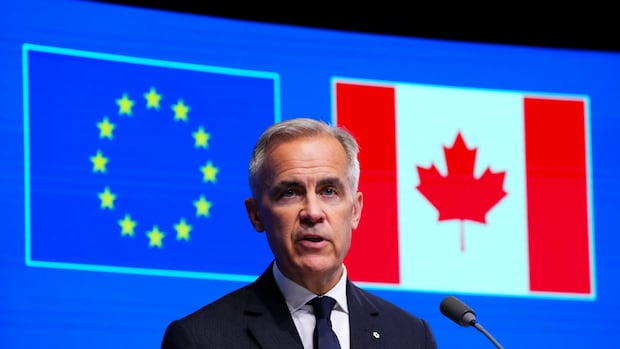
In his roughly 20 hours in Yerevan, Prime Minister Mark Carney will have only a brief window to engage with Armenia's political leadership before the European Political Community summit — where Canada has been invited as a guest of honour — gets underway. Carney is expected to meet with Armenia's Prime Minister Nikol Pashinyan just hours after landing at Zvartnots International Airport, but the rest of his agenda will be largely focused on European leaders. Russian President Vladimir Putin talks to Armenian Prime Minister Nikol Pashinyan during a meeting at the Kremlin in Moscow, Russia, in April 2026. Pashinyan is currently attempting to get re-elected in Armenia, on a platform focused on pivoting toward the West and moving away from Russian influence. (Pavel Bednyakov/Reuters)The EPC summit is a twice-yearly event that brings together members of the European Union, as well as some neighbouring countries on Europe's periphery in Asia. The first gathering took place just months after Russia's invasion of Ukraine. Ukrainian President Volodymyr Zelenskyy is expected to attend this one."At the Summit, the prime minister will meet with European leaders to reinforce collective security and transatlantic defence readiness, while advancing support for Ukraine," a statement from Carney's office said shortly before the trip.Most of the statement focused on Canada-EU ties, with Carney quoted as saying: "Canada is moving ever closer to our European partners and allies. Bound by our shared values, we are advancing cooperation in defence, energy and technology to build a more secure and prosperous future on both sides of the Atlantic." But Canada has recently been deepening ties with Armenia as well. Carney's predecessor, Justin Trudeau, was the first Canadian prime minister to visit the country, travelling there in 2018 as it hosted the Francophonie summit. Ottawa opened a Canadian embassy in Yerevan in 2023, and Canada even became the first non-EU country to join the European Union Mission in Armenia, a civilian monitoring mission set up to observe the Armenia-Azerbaijan border after the two countries fought a bloody territorial war over Nagorno-Karabakh in 2020. Prime Minister Justin Trudeau, right, and premier-designate of Quebec Francois Legault depart Ottawa for Yerevan, Armenia in October 2018. Trudeau and Legault attended the Francophonie summit. Trudeau was the first Canadian prime minister to go to Armenia. (Sean Kilpatrick/The Canadian Press)Regional experts told CBC News that Ottawa should focus on deepening those relationships, too. Armenia's "strategic" neighbourhood Christopher Waters, an international law professor at the University of Windsor, said Armenia's geographic position should make it a country of significant interest to Canada."The conditions are right to increase student exchanges, economic relations. Canada [can] take advantage of having an ally and a friend in a difficult neighbourhood, one which is increasingly looking to the West, looking to Canada and its allies, looking to Europe to get away, frankly, from the Russian sphere of influence," he said in an interview with CBC News. That westward pivot has been a stated ambition of Pashinyan since he came to power in Armenia in 2018, and it accelerated after Armenia lost the aforementioned war with Azerbaijan and blamed Moscow for failing to come to its aid.Nagorno-Karabakh — long recognized as part of Azerbaijan under international law but historically populated by an ethnic Armenian majority — returned fully to Baku's control in 2023, after a shelling campaign sent most of its 120,000 inhabitants fleeing to Armenia as refugees and led to the dissolution of its internationally unrecognized government. Police officers walk outside a courthouse on the day of the trial of former political figures and officials of the breakaway region of Nagorno-Karabakh, accused of various charges, including genocide and war crimes, in Baku, Azerbaijan in January 2025. The EU Parliament recently called for the release of Armenian political prisoners, something Canada has done as well. (Aziz Karimov/Reuters)Many of the leaders Carney is hoping to meet in Yerevan are from countries represented in the European Parliament, which this week triggered a diplomatic row with Azerbaijan by passing a resolution that included calls for the right of return to Armenians who fled Karabakh, as well as the release of political prisoners held by Baku. In the midst of an election campaign, and while trying to mend fences with Azerbaijan during a fragile peace process, Pashinyan has largely avoided commenting publicly on those issues, or on the destruction of an Armenian church in Karabakh — the latest such incident. But Waters said that silence should not stop Canada from speaking out."Canada could be acting to pressure Azerbaijan as an honest broker in the region," he said. "There are certain areas in which it's very difficult for Canada or like-minded states to intervene politically." Waters pointed, in particular, to border disputes between the two countries. "Those are state-to-state things that need to be worked out between Armenia and Azerbaijan." But Waters says humanitarian concerns and calls to protect cultural heritage should not be considered intervention."There are humanitarian steps that can be taken multilaterally, bilaterally, sometimes loudly," he said. Canada called for the release of political prisoners both last summer and under Trudeau, along with the right of return for refugees. But the Canadian government also faced criticism during the 2020 war over parts manufactured in Ontario that allegedly ended up in Turkish drones later sold to Azerbaijan and seen as crucial on the battlefield. Turkey and Azerbaijan denied the allegation, though it did prompt Canada to temporarily suspend military exports to Turkey. In a more recent regional development, the Armenian government last year arrested multiple religious figures it accused of plotting a coup against Pashinyan, including Bagrat Galstanyan, a cleric with Canadian citizenship affiliated with one of the opposition parties running against him. At the time, Global Affairs told CBC News it was in contact with local authorities but has not provided further details, citing privacy concerns. Opportunity for more defence ties, experts say Defence and military experts said Canada could also look to deepen engagement with the Armenian military.Alan Whitehorn, a professor emeritus at the Royal Military College in Kingston, said Canadian educators could work with Armenian military academies to support modernization."First of all, we're a respected middle power. And secondly, I think we have a good military educational system, particularly at the senior levels for the military colleges. And I think it's a good role model for Armenia," he said. Armenia is part of NATO's Defence Education Enhancement Programme, or DEEP, which is designed for non-member countries, "providing tailored practical support ... in developing and reforming their professional military educational institutions."Whitehorn said Canada already works with Armenia through DEEP, but could also pursue a more direct bilateral relationship. Meanwhile, the fact that Armenia is hosting the summit at all is itself a sign of the country's drift away from Russia, said Robert Huebert of the University of Calgary. "It's ... a message to Putin that his threats, that he keeps threatening NATO, saying you can't come close to my border. And I think that this is a means of saying we can go where we want." "I think it's also in an effort to show Putin that we've got major interest here. If people want to make common cause with us, we will recognize that."