STELLA O’MALLEY: Not jackboots, just breakfast rolls
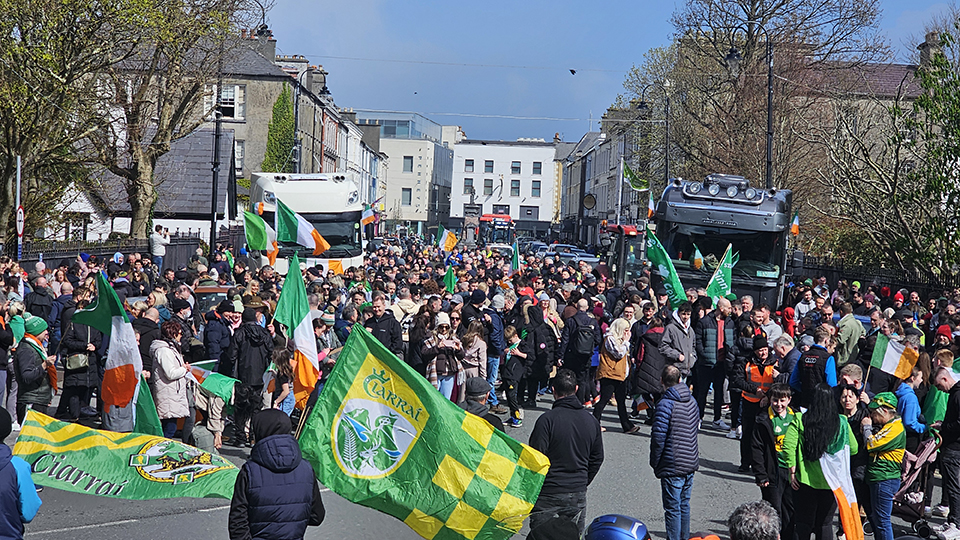
It was a good protest, effective and well run. Although it was ostensibly about fuel charges, it tapped into a bubbling mass of anger that sits just beneath the surface.
The colossal disconnect lies with the smugeratti – the comfortable class who contemptuously dismiss the public as far-right, fascist bigots while at the same time preening themselves as “left-wing” and brave champions of the working classes. Fintan O’Toole’s characterisation of the issue, in announcing that “Ireland’s far-right movement will emerge from the ‘breakfast roll-atariat”, reflects an insidious, snobbish attitude that has become all too familiar among the establishment – and it is this contempt that drove the Irish public to back the protestors.
I’ve studied this Irish Times/RTÉ persona for some years. I’ve met many of them and socialised with them. I’ve read their articles and listened to their podcasts. It’s not that they aren’t trying to be good people, they are. However, they truly believe certain theories are facts, and they surround themselves with people who fully accept these pseudo-facts. From this vantage point, they come to see anyone who questions the prevailing narrative as evidence of “the rise of the far-right.”
Indeed, “the rise of the far-right” is one of those concrete facts they treat as sacrosanct. The Irish Times/RTÉ persona reported so urgently on this supposed rise that I dreaded the outcome of the last general election. But they were completely inaccurate. When the results came in, it was clear that we had once more been led astray by a media class whose analysis has little bearing on reality. Ireland’s 2024 election returned a familiar verdict. The centre held, with Fianna Fáil winning 48 seats and Fine Gael securing 38. Sinn Féin won 39 seats, while Labour took 11. Not a single far-right candidate won a seat. In fact, this election was widely noted for the complete absence of a far-right breakthrough, despite the incessant warnings. Undeterred by the facts, the mainstream media nevertheless continue to insist the far-right are hiding under the bed.
Definitionally, the far right refers to political ideologies or movements that reject liberal democracy, embrace extreme nationalism, and seek to establish a highly authoritarian and hierarchical state. The establishment media have lost sight of this entirely. Today, they label people as “far-right” by applying a familiar trick – widening the definition so that anyone who questions accepted norms is placed into a basket of deplorables.
The problem is that these assumptions rely on a chain of trust, and that chain has been broken. We can no longer accept that peer-reviewed studies are trustworthy – there have been too many reports of funding shaping outcomes. Nor do many people assume that erstwhile newspapers of record will present the truth “without fear or favour” – the relationship between the media and funding has become too conflicted. Governmental policy, too, has been weakened by political agendas that seek to retain power rather than ethics. As funding and influence have become increasingly intertwined with institutions that claim objectivity, public trust has been steadily eroded.
Some of these accepted norms are more accurately described as sacred cows – to question them leads to vitriolic abuse and dismissive contempt from the mainstream voices. One example is the presumption that multiculturalism is always A Good Thing and asylum seekers should be automatically welcomed; any caution or thoughtful evaluation is treated as evidence of the “rise of the far-right.” A similar dynamic can be seen in discussions of medical transition, where this is also always A Good Thing that should be celebrated as trans people are an oppressed minority who should be able to freely access any medical intervention they choose. Anyone who points to long-term outcomes for medical transition, such as disproportionately high rates of psychiatric morbidity, criminality, unemployment, and, most worryingly, elevated rates of suicidality, is typically dismissed as a “far-right Christian bigot.”
Into this swamp of dishonesty stepped the fuel protestors. This was an unusual protest, in that it resembled an employer’s strike. There were no union representatives; these were mostly hard-working people running small family businesses that depend on diesel. They knew their customers and understood they could not blithely pass rising costs on to their customers – their businesses wouldn’t survive if they tried to. So they organised themselves and brought attention to the issue through peaceful protests across the country.
The response from the establishment was predictable. As usual, the “far-right” label was immediately applied. Jim O’Callaghan disgraced himself by suggesting that the protest was the result of outside influences such as Tommy Robinson. This claim suggests O’Callaghan is spending too much time on Twitter and not enough time talking to the people actually involved. I live in rural Ireland. The average Irish contractor, protesting with their lorries and tractors across the country, has never heard of Tommy Robinson. Nor are they particularly interested in what’s going on in Britain. The fuel protestors were motivated by the rising costs of running a small business and that demanded attention, not reactionary responses from the political class.
The authorities, having been made hysterically fearful of the rise of the far-right, decided to respond with a sledgehammer to crack the nut. They came in with pepper spray and they deployed the army. They embarrassed themselves with a histrionic response that was heavy-handed and bore little relation to the reality on the ground. The Irish public feel increasingly swindled by these mainstream media outlets. They don’t feel they are receiving a clear or honest account of events, and so they are turning instead to podcasts and online news outlets.
I was recently intrigued to realise that my local handyman no longer reads newspapers or listens to the radio. Instead, he relies on podcasts and online outlets. He immediately sided with the protestors. Why? Because he is angry. Ireland was once a high-trust society, but that trust has been steadily eroded. A few years ago, when Eoin O’Broin fell all over the place, visibly tying himself in knots as he attempted to describe what a woman was, the ordinary people of Ireland didn’t like it. We’re supposed to respect our Dáil representatives, not be embarrassed for them. We’re also supposed to trust the state-sponsored media, not be furious with them.
Ordinary people can see through the cosseted security of those who shape public narratives. Many in well-paid, stable positions struggle to grasp the pressures facing the self-employed. People like Fintan O’Toole live a long way from worrying about rising fuel charges. These costs are an immediate threat to livelihoods, and when those realities are dismissed or mischaracterised, it deepens the sense of disconnect and drives the anger now visible across the country.
Perhaps this is what was meant by the “breakfast roll-atariat.” Not a jackbooted far-right movement, but ordinary people who eat breakfast rolls rather than smashed avocado on toast, and who feel ignored, misrepresented, and ready to protest.