Tech Transforms the Live Sports Playbook
Sports producers battling rising costs amid audience fragmentation have much to explore at this year’s NAB Show, where an extended four-day Sports Summit complements an unprecedented display of tech innovations aimed at building fan engagement.Across exhibit halls and in meeting rooms and hotel suites, visitors will find an AI-driven potpourri of ever-expanding options that portend a wild ride ahead for sports producers.“Ideas can come from anywhere,” said Mike Davies, Fox Sports executive vice president of technical and field operations. “You just need to utter an idea, and it can be turned into reality in a matter of weeks or months.”
You may like
NAB Show Leverages Revitalized LVCC To Reflect M&E Transformation
Live Production Over IP in 2026: Software-Defined Everything
IP’s Impact on Imaging Tech on Full Display at NAB Show
The AI impact can be seen wherever equipment and software solutions used in live sports production are on display, including exhibits featuring:Next-generation cameras.Automated production workflows.Real-time data applications supporting feature personalization and insights into user behavior.Advances in immersive audio and video.Innovations in user experience like multiviewing involving sports program or play-action multiviewing.AI Abounds“There’s more and more AI, not just in postproduction, but using AI for camera tracking and image capture within the event,” said Duane Yoslov, senior vice president at Diversified, known for its role in designing and building experience-rich sports and other environments.“Some of the AI camera robotic tracking technology is really impressive.” He said many shots covering competition at the Winter Olympics “have never been done before.”The professional video industry's #1 source for news, trends and product and tech information. Sign up below.Indeed, the Milan-Cortina Winter Olympics offered an especially dramatic demonstration of the transformation in live sports coverage enabled by advanced production technology, in this case supplied by Comcast Technology Solutions (CTS).From its suite at the Encore Las Vegas, the company is explaining how “Comcast Sports360 from Comcast Technology Solutions enables us to deliver the speed, quality and reliability that Olympics coverage demands, supporting seamless, multiformat delivery across a wide range of platforms,” said Darryl Jefferson, senior vice president of engineering and technology for NBC Sports and Olympics.
Darryl Jefferson (Image credit: NBC Sports)NBC chose Sony Electronics, exhibiting in the Central Hall at C8401, to deal with the challenges posed for capturing the action in the widely dispersed, geographically diverse regions of the Milan-Cortina games.
What to read next
TV Tech Digital Editions
2026 NAB Show Exhibitor Insight: Appear
Cloud Workflows Are Redefining Live Sports Production
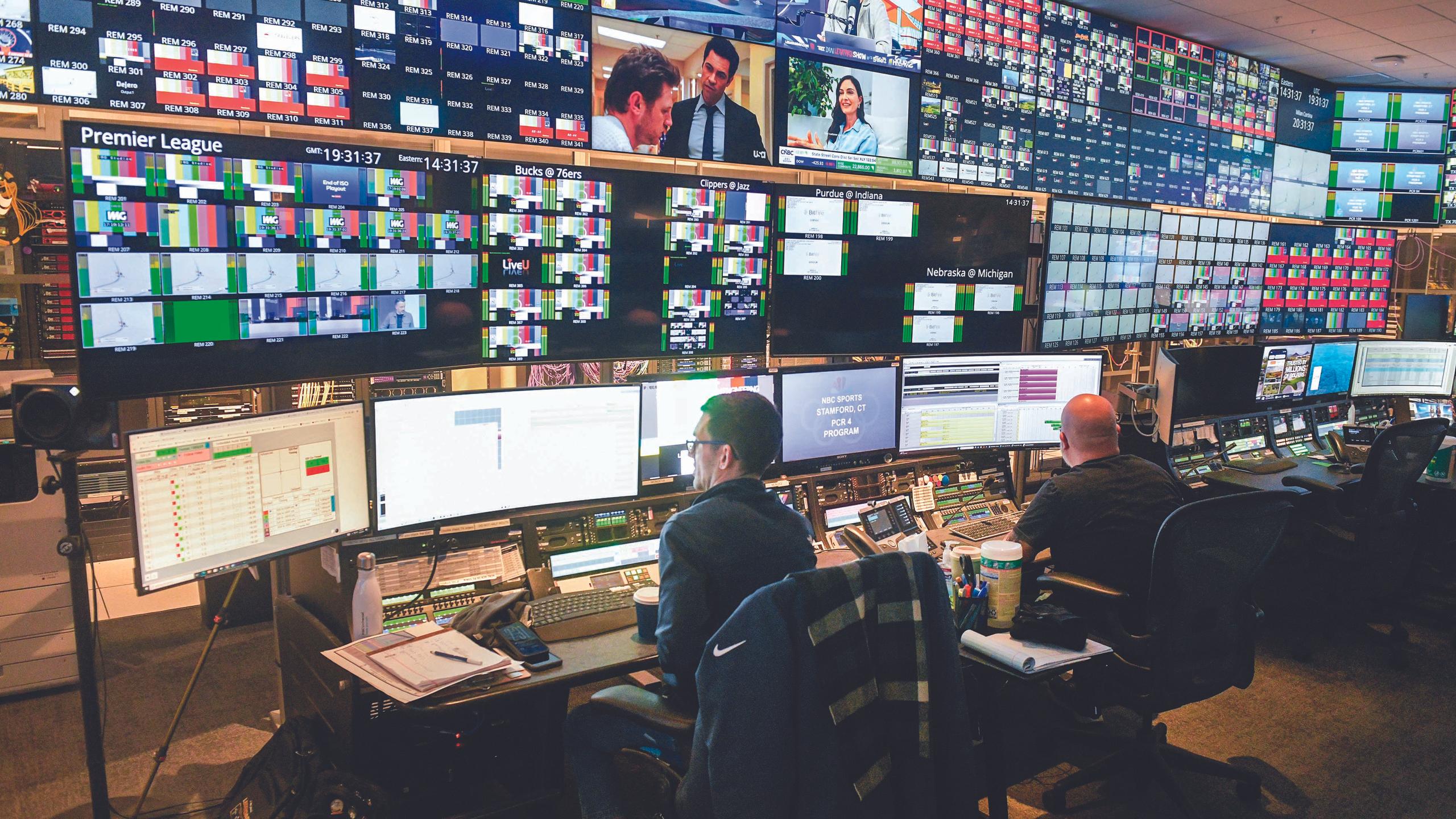
As described by Jefferson, the game plan leveraged “high-quality monitoring, color grading tools and highly customizable remote production workflows” with the “use of 2110 transport, teams of color experts shading Sony’s HDR cameras from a distance, enhanced PTZ robotic cameras and support for our end-to-end BT-2020 HDR Workflow through production and our facility in Stamford.”The many approaches suppliers of cameras and related gear are taking to address these new performance demands are on display across the Central Hall.For example, as reflected in the long-distance Winter Olympics production operations, one response to the new requirements involves support for operators’ shift to IP-based production workflows. Because it often happens incrementally, the shift requires support for seamlessly switching camera feeds between SDI output and IP transport over ST 2110 or alternatives like Network Device Interface (NDI) or Secure Reliable Transport (SRT).“We’re seeing a shift to IP-based workflows, especially in the high-end broadcast space,” said Peyton Thomas, a product manager at Panasonic.At booth C3509, Panasonic is displaying 4K Studio and 4K Multipurpose Cameras supporting selection of multiple transport options without the use of an external camera control unit (CCU). Live IP feeds into production workflows can include hybrid workflows anchored in Panasonic’s KAIROS IT/IP software system to enable live A/V production processing with an unrestricted number of media effects utilizing SDI baseband or IP signals formatted to ST 2110, NDI or SRT.Live Tech Gets VersatileAs for the suppliers focused on live production workflows, multiprotocol versatility is just part of what’s in play to add efficiency, remote operational flexibility and enhanced feature output to their platforms.There’s also a widespread focus on fostering interoperability to address producers’ objections to vendor lock-in as they move to cloud-based software solutions.One case in point can be found in the Central Hall, where Grass Valley (C2408) is promoting the GV Media Universe as a multivendor environment in which its virtualized Agile Media Processing Platform (AMPP) operates as a single control layer, seamlessly integrating live production workflows across its own and other hardware and software solutions.5 KEY TAKEAWAYS1. AI is powering live production, from robotic cameras to real-time analytics.2. IP workflows are becoming standard, supporting ST 2110, NDI and SRT.3. Software-defined platforms give producers flexible, virtualized control.4. Open-source frameworks like MXL are breaking down vendor barriers.5. Low-latency streaming, including MOQ, is bringing digital delivery closer to broadcast speed.Similarly, TVU Networks, exhibiting in the West Hall (W1717), has responded to broadcasters’ migrations to cloud production by opening its MediaMesh-based remote production ecosystem to access by competitors.An emerging force behind vendor interoperability, as well as virtualized cloud efficiency in live sports production workflows, is the Media eXchange Layer (MXL) software development kit (SDK), managed through the Linux Foundation-backed MXL Project and supported by industry organizations and vendors worldwide.The open-source MXL SDK provides a commonly shared approach to working with packetized video, audio and data essences as individual microservices in container-virtualized datacenters.“It is a way of breaking down the barriers, not having to encapsulate 2110 every time you want to do another bit of processing in the workflow,” said Daniel Robinson, product manager for MXL at Matrox.Robinson says the company, exhibiting in the North Hall at N2451, is one of about six vendors “that have actually got it working in our product and have since the beginning.”Another trend in full bloom at NAB Show involves two approaches to enabling multiviewing by sports fans, one that allows them to track multiple parallel games through a single, immersive viewing experience and the other enabling access to multiple camera feeds.Multiviewing of one kind or another is now supported by several vendors at the show, including MediaKind (W1743), Harmonic (W2831), Techex (W2267) and Red5, which is running a live multiview display of camera feeds from the show floor at Nomad Media’s booth (W2357).Marking another new development with much broader implications, Red5 is also one of a growing coterie of streaming platform providers, including Bitmovin (W3323), CacheFly (W3129), Cisco (W2633), Cloudflare (W2300G), Synamedia (W2851) and others, who are in the process of enabling real-time interactive streaming of sports and other live content via the emerging Internet Engineering Task Force (IETF) standard known as Media Over QUIC (MOQ).Red5 is demonstrating MOQ at the Nomad Media booth in conjunction with global CDN supplier CacheFly and in a display with Amazon Web Services (W1701), showing how a live-streamed sports production distributed in real-time over MOQ and at higher latencies over Low-Latency HLS and conventional HLS can be managed from a single browser.© 2026 NAB