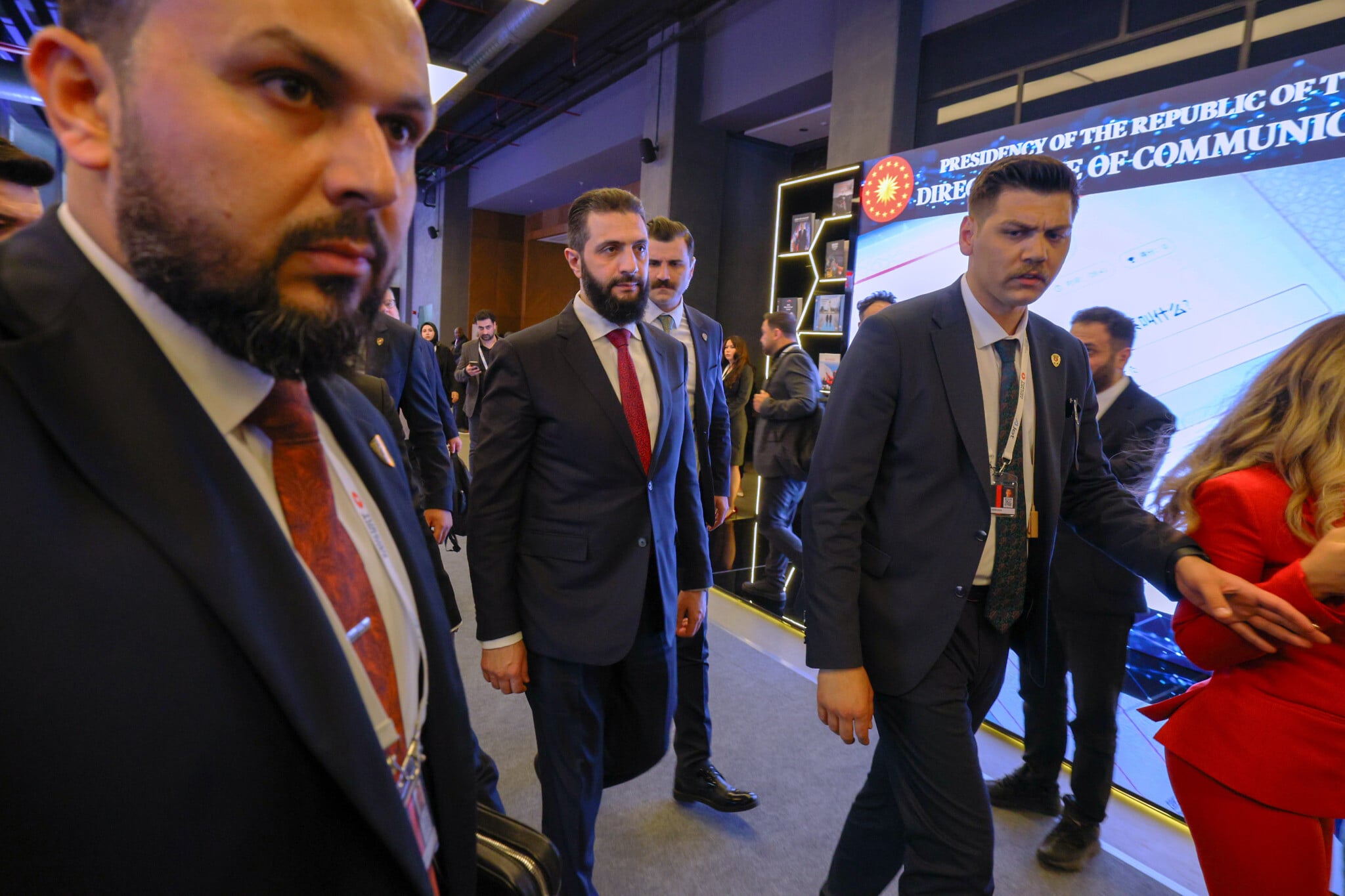
Syria’s Sharaa: Israel has acted with ‘brutality,’ but talks with it not at dead end
Syrian President Ahmed al-Sharaa said Thursday that talks with Israel on a potential security agreement haven’t reached a dead end, but he accused Israel of acting with “brutality” in the country.
“We are serious about reaching a security agreement that preserves regional stability,” Sharaa, whose jihadist-led forces ousted longtime strongman Bashar al-Assad in 2024, told Turkey’s Anadolu news outlet.
“The negotiations have not reached a dead end, but they are progressing with great difficulty due to Israel’s insistence on maintaining a presence on Syrian soil,” he said.
Israel launched a wave of airstrikes against Syrian military assets in the wake of Assad’s overthrow, saying it could not risk powerful weapons getting into the wrong hands. The Israel Defense Forces also took control of a buffer zone previously controlled by the UN. Since then, Israel has demanded a demilitarized zone in southern Syria.
The IDF also intervened last year during unrest in the Druze-majority area of Sweida, at the urging of Druze in Israel. Sharaa’s forces have been accused of atrocities against members of the minority group, which Israel has vowed to protect.
Get The Times of Israel's Daily Edition
by email and never miss our top stories
By signing up, you agree to the terms
In light of all these developments, Israel and Syria’s new authorities have held several rounds of direct talks since the end of last year, and after negotiations in January — and under US pressure — they agreed to establish an intelligence-sharing mechanism as they edged toward a security agreement.
IDF reservists of the 55th Paratroopers Brigade operate in southern Syria, in an image published on November 21, 2025. (Israel Defense Forces)
Sharaa, in Turkey for the Antalya Diplomacy Forum, told Anadolu that “Israel responded to Syria with great brutality, targeting numerous Syrian sites, violating Syrian sovereignty and occupying parts of the territory adjacent to the already-occupied Golan Heights.”
Israel captured the Golan Heights from Syria in the 1967 Six Day War and annexed it, a move that Syria and most countries don’t recognize.
At the forum itself on Thursday, Sharaa affirmed Syria’s claim to the territory, saying that “the Golan is the right of the Syrian people, and no country will give up part of its land.” But he acknowledged that negotiations are taking place in several stages.
In the first stage, talks are focusing on an agreement based on the 1974 Agreement on Disengagement, which was signed in the aftermath of the 1973 Yom Kippur War and established the UN buffer zone.
“That agreement held for 50 years until Israel violated it after the fall of the Assad regime,” Sharaa said. “Later, if this succeeds, we will enter long-term negotiations to resolve the issue of the occupied Golan.”
Sharaa: IDF campaign in Lebanon must not be linked to Syria
Anadolu also asked Sharaa about “Israeli Premier [Benjamin] Netanyahu’s recent statement linking Israel’s presence in Lebanon to reaching the Druze population in Syria.”
It was not immediately clear what statement the question was referring to, but it came after renewed fighting in Lebanon following the Iran-backed Hezbollah terror group’s attacks on Israel starting March 2. The fighting paused at midnight Thursday-Friday, with the adoption of a US-declared 10-day truce amid peace negotiations between Israel and Lebanon.
An Israeli soldier on military vehicles in northern Israel, on the border with Lebanon, following a ceasefire between Israel and Hezbollah, on April 17, 2026. (AP Photo/Ariel Schalit)
Israeli officials have said, amid the renewed fighting, that the IDF is establishing a demilitarized “security zone” in southern Lebanon up to the Litani River, until the threat of Hezbollah is removed.
In response to the question, Sharaa said: “As for the war being waged on Lebanon, there are many other solutions available that do not involve directly targeting buildings and infrastructure. Lebanon cannot withstand a conflict of this scale. Linking these developments to southern Syria represents a major threat to regional security, not just to Syria alone.”
Syria: All bases that hosted US troops now under state control
Also Thursday, the Syrian foreign ministry said the Damascus government had taken control of all military bases that had previously hosted US troops in the country.
The ministry issued a statement welcoming “the completed handover of military sites where United States forces were previously present in Syria to the Syrian government,” adding that the move was carried out “in full coordination between the Syrian and American governments.”
The US-backed, Kurdish-led Syrian Democratic Forces, which had been key to the fight against the Islamic State group (ISIS), has in recent months been made to integrate into the central Syrian state, after an offensive by Sharaa’s forces into areas that broke away during the civil war, and a subsequent ceasefire and integration deal.
Syria’s foreign ministry said that “the extension of Syrian state authority over areas that had previously been outside its control… is the result of the Syrian government’s sustained efforts to unify the country within the framework of a single state.”
The handover also “reflects the successful integration of the Syrian Democratic Forces into national structures, and the Syrian state’s assumption of full responsibility for combating terrorism and addressing regional threats on its territory,” the statement added.
A US military vehicle is transported on a truck as part of a convoy withdrawing from Qasrak base in northeastern Hasakah province toward the Jordanian border near Daraa, Syria, on April 16, 2026. (AP Photo/Ghaith Alsayed)
Damascus said it viewed the US move as reflecting “a shared assessment that the circumstances which originally necessitated the American military presence in Syria… have fundamentally changed.”
“The Syrian state is today fully capable of leading counterterrorism efforts from within, in cooperation with the international community,” it added.
The US Central Command, which is responsible for American troops in the Middle East, told AFP that US forces “have completed turning over all of our major bases in Syria, as part of a deliberate and conditions-based transition.”
“US forces continue to support partner-led counterterrorism efforts, which are essential to ensuring the enduring defeat” of ISIS, the command said.
EU planning to relaunch formal ties to Syria, memo says
The European Union, meanwhile, plans to deepen its engagement with Syria by relaunching formal political contacts and paving the way for closer economic and security ties, according to a document seen by Reuters.
The background paper, produced by the bloc’s diplomatic arm and circulated to EU member countries this week, said the EU would fully resume its 1978 cooperation agreement with Syria and begin a High-Level Political Dialogue, an EU term for formal and structured talks, with the country’s transitional authorities on May 11.
German Chancellor Friedrich Merz, right, and Syrian President Ahmad al-Sharaa attend a press conference in Berlin, Germany, on March 30, 2026. (AP Photo/Markus Schreiber)
In a notable policy adjustment, the EU also said it would “reframe and adapt” its sanctions regime to maintain leverage while engaging with Syria’s leadership and targeting spoilers of the transition, according to the paper.
The paper outlined plans to step up economic engagement, including a framework for trade and investment, mobilizing private sector funding and supporting reforms to improve Syria’s business environment through a new technical assistance hub.
It also said the EU would work with authorities on facilitating the “safe, voluntary and dignified return” of refugees and displaced people.
Europe hosts over 1 million Syrian refugees and asylum seekers, roughly half of whom are in Germany. Their return has been on top of the agenda in most discussions between European capitals and Damascus since Assad’s ouster in late 2024.
On security, the paper said the EU could support training for Syrian police and institutional capacity-building in the interior ministry, alongside cooperation on counterterrorism and efforts to address drug trafficking and organized crime.
The document also underscored EU backing for implementing the agreement struck in January between Damascus and Kurdish-led authorities.