2026 Volkswagen Taigun Facelift: Old Vs New Compared In Detail
Volkswagen has unveiled the first facelift of the Taigun in India with the aim of making it appeal to a wider audience with a new design and updated feature list. The pre-facelift model was loved by performance-oriented buyers who wanted a family car. Volkswagen has kept the same spirit alive, but made the overall package even better. The facelift carries subtle changes to both the exterior and interior, and the attention to detailing might surprise you.
If you’re wondering what’s changed between the old and new Taigun, here’s a detailed old vs new comparison. We take you through the design changes, feature additions, powertrain tweaks, and more:
Design
Front
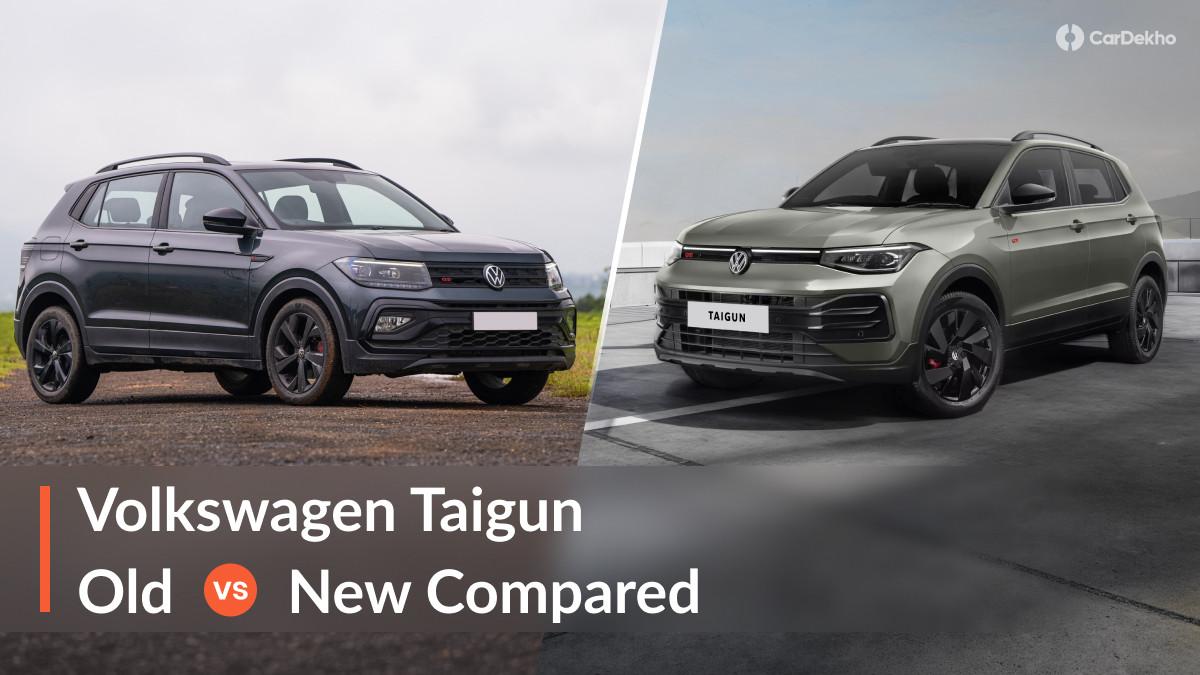
The changes to the front fascia of the Taigun facelift are not revolutionary, but it looks more elegant than before and carries the same sporty feel. The Taigun now sports a slimmer grille and slim LED headlights. Connecting the headlights is a new, sleek LED DRL strip that runs through the grille and also illuminates the VW logo. The front bumper has also been tweaked to look more sophisticated, which also houses glossy black / chrome inserts (depending upon variant) and a skid plate, which continues to offer a sporty look. Keen observers would notice that the front profile is now aligned with other Volkswagen cars like the Tiguan R-Line and the Tayron R-Line.
Side
In profile, the overall silhouette of the Taigun remains unchanged. It continues with its compact proportions just like the outgoing model, along with a strong shoulder line and round arches. Even the dimensions of the Taigun are the same. Further adding to the road presence are thick body claddings, along with the roof rails. The new model does get fresh designs for the 17-inch alloy wheels. The side profile of the Taigun builds a strong character, and it continues to be one of the most compact SUVs in its segment. The use of chrome elements is limited to the door handles, which increase the sporty approach.
Rear
Moving towards the rear, the most noticeable change is the addition of new slimmer connected LED taillights with sequential turn indicators and an updated tailgate design. The rear bumper has been updated to carry a fresh and sleek look with chrome / glossy black elements and thick body claddings, which are continued at the rear as well. The new design language at the rear shows elegance without making a lot of noise. You continue to get an integrated spoiler and a shark fin antenna to complete the overall design.
Colour Options
The Volkswagen Taigun facelift is offered in eight colour options, of which two colours are new. These new colours are called Steel Grey and Avocado Pearl. Apart from the new ones, you can also have the Taigun in existing colours such as Carbon Steel, Carbon Steel Matte, Reflex Silver, Wild Cherry Red, Lava Blue, Candy White and Deep Black.
Interior
The earlier version kept things simple and functional, with a clean layout, smaller screens, and more hard plastics. In contrast, the facelift builds on the same basic design but improves how everything feels and looks. The infotainment and instrument displays are larger and more modern, and the leatherette upholstery gets fresher patterns. The dashboard gets textured plastics. The cabin also gets a larger panoramic sunroof, replacing the previous single-pane unit, which helps make the cabin feel more open.
Features And Safety
The Taigun has always been a very well-equipped car, but over time, it desperately needs an update to stay fresh in the segment. With the facelift of the Taigun, Volkswagen has further enhanced the package by providing some new features that boost comfort and convenience. To begin with, the Taigun now features a panoramic sunroof, rear seats with massage function, ambient lighting, a 10.25-inch digital driver’s display with turn-by-turn navigation, and an updated 10.1-inch infotainment screen with AI Assistant and wireless Android Auto and Apple CarPlay.
The Taigun facelift carries forward many of its features from the older model. These include 6-way powered and ventilated front seats, cruise control, automatic climate control, automatic headlights, rain-sensing wipers, auto-dimming IRVM, a 6 Speaker sound system with subwoofer and amplifier, and a wireless phone charger.
In terms of safety, the Taigun facelift borrows its equipment from the outgoing model. It is equipped with 6 airbags, electronic stability control, traction control, all-wheel disc brakes, hill hold assist, front and rear parking sensors, rear view camera, rear wiper with defogger and a tyre pressure monitoring system.
Powertrain
Volkswagen has introduced a new 8-speed torque-converter automatic gearbox for the 1-litre TSI engine, replacing the older 6-speed unit. Apart from this, there are no new additions/changes in the powertrain domain. The Taigun Facelift continues to be offered with a 1-litre and a 1.5-litre turbo-petrol TSI engine options. The 1.5-litre turbo petrol engine continues to be exclusively available with a 7-speed DCT gearbox.
Here are the detailed specifications of these powertrains:
Engine
1-litre TSI turbo-petrol
1.5-litre TSI turbo-petrol
Power (PS)
115 PS
150 PS
Torque (Nm)
178 Nm
250 Nm
Transmission
6-speed MT / 8-speed AT
7-speed DCT
MT- Manual Transmission, AT- torque converter automatic transmission, DCT- dual clutch automatic transmission
You can head to this story to know about the variant-wise powertrain split.
Rivals
Prices for the Volkswagen Taigun Facelift are expected to start from Rs 10.60 lakh (ex-showroom). To know more about the new Taigun, check out this story.
The 2026 Volkswagen Taigun puts up a strong fight against competitors such as the Hyundai Creta, Kia Seltos, Tata Sierra, Toyota Urban Cruiser Hyryder, Renault Duster, Skoda Kushaq, Maruti Grand Vitara and Victoris, MG Astor, Honda Elevate and Citroen Aircross.
The Taigun is a very sorted out product, but in a sea of rivals, have a look at some of the alternatives to the Volkswagen Taigun and what they offer that the Taigun does not:
Kia Seltos: Bigger in size, a dominating styling, spacious cabin, more features and a diesel engine.
Hyundai Creta: The best seller that does everything on point you expect from a compact SUV.
Renault Duster: The one who started this segment makes a comeback and delivers great performance backed by an impressive ride and handling.
Tata Sierra: An iconic nameplate with a bold lifestyle appeal, standing out with its unique design, tech-laden cabin, and diverse powertrain options.
Maruti Victoris/Grand Vitara: The fuel-efficient champions of the segment, which offer strong hybrid tech, AWD, and a peaceful ownership.
Toyota Urban Cruiser Hyryder: Same qualities as the Grand Vitara, but carries Toyota’s badge and a strong reliability factor.
Honda Elevate: A no-nonsense, spacious SUV that nails practicality and offers intriguing features, combined with Honda’s reliability.
Skoda Kushaq: The Taigun’s sibling with a slightly sharper European flair, blending solid built quality with an engaging drive experience.