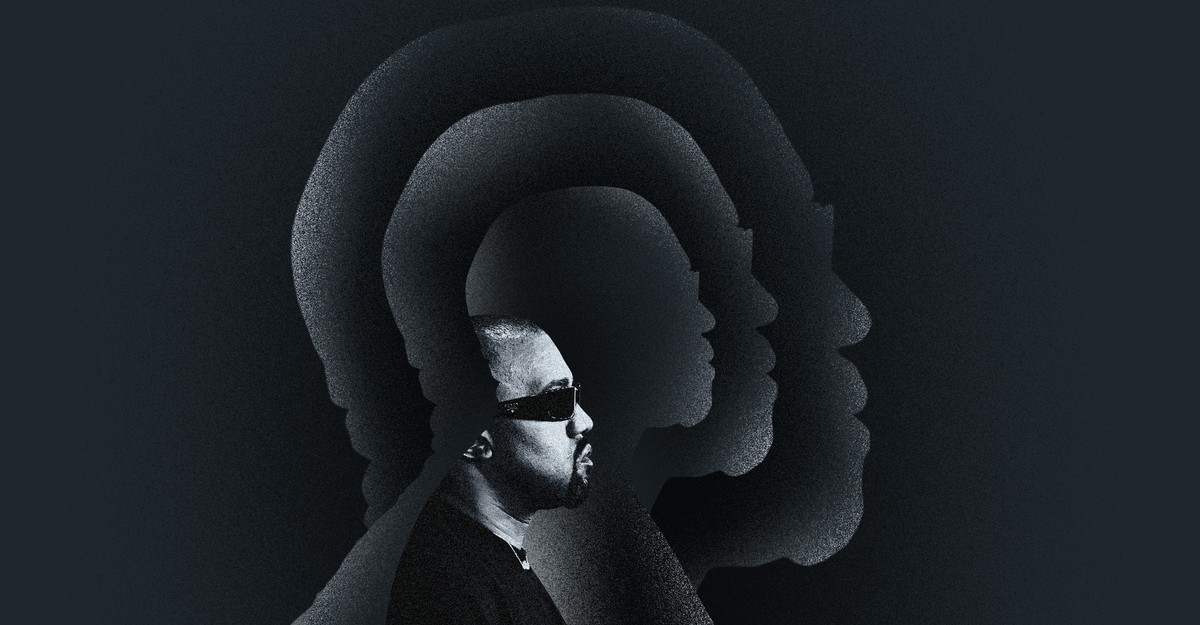
The Blogs: Kanye West Made Antisemitism the Art. Unlike Wagner.
A government that rarely bans artists banned one last week. The British Home Office blocked Kanye West from entering the United Kingdom, ruling that his presence would not be conducive to the public good. The Wireless Festival in London, which had booked him as headliner for three nights in July, was cancelled entirely. Sponsors fled. Prime Minister Keir Starmer said West should never have been invited in the first place. What the decision settled is less interesting than what it exposed: not whether you can love an artist’s work while rejecting his ideology, but whether the conditions that once made that position livable still exist.
Kanye West has thirty million followers. In 2022, before any song had been written on the subject, he posted that he was going “death con 3 on JEWISH PEOPLE.” The post reached tens of millions of people within hours. No record label, no editor, no institution stood between the statement and its audience. This is not a detail about one man’s behavior. It is a description of a new kind of power, one that did not exist a generation ago, and for which we have not yet developed adequate moral categories. The scale of harm is not equivalent to the scale of moral responsibility: an artist with a hundred followers who spreads hatred is equally wrong. But the damage is not equal. And a difference in damage of this magnitude demands a different order of attention.
Richard Wagner is the figure this debate always returns to, and for good reason. Wagner published his antisemitic essay “Judaism in Music” in 1850, when he was already among the most influential composers in Europe. The text argued that Jewish artists were biologically incapable of genuine creative expression, vicious, public, intended to provoke. And yet most of his audience encountered it through the slow channels of nineteenth-century print culture, entirely separate from the opera house, where his music arrived through conductors, critics, and decades of interpretive tradition. Theodor Herzl, the founder of Zionism, could be moved to his core by Wagner’s music at the very moment he was conceiving a Jewish state, because the two reached him through different channels and demanded different kinds of attention. The distance between the pamphlet and the opera was not a philosophical position. It was a structural fact, a product of how high culture worked, how slowly ideas traveled, how many institutions stood between a composer and his public.
Adorno argued that mass culture produces passive audiences, people who receive rather than interpret, who consume rather than engage. He could not have imagined what the digital age would add to what he described. Today, a listener streams West’s music on Spotify and follows him on X. These are technically separate platforms, but the person using them is not separate. The same individual who presses play on an album often also scrolls through a feed where the artist’s ideology arrives unfiltered, without editor or intermediary, amplified by an algorithm that rewards provocation over nuance. The most extreme statements travel furthest and fastest; that is not incidental to the technology, it follows from how it is built to operate. There is no institutional mechanism that separates the music from the antisemitism. The only thing standing between them is the listener’s own willingness to maintain that separation, actively, continuously, against the grain of every platform she uses. That is a very different condition from the one Wagner’s audience faced.
What West has done goes further still. He did not simply find himself in a media environment that bundles art and ideology. He announced the bundle. His 2023 album Vultures contained antisemitic lyrics. He then released a song titled “Heil Hitler” on May 8th, VE Day, the anniversary of the Allied victory over Nazism, whose chorus has his followers chanting praise of Hitler, and which ends with a recorded speech by Hitler himself. In interviews, he declared his new aesthetic to be, by his own description, antisemitic. The song frames this not as ideology but as emotional response: a father who cannot see his children, whose bank accounts have been frozen, who has so much anger and no way to take it out, and who therefore, the lyric concludes, became a Nazi. This is not incidental. It is the mechanism of the harm. West took a narrative of personal suffering and used it to make antisemitism feel like a reasonable human response, then distributed that narrative to tens of millions of people simultaneously.
In enlisting his art in the service of a fixed ideology, West has also narrowed what that art can do. Great art opens possibilities; propaganda closes them. His earlier work knew the difference.
The British government answered the question in its own way: block the entry, cancel the festival. That is one kind of response to the knowledge that separation between the art and the antisemitism is no longer available. But it is a state response, and it raises questions that do not resolve themselves: a government that can ban an artist for his ideology can, in principle, ban artists for other ideologies, and the principle that authorizes the one does not automatically contain the other. The audience is left with something smaller and more personal.
West has cited bipolar disorder to explain his returns. The cycle continues regardless. He has apologized more than once, and each time returned. The apology, it turns out, is also part of the system: it resets the tolerance of the audience just enough to make room for the next escalation. Six and a half million people watched “Heil Hitler” within two days of its release, after it had already been banned from every major platform. An apology travels less far than a provocation. An audience that still insists on separating the art from the antisemitism is no longer making an aesthetic judgment. It is sustaining a separation the artist himself has worked to eliminate.
Doctoral candidate at Bar-Ilan University's School of Communication, researching the emergence of narratives on digital platforms and collaborative environments and their impact on collective identities and public discourse.