Russia’s massive Black Sea problem is worse than it looks
On paper, the Russian Navy remains the dominant force in the Black Sea. But after ceding control to Ukraine’s uncrewed surface drones, it now faces a mounting crisis: its key base at Novorossiysk is increasingly untenable, unless Moscow is willing to absorb further warship losses.
Dramatic drone footage captures a Ukrainian strike on a Russian Navy frigate, underscoring the precision and resolve of Ukraine’s unmanned forces. The April 5th attack, part of a wider air raid on the Russian Black Sea port of Novorossiysk, adds to the already lengthy highlight reel of the war.
Yet it points to a deeper reality in the Black Sea. Russian Navy vessels are no longer safe in the base at Novorossiysk. Having relocating from Sevastopol to evade Ukrainian strikes, they now face comparable threat levels in what was once considered a safe haven. But they have a problem, where to go?
The Ukrainian strike on the Russian frigate
The Pr.11356M Grigorvich-class ship, likely Admiral Essen, is one of only two Russian frigates in the Black Sea. Since the sinking of the Slava-class cruiser Moskva on April 14, 2022 they have been the largest warships in the Russia’s fleet and a strategic asset. Armed with Kalibr cruise missiles, they have frequently participated in missile strikes on Ukraine. They can launch their missiles without leaving port, and it seems possible that that is what this vessel was preparing to do. It was berthed along the outer sea wall instead of its usual berth much deeper inside the base.
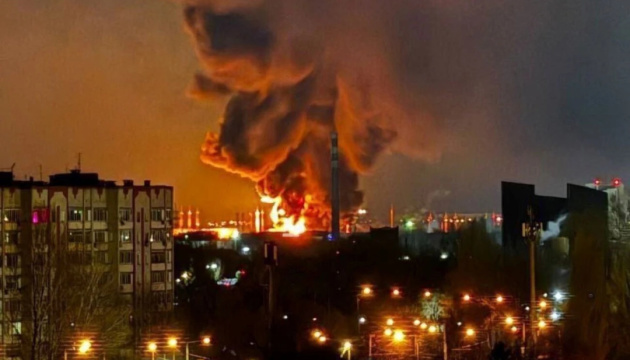
Ukraine’s strike drones (OWA-UAVs) reached deep into Russian territory. They flew in from the seaward side to strike the important frigate. Other drones successfully hit the oil export infrastructure nearby, causing massive fires which lit up the nighttime sky. A hail of Russian missiles and anti-aircraft fire, assisted by spotlights, couldn’t keep them at bay.
A fleet in being
The Russian Black Sea Fleet is confined to Novorossiysk. Threatened by a plethora of uncrewed surface vessels (USVs), underwater drones (AUVs) and aerial drones (UAVs), they rarely venture out of port. The submarines often submerge at their berths to reduce their visibility to drones.
Now the protective seawalls of Novorossiysk are becoming a cage. The increasing accuracy and confidence of Ukrainian drone forces makes it only a matter of time before more serious damage is inflicted.
Nowhere to run to
Nestled in a mountainous inlet on Russia’s Black Sea coast, Novorossiysk is between 200-350 nautical miles from Ukrainian held territory. Yet it is now firmly in the crosshairs, threatened by surface, sub-surface and aerial drones. The latter, Ukraine’s long-range strike drones, are being a dominant force.
Russia’s problem is that there is no other port to retreat to in the Black Sea. The port at Sochi, or across the border at Ochamchire in Georgia, are both small and offer limited facilities. And retreating through the Volga-Don Canal to the Caspian Sea may be irreversible.
It may therefore be only a matter of time before they are compelled to return to sea, exchanging their vulnerability to aerial drones in port for the persistent threat of USVs offshore. In a war where Russia is famously fighting a country ‘without a navy’, every ship lost will be a humiliation. So, the Russian sailors must succeed against every single incoming threat. But the Ukrainians, using expendable uncrewed platforms, only have to get lucky once.








Comments (0)