Trump's Migration Rules Force Wage Gains in Meatpacking
President Donald Trump’s migration cutoff is pressuring a huge meatpacking firm to offer better wages to President Joe Biden’s last wave of low-wage migrants.
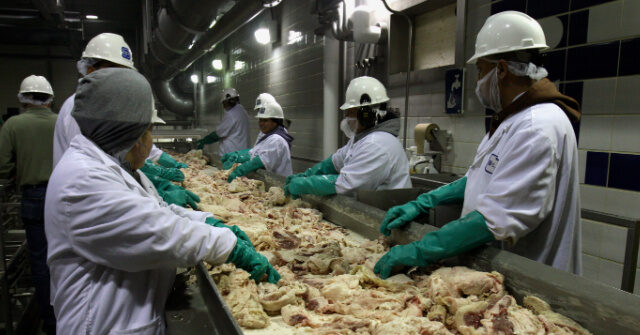
JBS is offering wage gains, a cash bonus, better benefits, and even a retirement plan, after a rare strike by migrant employees at the JBS slaughterhouse in Greeley, Colo., said a company statement, which added:
Since 2019, base hourly wages at the Greeley plant have increased by approximately 46%, outpacing Northern Colorado/Front Range inflation of roughly 25% over the same period. This represents a real wage growth of about 16% for team members.
The three-week strike in Colorado has been suspended to allow further negotiations, said the union, which has a very different perspective than JBS.
Since late 2021, as Biden’s migrants flooded the labor market, the JBS workers have seen wage gains of just 7 percent, even though healthcare contributions rose by almost 40 percent, according to the union.
JBS “sought to limit workers’ wages and has instead insisted on wage increases of barely 1.5% on average per year, far below both historic and anticipated inflation,” said a statement by the local branch of the United Food and Commercial Workers International Union.
https://www.instagram.com/reels/DWvJrDfjHZE/
“Workers remain united and will continue to fight until JBS fully ends its unfair labor practices and gives workers a contract offer that protects them, shows workers the respect they deserve, and pays them a livable wage,” said Kim Cordova, the local president.
In June 2025, amid Trump’s cutoff of new migrants, JBS was forced to grant pay raises, sick leave, and even a pension plan to 26,000 meatpackers in Iowa. “I’ve been working at JBS for 10 years, and when I got the news about the pension, I was excited,” said Thelma Cruz, who works at the JBS Pork plant in Marshalltown, Iowa. “My husband also works here, and when we retire, we will both get pension checks every month.”
Since then, wage gains have been curbed by the usual alliance of corporate lobbyists and pro-migraiotn progressives.
For example, agriculture-sector lobbyists pushed Trump to curb ICE raids on meatpacking and agriculture sites after ICE picked up 76 illegals working at a Nebraska meatpacking plant in June 2025.
For decades, the meatpacking companies have been boosted by the federal policy of extracting workers from poor countries via legalized and illegal routes. The imported workers replaced Americans, accepted lower wages and more dangerous working conditions, and were replaced by subsequent inflows of illegals and refugees.
The federal government has also imported workers, renters, and consumers for technology investors, the trucking industry, Democratic city governments, real estate investors, and many other economic sectors.
Most of the JBS workers at the Greeley site are Biden migrants from Haiti, Somalia, Burma, and Mexico. They include a mix of legal refugees, illegal migrants, and migrants with various temporary work permits. The far-left Nation magazine reported:
As of 2020, an estimated 80–90 percent of [the 3,800] workers at the Greeley plant were foreign born. Workers speak over 50 languages on the disassembly line as they slice, debone, trim, and grind up to 6,000 carcasses a day. Kim Cordova, the president of United Food and Commercial Workers (UFCW) Local 7, which represents workers at the plant, said JBS’s reliance on immigrant labor is strategic. “They’re really good about bringing in folks from different countries that don’t know their rights yet or are here seeking asylum,” she said. JBS knows that precarity and fear means “they can run those chain speeds [on the production line] fast.”
Various far-left groups accepted federal funds to deliver the migrants to the meatpackers, said Mark Krikorian, director of the Center for Immigration Studies. He told Breitbart News:
It enabled [the meatpackers] to staff their plants with desperate folks who don’t really have the knowledge or connections or experience to be able to bargain for more money or demand changes to work routines, any of that sort of thing. The inevitable result is lower wages and potentially dangerous working conditions … By delivering this endless supply of cheap, controllable, desperate workers, the government refugee policy was disincentivizing companies from making investments in machinery that increase the productivity of workers. That’s just not good for the country.
JBS is a Brazilian multinational company whose top executives try to maximize their stock price by minimizing costs, including wages and investments in technology.
Under Trump, JBS executives are trying to offset the wage gains by investing in labor-saving machines, such as computer-controlled saws.
For example, JBS is spending roughly $135 million on a new sausage factory in Iowa, where a workforce of just 500 people is expected to produce some 130 million pounds of sausage each year from roughly 500,000 pigs. The technology would allow each employee to process 1,000 pigs per year — and so the union will push to win a share of the profits created by the high-tech investments.
This video shows a high-tech JBS plan in high-wage Australia, which is far more automated than a U.S. slaughterhouse in 1980 or the 1930s:
The left-wing progressive groups that imported refugees for the meatpackers helped to create this problem, said Krikorian:
This really is an indictment of the refugee settlement groups that have partnered with these meatpackers in the probably naive assumption that this would be good by providing jobs for these [new] refugees. But their complete ignorance of economics has revealed … that they didn’t understand that what they’re doing is giving these companies a controllable workforce … [and] they don’t appreciate the fact that they are tools of capital.
In capitalism, you need a yin and a yang. you need the left and the right pulling in opposite directions so you end up somewhere in the middle.
“What’s happened here is that the left has ceded the pro-worker argument to Republicans, to Trump specifically,” he added.
Unsurprisingly, major investors are distraught at Trump’s cut-off of more migrant labor, renters, and consumers. For example, on March 31, Fortune magazine reported that investor Ken Griffin wants more:
Griffin has said that the Trump administration has made significant progress securing the southern border. At the same time, he’s stressed that the U.S. should continue to welcome talented people from around the world. “The southern border was the source of people willing to do tough jobs for modest wages—building houses, washing dishes, picking crops,” he says. “Reducing immigration will bring higher prices for groceries, housing, and food. We’ve rolled back the welcome mat too much.”
He states that any foreign student graduating from a U.S. college or graduate school “should get a [work] visa stamped to their degree.”
Progressives hide their ambitions and submission to Wall Street by pretending migration is about culture. liberation, and minority rights, but not the extraction of human resources from poor countries to serve as stimulants in a consumer economy.