Solar power in Africa is heating up — thanks in part to chili peppers
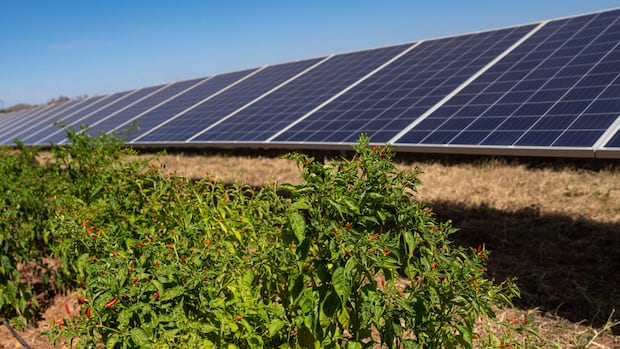
They're the chili peppers in the spicy chicken at a restaurant chain you might know. And they were an ingredient used by a Canadian company to build the first solar power plants in Malawi. About a tenth of Malawi's grid power now comes from two new solar plants built by Toronto-based JCM Power. The 60-megawatt Salima solar plant, co-owned with InfraCo Africa Ltd., became the country's first solar plant in 2021. Golomoti came a year later, and its five-megawatt battery is the first such storage system for a utility-scale project in sub-Saharan Africa.They're badly needed — as recently as 2023, less than 16 per cent of people in Malawi had access to electricity.JCM Power's Golomati power plant, seen in November 2021, includes a 5MW battery. It's the first such storage system for a utility-scale project in sub-Saharan Africa. (JCM Power)But there were reasons solar took so long to arrive, despite the obvious need and the country's sunny climate.Loris Andrys, JCM's Cape Town-based senior business developer for Africa, said before those projects, Malawi was a "frontier market," where regulations for solar power projects didn't exist. Developing them became part of the process of building Salima and Golomoti.A man holds a bag of bird's eye chilis grown in and around JCM Power's solar plants. (JCM Power)Another challenge was that the Malawian government pays JCM in Malawian kwachas, which is volatile compared to other currencies and can devalue quickly.JCM Power's solution was to invest the kwachas into community farming of African bird's eye chili peppers in and around the solar panels. These, in turn, are sold in U.S. dollars, largely to Nando's Peri-Peri, a chain of chicken restaurants (there are locations in Canada) with a signature hot sauce."This is a very original, innovative way on how we can adapt," said Andrys.Africa's solar opportunityAccording to the International Energy Agency, Africa has 60 per cent of the world's best solar resources, since most of it is near the equator, with little dust and cloud cover.Meanwhile, there's been a push to connect the 600 million Africans with no access to electricity by 2030 to align with the UN's goal of universal access. African power demand is expected to increase eight-fold by 2050, reports the Global Africa Business Initiative, organized by several United Nations agencies.Amos Wemanya, senior climate advisor at Power Shift Africa, an African think-tank that promotes renewable energy, said many African countries have traditionally relied on imported fossil fuels with volatile prices. Solar, he said, "provides the opportunity for energy sovereignty."Solar achieved record growth in Africa in 2025, with a 54 per cent increase in solar installations, the Global Solar Council reports. That's happening along two tracks: rooftop systems funded by individual homeowners and utility-scale plants that connect to national grids, which are considered the cheapest option to provide electricity access to nearly half the African population who need it.Large-scale plants are often funded with the help of foreign countries.While China and some European countries are bigger investors in clean energy in Africa, some Canadian companies also have projects on the continent. While private funding accounted for roughly two-thirds of investment in 2024, the IEA says public and development finance is important in new markets or "commercially unviable areas."JCM Power is owned by five development banks, including FinDev Canada, a federal Crown corporation with a mandate to support businesses in developing markets and promote sustainable development.In addition to Malawi, JCM is developing new opportunities in Namibia, Botswana, Mozambique, Zambia, Zimbabwe, Congo and Tanzania.Birds perch at JCM Power's Salima solar plant in Malawi. (JCM Power)Andrys said compared to the company's projects in other regions, such as South Asia, those in Africa are smaller and "much more challenging."But he said "we will remain in Africa, because that's the place where we can impact the most people."Those impacts can go beyond providing power itself. For example, FinDev Canada required JCM to ensure women get leadership opportunities in places like Malawi, which still faces gender equality challenges. Grace Kalowa, who was first hired as the local gender inclusion specialist, is now the Malawi country manager for JCM Power, and a quarter of the 63 employees at the Malawi plants are women.While JCM leverages development funding, private investment is playing a growing role in African solar projects, as public and development finance for energy projects in Africa has fallen by a third in the past decade, largely due to spending cuts by Chinese development banks, the IEA reports.WATCH | How solar panels are changing the lives of India's salt farmers:Solar panels are multiplying across western India's salt plains, and farmers tell CBC’s South Asia correspondent Salimah Shivji the technology has completely changed their lives.Vancouver's Stardust Solar launches first franchise in ZambiaStardust Solar Energy is a public, Vancouver-based company that's part of the growing private investment in solar in Africa, generally in more established markets.Zambia added 139 MW of solar last year. This year, Stardust is launching a 35-hectare, 30 MW solar project there through its new local franchise, Megatricity Energy.Stardust already has more than 100 franchises in Canada, the U.S. and the Caribbean, but this is its first in Africa. Eamon McHugh, the company's director and chief operating officer, said it's crucial for Africa to deploy more power, "and solar just happens to be one of the fastest to deploy energy sources."Franchisees Ochas Kashinge Pupwe and Lee Lewanika Simbeye launched a franchise with Stardust in Biloxi, Miss., last year and almost immediately talked about expanding to Zambia, where they grew up. The team lined up a power purchase agreement with the national utility, purchased land in Zambia's copper belt region, and the franchise officially launched in September.McHugh said they're currently doing geological testing — "making sure there's no emeralds and copper on the land first." He expects the plant to begin power production this summer and be at its full 30 MW capacity in 2027.Stardust is providing services like engineering, financing and training, while the franchisees are responsible for managing local construction.McHugh said they're also looking into other opportunities, like being able to offer training through schools and install solar on homes, clinics and schools in the area through a local "Green Cities" fund.He added that while foreign financing is often crucial for solar projects in Africa, the franchise model benefits communities. "We're not just a big company coming in to build a solar plant. We enable local businesses to grow and become a professional solar business."But he also thinks this can be good for Stardust itself: "There's incredible opportunity there."Eamonn McHugh, far left, Lee Simbaye, third from left, and Ochas Pupwe, second from right, visit the site that will host a new Stardust Solar franchise in Zambia. It already has some water and energy infrastructure. (Stardust Solar)Caution needed for sustainable solarCarole Brunet is an associate professor at the INRS (Institut national de la recherche scientifique) in Montreal and a lecturer at Polytechnique Montreal who researches the social and environmental impacts of the global energy transition. She has studied utility-scale solar projects in Morocco, Senegal, Burkina Faso, Madagascar and South Africa.She said development banks have many guidelines to promote responsible, sustainable development and maximize the benefits of such projects. Those could include enhancing local agriculture, ensuring local training and employment opportunities or promoting gender equality."Unfortunately … I haven't seen any [solar] power plants where sustainable development objectives have been respected to the extent that they should," she told CBC News in French.She said some solar development is happening too fast for the impacts to be properly managed.Some projects take up huge tracts of land that communities may lose access to, cut trees that provided shade and cooling, or use up scarce resources such as water for things like cleaning the panels, while providing less employment than expected, causing tensions with local communities.Wemanya at Power Shift Africa agreed that this can happen, especially when solar is deployed quickly in utility-scale projects. He thinks this can be minimized, however, if local communities organize and advocate for their own needs, and if solar deployment is tied to developing local industries, such as mining or irrigation of local crops. He believes that could also encourage more private investment, because "investors [will] have the confidence that … it's energy that's generating value."