Scientists Suspect They’re Overestimating Microplastics Due to an Embarrassing Mistake
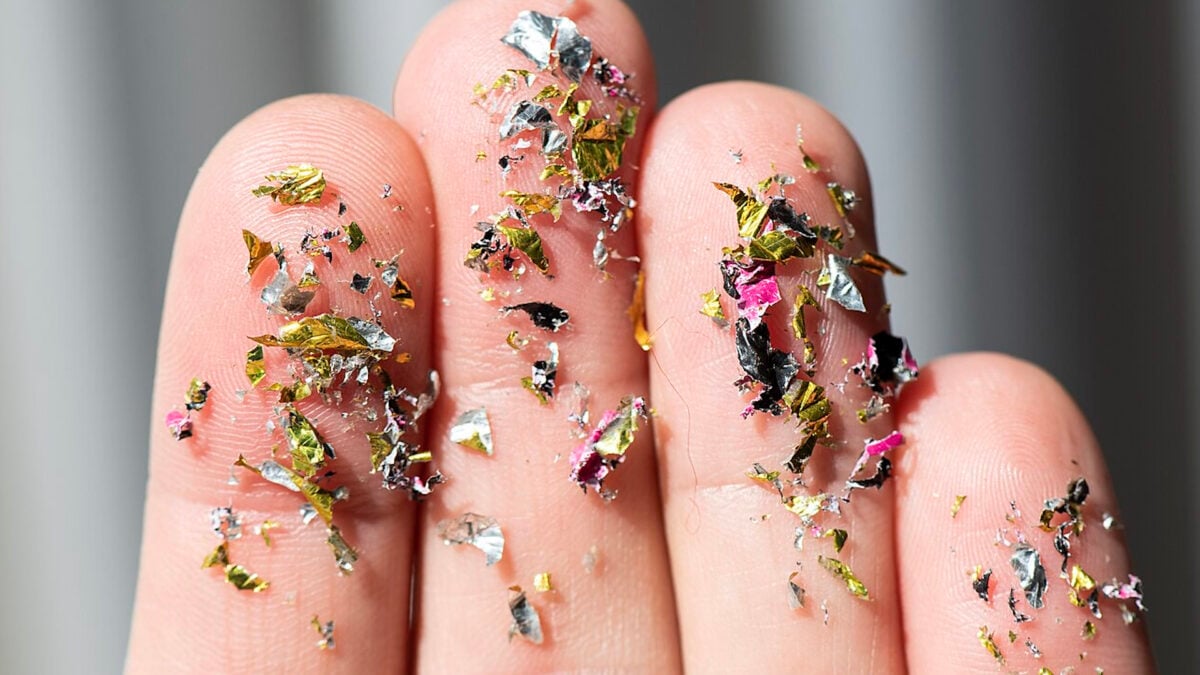
Earth’s worrying pall of microplastics—recorded by scientists practically everywhere, across our planet’s oceans, aloft in clouds above Mount Fuji, burrowed into human brains, and even in the testicles of our poor damn dogs—might be modestly less apocalyptic than previously thought. Researchers at the University of Michigan (U-M) have identified a surprising and arguably mildly embarrassing error that might be contributing to dramatic overestimates of microplastics content across multiple studies: flecks of debris shed by the standard latex and nitrile gloves that scientists typically use in the lab. Tiny soap-like salts, called stearates, coat these gloves as remnants of the manufacturing process, according to the new U-M study, where they can rub off, creating thousands of false positives per square millimeter (or about one-thousandth of a square inch).
The U-M team replicated a common test surface for microplastics work to evaluate how seven different types of disposable lab gloves could muddy the final microplastics count in each case. “The type of contact we tried to mimic touches upon all varieties of microplastics research,” according to a statement from the study’s lead author Madeline Clough, a recent doctoral graduate at U-M. “If you are contacting a sample with a gloved hand,” Clough said, “you’re likely imparting these stearates that could overestimate your results.”
A trick of the light Obviously, a stearate salt is not a plastic. But the microscale geometry of these salts looks similar to polyethylene, one of the most common forms of plastic found polluting our environment at the microplastic scale. (Clough’s study went with the definition of microplastic as a particle between one and 5,000 micrometers, i.e. between very small and about 0.2 inches.)
Stearate’s physical resemblance to polyethylene at these sizes has proven to be close enough to fool the infrared light-based techniques used to scan samples of microplastic particulates. “Researchers use vibrational spectroscopy to identify microplastics,” Clough explained in an essay for The Conversation, with her study coauthor Anne McNeil, “which entails measuring how the particle interacts with light to produce what scientists call a chemical fingerprint.” Vibrational spectroscopy utilizes nondestructive interactions between the energy and photons in a beam of infrared light, an effect called “Raman scattering,” to provoke and measure distinct vibrations, rotations, and other movements by the molecules a given researcher is hoping to identify. It can be subtle work. Sometimes, science is more art than science. (A lot of people don’t get that.)
“That’s why we need chemists and people who understand chemical structure to be working in this field,” McNeil, a professor of chemistry, macromolecular science, and engineering at U-M, noted in the university’s statement. Above, micrometer-scale imaging shows how visually similar stearate salts shed by many lab gloves (top) appear to look to some microplastics (bottom). Credit: Madeline Clough, University of Michigan If the glove sheds, you must retread The researchers rigorously crafted an identical set of aluminum-coated silicon surfaces and brought them each into contact with three professional-grade types of latex gloves, three nitrile gloves of similar quality, and one ultra-high-purity nitrile glove used in circuit-manufacturing cleanrooms.
“We hypothesized that the strict contaminant-free standards of cleanrooms would necessitate particulate-free gloves,” the team explained in their study, published last month in the Royal Society of Chemistry journal RSC Analytical Methods. True to form, they reported, the cleanroom gloves produced “fewer false positives per unit area than other glove varieties.” Latex gloves proved to be markedly worse than the nitrile gloves, overall, with one of those three tests producing roughly 7,000 “false positive” stearate particles per square millimeter. The three lab-standard nitrile gloves tended to produce false positives in the low thousands per sq-mm. The cleanroom gloves, by contrast, produced at worst a few hundred per sq-mm.
Crucially, however, the researchers do not believe their findings minimize the reality of microplastics pollution as a very real global problem: “We may be overestimating microplastics,” McNeil noted, “but there should be none.” In addition to recommending cleanroom gloves for future microplastics research, or when possible no gloves at all, Clough and McNeil also noted in The Conversation that they had “developed methods to help differentiate the chemical fingerprints” of stearate salts. The team has been refining and publishing on this technique, a machine-learning statistical analysis on the Raman-scattering data called conformal prediction, since at least 2024. Their goal, as they wrote in the new paper, is to help themselves and other microplastics researchers “recover older, potentially contaminated datasets.”
“We plan to continue our research on Michigan’s atmospheric microplastic contamination,” Clough and McNeil wrote, “this time without gloves.”