MARY CARR: The court victory against BIG TECH is another example of David Vs Goliath challenges battling the toxic tide of INTERNET HARM... But what are our big talking politicians intending to do about it?
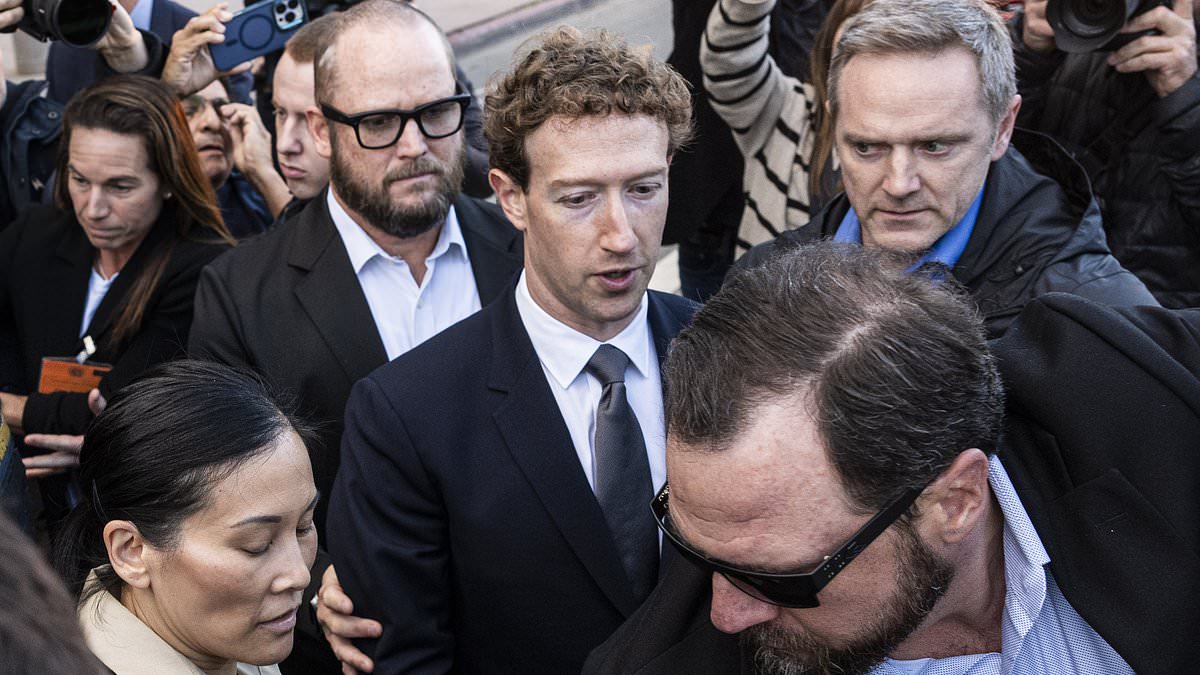
The reign of the Gods Of The Internet and their untrammelled power nudged closer to the end last week.The landmark ruling whereby a Californian jury agreed that the ‘addictive design’ of Instagram, Facebook and YouTube helped fuel a young woman called Kaley’s serious mental health battles and awarded her $3million in damages has been hailed as a game-changer, the biggest victory so far in the campaign to tame the internet wild west.Neither the testimony of Mark Zuckerberg nor other tech bros could persuade the court that social media use was foremost an issue of personal or parental responsibility, or indeed that tech addiction was not real or not deliberately engineered by its creators to be that way. Facebook founder Mark Zuckerberg leaves the Federal Courthouse in downtown Los Angeles, USA, in February after defending the company in a landmark social media addiction trialThe ruling will be appealed, of course; otherwise, the tech giants stand to lose billions settling the hundreds of lawsuits due to be launched in the wake of the groundbreaking verdict.They also need to defend the myth of social media as a revolutionary new technology so far beyond the reach of human regulation that responsibility for content creation and consumption must be pinned on the shoulders of the little people rather than the moguls.If they win that point they can safeguard engagement, the lifeblood of their business model, from being compromised by any court-ordained rethinking of the features that keep users endlessly scrolling. No one in Silicon Valley is going to surrender their genius operation, conducted in what, to all intents and purposes, is a government-free zone and with a callous insouciance towards user welfare, without a knock-down, drag-out fight.Yet as the US courts seem to finally have an appetite for putting an end to the tech tycoons’ gallop – a second case in New Mexico found Meta violated state law by enabling child sexual exploitation on its platforms and fined it $375million – the EU banned nudification apps by a decisive 569 votes to 45 in Strasbourg. And here, gardaí launched a module for secondary school students on cyber-security and non-consensual sharing of intimate images online, essentially the nuts and bolts of Coco’s Law, named after Nicole Coco Fox who, aged 21, took her own life in 2018 following a sustained period of physical and online bullying.Nicole’s mother, Jackie Fox, attended the launch at Our Lady of Mercy School in Drimnagh, Dublin, and also addressed the European Parliament in recent weeks about the campaign she orchestrated so that something positive came from Coco’s devastating death. European Parliament President Roberta Metsola, right, embraces Jackie Fox during a debate at the European Parliament in Strasbourg, France on March 10Jackie told the students about how her daughter’s life was made a misery by social media, how her confidence was broken and how she was told to ‘kill herself’ and ‘even sent videos on how to do it’. ‘Right now, standing here I am beyond heartbroken,’ she said. ‘I had to lose my daughter for everyone else to gain.’It’s all progress but it’s dispiriting that advances are only made in the time-honoured fashion, after a tortuous David-and-Goliath struggle. It’s always the little person, the innocent child or the grief-stricken parent, people who have learned the hard way about the profound damage caused by social media, who must first raise awareness and then face down the tech titans with their bottomless pockets and armies of expensive consultants and wily experts. Individuals like Jackie Fox and her daughter Coco, who paid the ultimate price for digital capitalism, and, in California, 20-year-old Kaley who, like so many doomed children, became addicted to YouTube and Instagram when she was six and developed body dysmorphia and depression. Also, non-governmental organisations and humanitarian, child-protection groups are the ones who lead the charge against Big Tech, never governments or politicians.In the US, while state governments recently started enacting laws on social media usage for children through regulations governing mobile phones in schools or age-verification requirements, Congress has declined to pass legislation regulating the sector. The tech leaders generally enjoy a cosy relationship with Donald Trump, particularly Elon Musk, who the president brought into his inner circle. Zuckerberg, Jeff Bezos and Tim Cook from Apple turned out for Trump’s inauguration; indeed, Amazon boss Bezos curried special favour with the president by paying Melania Trump millions for a pointless documentary about her life as first lady. Parents and family members embrace before entering the Los Angeles Superior CourtYet Trump’s deafening silence about last week’s verdict suggests that their careful investment at the highest level may not be paying off as they might have hoped. Trump has bigger fish to fry, like wars in the Middle East, but, like the Irish Government, he may want to steer a delicate line between not alienating a sector whose fortunes are central to the economy while reflecting the public’s genuine dismay at the unparalleled might of Big Tech, its existence beyond the ties of regulation or restrictions, and its evading of laws the rest of us must live by.During the recent scandal over X’s AI tool Grok and its nudification apps, our AI Minister Niamh Smyth hauled executives in to meet her. Yet no one was under any illusion about her or anyone else in Government doing anything to seriously jeopardise companies that provide the State coffers with such a handsome income stream. Far better to wait for the EU to crack the whip.Politicians like Simon Harris and Ms Smyth talk the talk but their hands are tied by the economic reliance on tech. Meanwhile, those with nothing left to lose fight the good fight.