Italy’s World Cup Nightmare Is Only Getting Worse
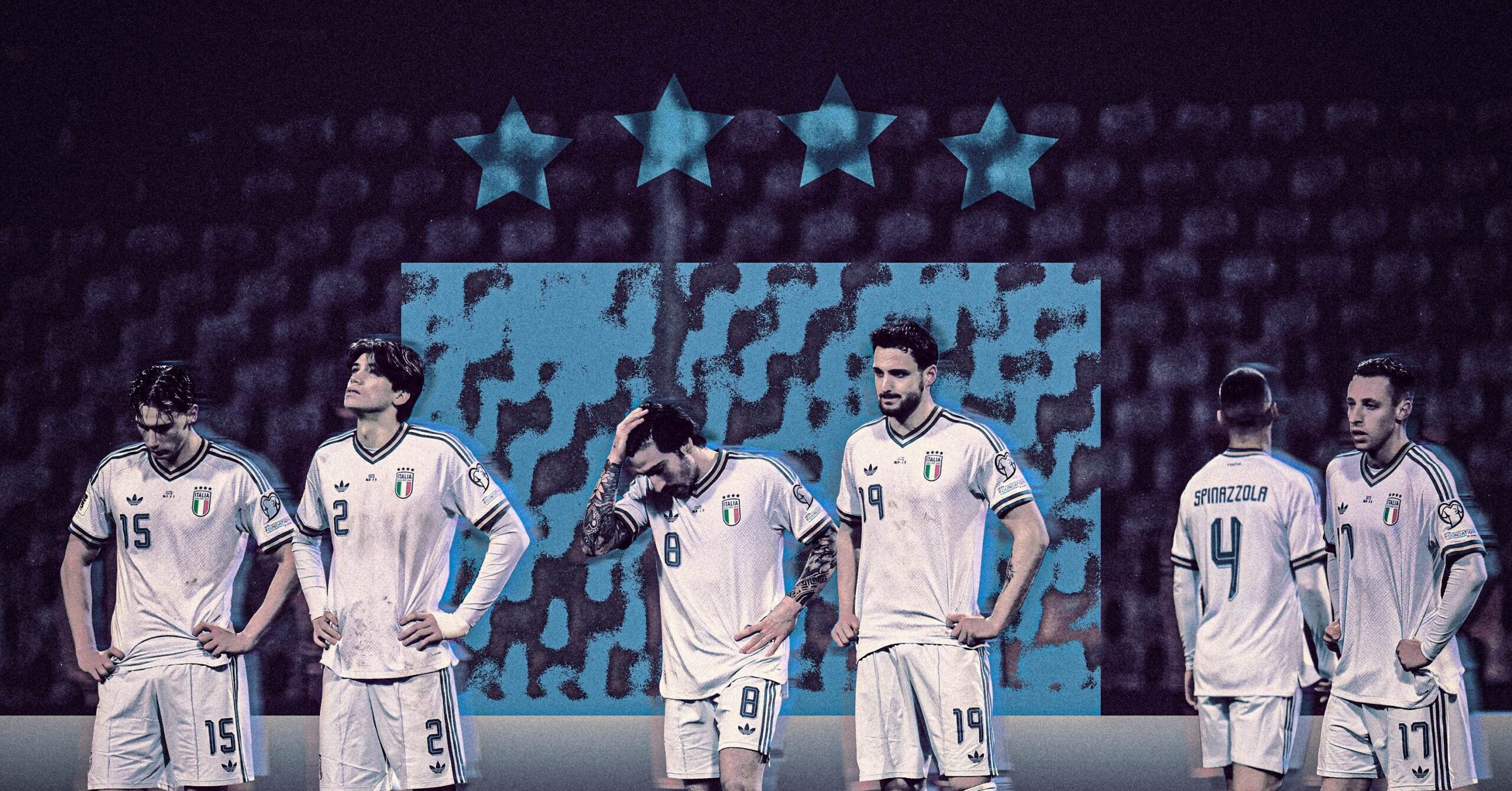
SoccerSoccerAfter a penalty shoot-out loss to Bosnia and Herzegovina, Italy will now spend a third consecutive World Cup watching from the sideline. What happened to the country’s once-proud soccer tradition? And will it get back to the top anytime soon?By Anthony DabbundoApril 2, 10:30 am UTC • 7 minThe last time Italy played in a knockout-round match at the FIFA World Cup, it was July 2006. The iPhone hadn’t been invented yet. Twitter launched later that month. Netflix was still exclusively mailing DVDs. Italy beat France in a penalty shoot-out—following the infamous Zinedine Zidane headbutt of Marco Materazzi—to win its fourth World Cup. It stood atop the soccer world. This July will mark 20 years since that historic Italian triumph in Berlin. Yet after their surprise defeat to Bosnia and Herzegovina in Tuesday’s European playoff final, a result that felt shocking in the moment but predictable in hindsight, the Italians will now watch an unfathomable third consecutive World Cup from home. Their penalty shoot-out loss means that the smaller soccer nations of Sweden, North Macedonia, and Bosnia and Herzegovina have booted Italy from the last three qualifying cycles. And collectively, these failures have been so improbable that there’s a growing belief that the nation’s soccer team is still suffering from the “Curse of Materazzi.”If Italy missed the World Cup only once, you could call it variance. Strange things happen all the time in soccer: The Dutch missed out in 2018 after being semifinalists in 2014; the United States infamously lost to Trinidad and Tobago and failed to qualify in 2018 as well. It was a weird cycle. Missing out twice is embarrassing. But three times is something else entirely. Imagine if a program as big as North Carolina failed to make the NCAA tournament for an entire decade. Or if Alabama football posted seven consecutive losing seasons. That’s the scale of this fall from glory. Something that would’ve been unthinkable before 2014 is now far too commonplace.This failure is an indictment of Italy’s entire soccer federation, from the lowest levels of player development to the highest levels of decision-making. And especially so in 2026, when the expanded World Cup field means that qualifying is easier than it’s ever been. The expansion to a 48-team field vastly increased the margin for error for the highly rated teams across the globe. The rest of Europe’s elite—Germany, Spain, England, France, Portugal, and the Netherlands—all made it through. Six of the top 10 South American teams qualified. Sweden didn’t win a single one of its first six qualifying matches, but it backed into the European playoffs and an eventual World Cup spot via a UEFA Nations League place. Sixteen European teams will play in North America this summer. Italy is somehow not one of them. For a nation that used to feel like the final boss of international soccer, it’s been shocking to watch it slowly fade into just another blip on the World Cup radar. Italian fans will point to their Euro 2020 (in 2021) trophy as the shining beacon from an otherwise lost two decades. Former manager Roberto Mancini had the Italians humming via a stellar combination of pressing and possession. Gianluigi Donnarumma’s penalty kick–saving heroics helped nudge Italy past both Spain and England in the final two matches. But as much as the Azzurri dazzled in that tournament, it has proved to be a lightning-in-a-bottle moment. Since then, Federico Chiesa has battled numerous injuries and has not been the same player he once was. Ciro Immobile has aged out of the top levels of Serie A. The legendary defensive duo of Leonardo Bonucci and Giorgio Chiellini has retired. Italy hoped that highly successful Napoli manager Luciano Spalletti could fix things when he came in following the disastrous 2022 cycle. When he couldn't, the team tried 2006 World Cup champion and veteran Serie A manager Gennaro Gattuso. He failed too. No one watching the Italians at Euro 2024 or in this qualifying cycle could catch a glimpse of the hard-nosed, defensively sound identity that once defined them. Both Spain and Switzerland comfortably beat them at Euro 2024, and Norway thumped them 3-0 and 4-1 in two World Cup qualifiers last fall. At no point in either match did Italy look on the level of Norway. If you were drafting players to make a combined XI between Norway and Italy, you wouldn’t even hesitate before selecting two Norwegians—Erling Haaland and Martin Odegaard—with the first two picks. Defensively, the Azzurri still have some top-level personnel. Donnarumma remains one of the sport’s top goalkeepers, and Inter’s Alessandro Bastoni is considered one of the most reliable central defenders in the world—even if he lost his head on Tuesday and got sent off for his last-man tackle. It was a stunning miscalculation of risk for such an experienced defender. Despite those stars, though, the talent across the board in this generation of Italian players is still down from where it used to be. As the Italians lost touch with their soccer identity on the pitch, their talent base hollowed out around it. Italy’s development pipeline has fallen behind those of England, Spain, Germany, and France. All four countries will be in North America this summer with squads full of under-25 talent. Bukayo Saka, Nico Williams, Lamine Yamal, Michael Olise, Désiré Doué, and Jamal Musiala are already some of the best players in Europe. Italy doesn’t have a single difference maker of that quality in the attacking half of the pitch. In its most important match in four years, Italy started Serie A journeymen Moise Kean and Mateo Retegui together as a striker duo. Over the last decade, the rest of Europe’s top nations have industrialized player development. France built an assembly line of elite athletes. England flooded the Premier League with money and minutes for young players. Spain rebuilt its technical identity around a new generation. Germany climbed out of its own down period following the 2014 World Cup and can now overwhelm opponents with its passing and attacking quality.Italy has not kept up. Serie A is slower-paced than the other top European club leagues, and it’s more reliant on aging players. The stadiums and infrastructure across the league have not been modernized. And while Italy previously overcame some talent gaps with its hardened identity of winning ugly, that hasn’t proved to be a sustainable model across generations—something Italian soccer is learning in real time. Meanwhile, Italian men’s tennis is in the middle of a full-blown tennaissance, driven by Jannik Sinner and backed by heavy national investment in courts, coaching, and events. There are now six Italian men, none older than 30, ranked among the top 75 tennis players in the world. Italy still has dynamic and explosive young athletes, but many of them are choosing tennis rackets over cleats. A 2024 report in The Guardian said that the percentage of Italians following tennis has nearly doubled since 2016 and that children’s tennis club enrollments in the country have risen from 129,000 in 2001 to more than a million. In France, kids grow up wanting to be Kylian Mbappé. In Spain, it’s a mix of Carlos Alcaraz and Lamine Yamal. In England, soccer still dominates the cultural imagination. In Italy right now, the most compelling male sports star isn’t a soccer player. For a country defined by the mythology of its national team, that shift matters. Defender Riccardo Calafiori is the only player under 25 who started in Tuesday’s penalty shoot-out loss to Bosnia and Herzegovina. This isn’t just a bad generation. It’s a lost one. Serie A is much older than it’s been in the past, too. Juventus and AC Milan have failed to remain at the heights the clubs reached in the 1990s and 2000s. Neither is a real contender at the top of the European pyramid right now. Juventus hasn’t been to a Champions League final since 2016, and Milan has made only one semifinal since winning the Club World Cup in 2007. Inter has been the only Italian club to really threaten the top continental powers in the Champions League lately, and it’s routinely done so as one of the oldest teams in the Big Five leagues across Europe. And the majority of its most reliable players—outside of Bastoni and midfielder Nicolò Barella—are not even Italian. While attacking stars are typically the headliners of any soccer team, that has not been the case for Italy. Outside of Francesco Totti, the most iconic Italian players of the past 30 years have been defense-oriented: Paolo Maldini, Bonucci, and Chiellini. Gianluigi Buffon was a multi-decade stalwart in goal for the Azzurri. Andrea Pirlo had an innate ability to pick out any pass as a midfielder, but he operated from a deep-lying role far from any regular goal-scoring. The Italians haven’t typically relied on the tricky winger or the traditional striker—rather, they’ve taken solace in being hard to beat. There was a time when Italy was one of the most feared matchups in global soccer.You could be more talented, and it still wouldn’t matter. They were the ultimate neutralizers. They slowed the game down. They frustrated you. They waited for your mistake, capitalized on it, and then gave you nothing in return. Brazil had its jogo bonito. Spain had its possession structures. Germany had its pressing. Italy had its resistance. And now, that resistance is gone.The structure that defined this team is crumbling—and with every failed qualifying cycle, new generations of Italians are growing up not knowing what the country’s soccer ethos is anymore.Anthony DabbundoAnthony Dabbundo is a sports betting writer and podcast host featured on The Ringer Gambling Show, mostly concentrating on the NFL and soccer (he’s a tortured Spurs supporter). Plus, he’s a massive Phillies fan and can be heard talking baseball on The Ringer’s Philly Special. Also: Go Orange.