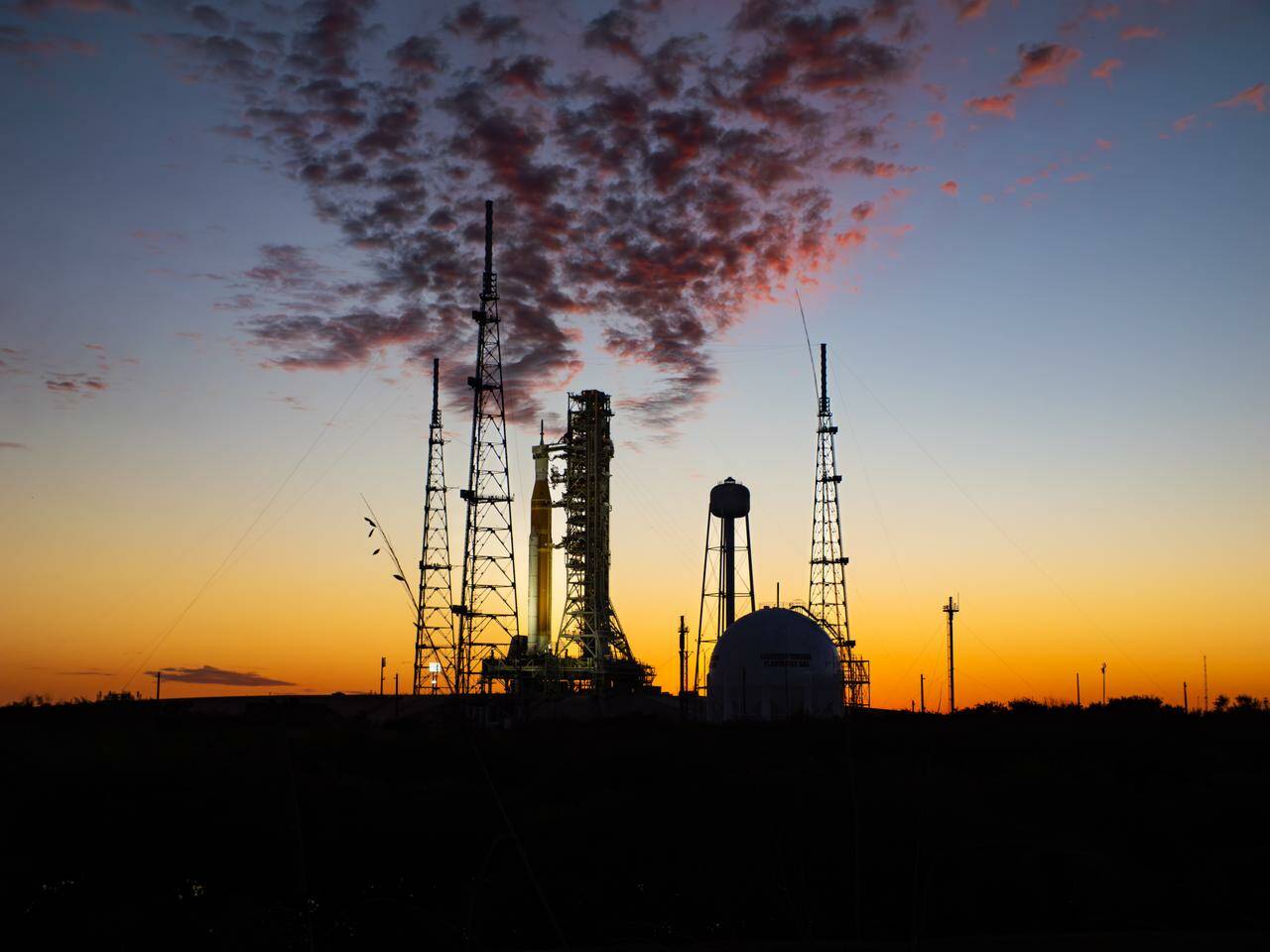
Artemis II countdown begins as NASA prepares for crewed Moon flyby
NASA is preparing to send astronauts around the Moon, with the Artemis II mission countdown set to begin tonight.
The launch of the enormous Space Launch System (SLS) rocket is scheduled for April 1, with a two-hour launch window opening at 22:24 UTC. The countdown is set to start this evening, with the launch team arriving at their stations at L-49 hours, 50 minutes and the countdown beginning at L-49 hours, 40 minutes.
The rocket and spacecraft will then be prepared for launch, with propellant loading beginning at around L-9 hours, 55 minutes. At the four-hour mark, the crew is strapped into the Orion capsule and, if all goes to plan, at T-6.36 seconds, the RS-25 engines start up, followed by the solid rocket boosters, and humans will be headed toward the Moon for the first time in more than half a century.
After dealing with leaks identified during the Wet Dress Rehearsal (WDR) and a helium flow problem that required a rollback to the Vehicle Assembly Building (VAB), the launch has been a long time coming.
During the mission, which will send the Orion spacecraft around the Moon, the crew of Canadian Space Agency (CSA) astronaut Jeremy Hansen and NASA astronauts Christina Koch, Victor Glover, and Reid Wiseman may surpass the record for the farthest distance humans have traveled from Earth set by Apollo 13.
The trajectory will also result in a temporary loss of communication as the crew passes behind the Moon. However, during a video segment, Dr Nicola Fox, associate administrator for NASA's Science Mission Directorate, said: "We will actually be able to talk to our astronauts while they're on the far side of the Moon."
That appears to conflict with NASA's stated communications plan. A NASA spokesperson told The Register: "When Orion flies behind the Moon, the crew will lose communication with the Earth for anywhere from 30-50 minutes, depending on when they launched.
"During that time, they will be taking photos and video of the Moon's far side and making observations to be shared with scientists on the ground after they regain communication."
It is a minor point in the context of the mission as a whole, but accuracy matters.
The lunar flyby is expected on April 6 (assuming the launch goes off as planned on April 1), and the crew will return to Earth with a splashdown in the Pacific Ocean at approximately 0006 UTC on April 11.
At present, the only constraint to an April 1 launch, unless something crops up during the countdown, is the weather. At the moment, the forecast gives an 80 percent chance of acceptable conditions. This will drop to 75 percent if there is a 48-hour delay.
Artemis II was originally planned as a precursor to the lunar landing mission Artemis III. However, the Artemis III mission has now been repurposed as a 2027 Low Earth Orbit test of lunar landing technologies. Artemis IV is to be the first landing mission in 2028.
And beyond? It's difficult to say. NASA recently proposed a plan to construct a moonbase and pause the Gateway space station. Reports have also circulated suggesting that after Artemis V, NASA might ditch the SLS in favor of a commercial alternative.
For now, however, all eyes are on Artemis II. While the crew will not enter lunar orbit in the same way as Apollo 8, it will be the first time a crewed vehicle has ventured so far in more than half a century. If all goes to plan, there won't be as long to wait until the next trip to the Moon. ®