NASA astronaut reveals terrifying 20-minute medical crisis that triggered historic space evacuation from the ISS
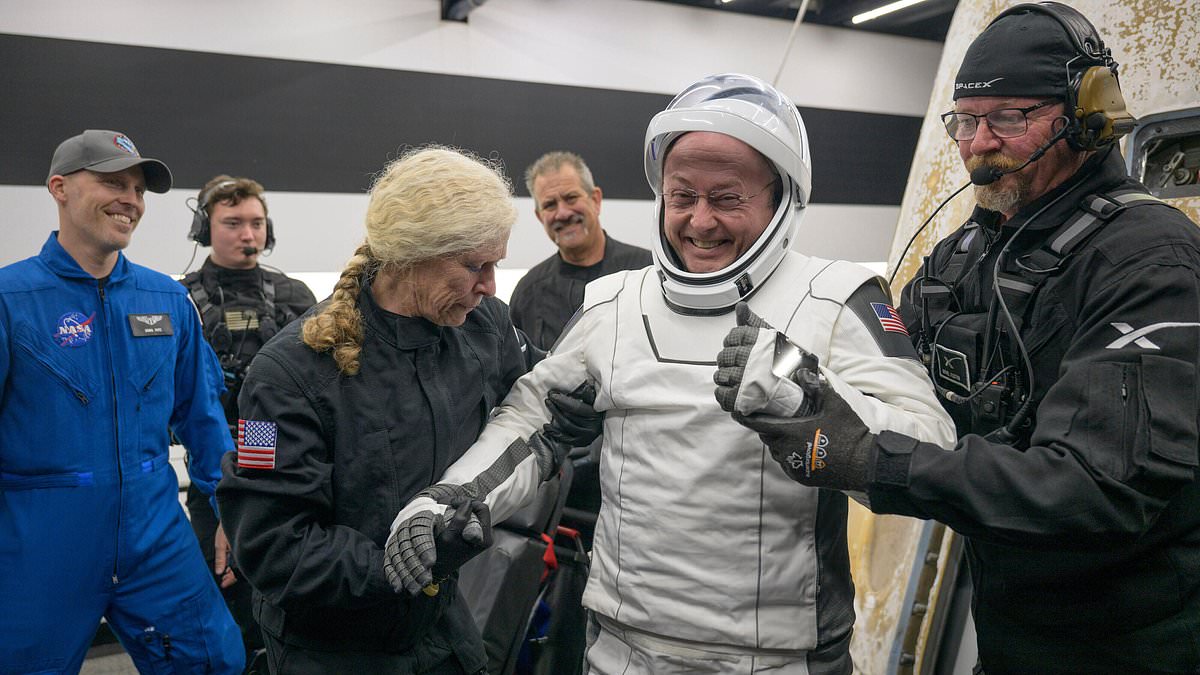
The astronaut who prompted NASA's first medical evacuation earlier this year has revealed he lost the ability to speak in space.Mike Fincke said he was eating dinner on January 7 after prepping for a spacewalk when the terrifying event unfolded.He couldn't talk and remembers no pain, but his anxious crewmates jumped into action after seeing him in distress and requested help from flight surgeons on the ground.The medical emergency triggered the first ever evacuation of the International Space Station.But doctors still don't know why he suddenly fell sick.'It was completely out of the blue,' Mr Fincke said. 'It was just amazingly quick.'The 59-year-old retired Air Force colonel said the episode lasted roughly 20 minutes and he felt fine afterward. He said he had never experienced anything like that before and hasn't since.Doctors have ruled out a heart attack and the astronaut said he wasn't choking, but everything else is still on the table and could be related to his 549 days of weightlessness. NASA astronaut Mike Fincke is helped out of the SpaceX Crew-11 capsule after they re-entered the Earth in a middle-of-the-night splashdown near San Diego, California on January 15 The agency previously revealed that astronaut Mike Fincke (second from left) experienced the issue, which cut Crew 11's mission shortMr Fincke was five and a half months into his latest space station mission when the problem struck like 'a very, very fast lightning bolt'.'My crewmates definitely saw that I was in distress,' he said, with all six gathering around him.'It was all hands on deck within just a matter of seconds.'Mr Fincke said he can´t provide any more details about his medical episode. The space agency wants to make sure that other astronauts do not feel that their medical privacy will be compromised if something happens to them, he explained.The space station's ultrasound machine came in handy when the event occurred, he revealed, and he said he has gone through numerous tests since returning to Earth.NASA is poring through other astronauts' medical records to see if any related instances might have happened in space.The Crew-11 astronauts safely splashed back to Earth following NASA's first medical evacuation in 65 years of spaceflight.The decision was made to bring the crew - including NASA astronauts Zena Cardman, Mike Fincke, Japanese astronaut Kimiya Yui, and Russian cosmonaut Oleg Platonov - home a month ahead of schedule. This was the first time a crew on board the ISS had their mission ended early due to medical reasonsLast month, Mr Fincke identified himself as the one who fell ill to put an end to swirling public speculation.Health issues that can arise on the ISS Blood clotsBone and muscle atrophyLoss of vision Radiation damageCircadian rhythm disruptionAccelerated ageing General health decline He said he still feels bad that his illness caused the spacewalk to be cancelled - it would have been his 10th spacewalk but first for crewmate Zena Cardman - and resulted in an early return for her and their two other crewmates.The crew were taken straight to hospital after being brought back to Earth by SpaceX.'I've been very lucky to be super healthy, so this was very surprising for everyone,' Mr Fincke said.However, he said he has stopped apologising to everybody after NASA's new administrator Jared Isaacman ordered him to.'This wasn't you - this was space, right?' his colleagues assured him. 'You didn't let anybody down.'The astronaut, who has been to space four times, says he hopes he can return one day.When news of a medical emergency first broke, Mr Isaacman said he decided to bring the crew home out of an abundance of caution.He noted that the astronaut's medical episode was considered 'serious' and would require additional medical care on Earth.The evacuation followed NASA's Spaceflight Human-System Standard, which mandates contingency return procedures whenever onboard medical resources are insufficient.Although statistical models have long predicted that such an event could occur roughly once every three years, the plan has never before been used.Located 250 miles above Earth, the ISS functions as a testbed for research that supports deeper space exploration, including eventual missions to return humans to the moon and onward to Mars.The ISS is set to be decommissioned after 2030, with its orbit gradually lowered until it breaks up in the atmosphere over a remote part of the Pacific Ocean called Point Nemo, a spacecraft graveyard.EXPLAINED: THE $100 BILLION INTERNATIONAL SPACE STATION SITS 250 MILES ABOVE THE EARTH The International Space Station (ISS) is a $100 billion (£80 billion) science and engineering laboratory that orbits 250 miles (400 km) above Earth.It has been permanently staffed by rotating crews of astronauts and cosmonauts since November 2000. Crews have come mainly from the US and Russia, but the Japanese space agency JAXA and European space agency ESA have also sent astronauts. The International Space Station has been continuously occupied for more than 20 years and has been expended with multiple new modules added and upgrades to systems Research conducted aboard the ISS often requires one or more of the unusual conditions present in low Earth orbit, such as low-gravity or oxygen.ISS studies have investigated human research, space medicine, life sciences, physical sciences, astronomy and meteorology.The US space agency, NASA, spends about $3 billion (£2.4 billion) a year on the space station program, with the remaining funding coming from international partners, including Europe, Russia and Japan.So far 244 individuals from 19 countries have visited the station, and among them eight private citizens who spent up to $50 million for their visit.There is an ongoing debate about the future of the station beyond 2025, when it is thought some of the original structure will reach 'end of life'.Russia, a major partner in the station, plans to launch its own orbital platform around then, with Axiom Space, a private firm, planning to send its own modules for purely commercial use to the station at the same time. NASA, ESA, JAXA and the Canadian Space Agency (CSA) are working together to build a space station in orbit around the moon, and Russia and China are working on a similar project, that would also include a base on the surface.