Cooking like it’s the “last meal”: inside Operation Nanook’s Cambridge Bay kitchen
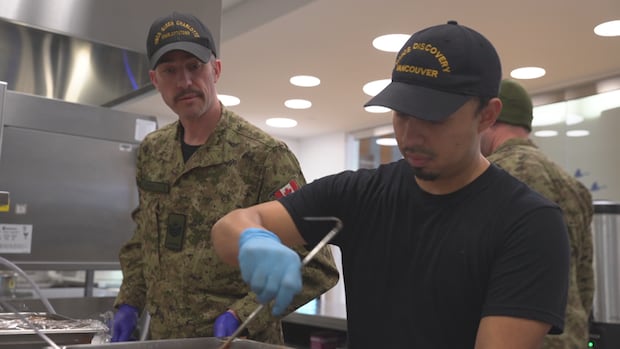
Petty Officer Adam Arsenault, left, and Sailor 2nd Class Jose Lazaro cooking at the Canadian High Arctic Research Station for Operation Nanook. (Elliot Pope/CBC News)
In the extreme cold of Cambridge Bay, Nunavut, Canadian Armed Forces personnel have been testing heavy artillery and doing ice water dives and parachute jumps as part of Operation Nanook.
But some officers in the hamlet are on a mission in the kitchen: to provide members with a taste of home.
“It could be the last meal, depending on operations, that the member will have in your kitchen,” Warrant Officer Gerald Francis said.
“So you’re going to make it with love, creativity and assuring that you put your heart and soul into every meal that you make.”
It’s not as straightforward as following a recipe, though.
The kitchen, set up at the Canadian High Arctic Research Station (CHARS), aims to serve over 160 members with three meals a day. And due to extreme weather conditions, sometimes supplies don’t make it to the hamlet.
Francis, who’s been in the forces for over 20 years, is currently leading the team of officers or “cookies” – which is one of the few military names for kitchen officers — in Cambridge Bay for Operation Nanook.
Operation Nanook is the military’s annual exercise to enhance its abilities to defend Canada’s North and the Arctic, and the forces say the current iteration is the largest one since it started in 2007; it’s also its first time in the extreme winter of Cambridge Bay.
Warrant Officer Gerald Francis said cooks in the military put their ‘heart and soul into every meal’ as ‘it could be the last meal, depending on operations, that the member will have.’ (Elliot Pope/CBC News)
“There’s been a lot of struggles since I’ve been here,” Francis said.
The forces get food orders once a week, but Francis said at times, his team has gone up to 12 days without receiving a delivery.
“Due to the limited amount of space that I have in my fridges, it’s only good for 72 hours up to possibly six days. So, I have to think ahead and order additional supplies and food to factor in the storm or the actual weather,” he said.
Depending on how much supply there is in the kitchen, members are told to substitute fresh meals with “mountain rats (rations)” — which are dehydrated high-energy meals soldiers use in extreme conditions to survive.
“It shows the harsh reality of these exercises, to have to eat this twice a day, sometimes for seven days in a row,” said Lt. Fadi Khalil, the public affairs officer for Operation Nanook, as he lifted a pack of frozen meals out of a pot at one of the operation sites.
At that dive site, a couple of officers were seen eating canned fish during breaks.
The tent, which was filled with military equipment, had a small box in one corner filled with packaged dry food. Each bag included a frozen meal and chocolates.
‘Here for a purpose’
Jose Lazaro, sailor second class, said the meal plans are constantly evolving as there isn’t any certainty on when a delayed order will actually arrive.
“We’re not sure if it will be coming today or the next day,” he said. “We have to make use of what we have, make different dishes instead of the same because we have to keep the morale up.”
Officers from across the country say working on these challenges together has fostered friendships as they work away from home for extended periods.
Lazaro, who is from Vancouver, said he’s befriended petty officer Adam Arsenault from Prince Edward Island.
Officers at the Canadian High Arctic Research Station making lasagna for members of the forces carrying out drills for Operation Nanook in Cambridge Bay, Nunavut. (Elliot Pope/CBC News)
“The cook community within the military is very tightly bonded,”Arsenault said.
“We’re making the best of the time we have here.”
Francis said even though his team has the comfort of working indoors in Cambridge Bay’s winter, they have a big purpose to fulfill.
“Coming in when it’s -62 C outside, and you’re having to adapt to climates, and you’re meeting different people from all across Canada…[telling you], ‘I never had such great food,’” he said.
A report written by Saloni Bhugra
Related stories from around the North:
Canada: Canada bets on ‘Build at Home’ defence strategy to reclaim sovereignty — and revive readiness, CBC News
Denmark: Denmark to provide four F-35 fighter jets to NATO’s Arctic Sentry, Reuters
Finland: Greenland clash left a mark on EU-US relations says Finnish PM, Yle News
Greenland: New Italy Arctic policy adds U.S. Greenland ambitions to growing Arctic competition narrative, Eye on the Arctic
Iceland: NATO chief to Arctic Allies: “We’re all frontline states now,” as Iceland’s role grows, Eye on the Arctic
Norway: Europeans step up submarine hunting in the North, The Independent Barents Observer
Russia: Russia claims first-ever North Pole aerial refuelling, TASS reports, Reuters
Sweden: Swedish military intelligence on the great power rivalry over Greenland, Radio Sweden
United States: Rubio says technical talks with Denmark, Greenland officials over Arctic security have begun, The Associated Press