'I was told find something special' - The ingredients to a good atmosphere, by those who know
Ciarán Kennedy
ALMOST AN HOUR before kick-off at the Stade de France on the opening night of this year’s Six Nations, thousands of supporters had already made their way inside to take their seats. Flags were waving, beers flowing and tunes blaring – everything from traditional French standards to the thumping beats of One More Time by Daft Punk.
Despite the persistent rain, this was the place to be, and that’s testament to the match day experience delivered in France. The ground has its issues – some experiencing lengthy delays to get inside – but the handful of bars located right outside allows for a late dash to find your seat.
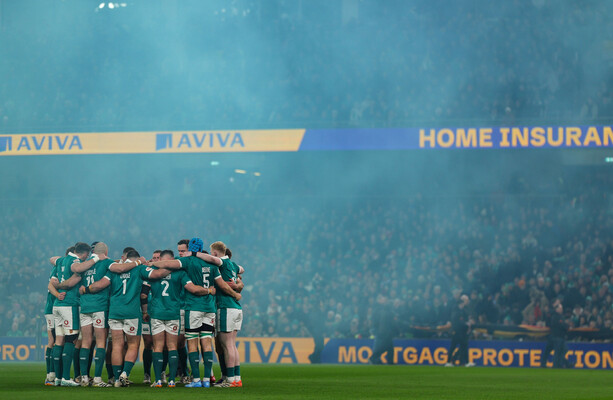
It was hard not to think of the much-criticised Aviva Stadium experience, where there’s little incentive to leave your brunch or your barstool earlier than necessary, and so the crowd often doesn’t swell until 10-15 minutes before kick-off. But how hard would it be to improve the atmosphere?
Before we look at the bad, it’s worth highlighting the good. There have been great occasions at the Aviva over the years where the crowd is highly engaged. The pre-game theatrics as the teams walk out are often excellent, especially for later kick-offs, and the IRFU’s decision to have former Munster and Ireland player Barry Murphy sing the anthems has worked well.
Yet the stadium’s reputation for stale match day experiences is there for a reason. Too often the ground is too quiet, too distracted. This was evident during the nervy round two win over Italy. Last Friday’s meeting with Wales was an improvement, and the crowd will surely be up for it when Scotland visit for a Triple Crown showdown today [KO 2.10pm, Virgin Media One].
The pre-game build-up at Stade de France is one of the best around. ©INPHO
©INPHO
There are multiple reasons why an atmosphere might not take off on any given day, and each one of those reasons could be stretched out into a dedicated article.
Poor or one-sided games are perhaps the biggest obstacle. Expectant Irish crowds have failed to ignite for early kick-offs against the likes of Fiji, Japan and the USA over the years. There is no comparing those experiences to some of the thrilling home wins against New Zealand, South Africa and France, where there is a genuine sense of jeopardy. Even two years ago, there was no ignoring the flat feeling in the ground as Ireland won the Six Nations a week after Grand Slam dreams had been shot down in Twickenham.
That’s not just an Irish rugby problem. There’s a reason Croke Park used to sell out for Leinster championship games before Dublin started dominating their provincial championship, or why some Manchester City fans yearn for the Maine Road days as the Etihad Stadium fails to hit capacity on Champions League nights.
Demographics are another, and on the big Six Nations days a frequent complaint is that the focus is too corporate. Tickets can be hard to get, or just out of reach for too many. For today’s game a Category 5 ticket would set you back €120, with Category A1 at €160. (Restricted view tickets ranged from €60-€77.50). The cheapest non-restricted view adult ticket across Ireland’s three home games was a Category 5 ticket for the Italy fixture, set at €90.
Outside of the lower-billing November and summer Tests, a general sale for Ireland home games is practically non-existent. This matters. The vibrant Irish crowd who stormed the 2023 World Cup in France felt a world away from your average home crowd for a Six Nations game. And it can’t just be about the number of people moving between their seats and the bar (or even staying inside the premium levels). The 2023 World Cup crowds weren’t going thirsty but the Stade de France still fizzed. Stadiums like the Principality in Cardiff have brought in large alcohol-free sections and continued to buzz on match day.
The last World Cup was a perfect example of how the support at Ireland away games can feel notably more lively. Think back to the recent win in Twickenham, where a strong Irish crowd belted out Ireland’s Call before launching into The Fields of Athenry in the early minutes. Post-game, the players spoke of how those moments helped fuel a dominant performance. A week previously, for the home win over Italy, Barry Murphy’s final act before kick-off was to lead a rendition of The Fields, where only a smattering of the late-afternoon crowd felt the urge to join in. Thankfully, he was greeted with more support last Friday.
Ireland had incredible support at the 2023 World Cup. Billy Stickland / INPHO
Billy Stickland / INPHO / INPHO
If supporters don’t feel any reason to be in their seats before the action starts, they’ll happily spend more time in a restaurant or a bar. So, what makes a supporter want to be in their seat long before the teams take to the pitch?
Brian McMahon, who runs culture and lifestyle site Brand New Retro, spent two seasons as Bohemians’ resident DJ at Dalymount Park and has now moved his records closer to home at Dundalk FC. His job is to help generate the right feeling as the crowd trickles in, building the energy as kick-off closes in.
“I’d be looking at the club and its values, its brand and how much they want to try and hype up the atmosphere or how much they want to build it organically,” McMahon says.
“With Bohs it’s more the latter, I certainly wasn’t there to be the hype man, it was just to play music. Their brand would be to support Irish acts, support acts that are pro-Palestine, but at the same time you have to cater for 4,000 people.”
To achieve this McMahon would mix his own tastes into crowd pleasers, fan favourites and a steady run of non-negotiables. For a male-dominated soccer crowd, a bit of Oasis rarely goes astray, and a Friday night League of Ireland game wouldn’t feel right without a blast of The Cure’s Friday I’m In Love.
“Football is a game of two halves, but I found with the music it was four quarters. The first quarter was the pre-warm up where the stadium is full of stewards and the really early arrivers, so you’re playing some music to warm up. The next stage would be when the players come out to warm up, where it’s important to bring the energy up. The third is peak time, 15 minutes before the game, and with Bohs it’s a ritual, the same every week.”
This familiarity plays a vital role in lifting the crowd to the right pitch.
Brian McMahon on DJ duties at Dalymount Park.
“Bohs would announce the teams with Freed From Desire instrumental in the background, then play Johnny Logan, Hold Me Now. Like Zombie (with a rugby crowd), Hold Me Now is tried and tested and the crowd know it. It’s not a big rock anthem, more a power ballad, but it’s got a great build-up to the chorus and when it kicks in all the home fans are singing, and that really works. It’s quite moving. Then just before kick-off there’s a short blast of The Auld Triangle. Chelsea have something similar with their song, The Liquidator.
I think it’s good to have a song fans can sing as well as just clapping along to.”
A team’s walk-out song can form an iconic part of the match day experience. For Ireland rugby internationals, in recent years that music has shifted from U2′s Where The Streets Have No Name to Fatboy Slim’s Right Here, Right Now. Since the 2023 World Cup, The Cranberries’ Zombie has at times been used just before kick-off, but oddly, it was a softer, almost spoken-word rendition. More recently that has been ditched for Sinead O’Connor’s stirring version of He Moved Through The Fair.
The most famous pre-game in sports history is arguably that of the legendary late 1980s/early 90s Chicago Bulls. As Michael Jordan, Scottie Pippen, Dennis Rodman and Co stepped into the flashing lights, Sirius, a 1982 track by UK artists The Alan Parsons Project, roared out of the PA as announcer Tommy Edwards did a roll-call of the Bulls’ superstars. Edwards was also responsible for the choice of music which became intrinsically linked to one of the most famous sports franchises of all time, soundtracking a run of six NBA championships in eight years.
“When Michael Jordan was drafted by the Bulls in 1984, coaches realised he was very special,” Edwards tells The 42.
“After just a few games they decided to put Michael in the starting lineup, and I was told to find something special for this very special athlete. I came up with Sirius after hearing it at a movie theater while the crowd was filing in. I was aware of the song because the radio station I worked at had played Eye in the Sky by The Alan Parsons Project. Sirius was the lead-in to the song, so I was very familiar with it. I thought it would be perfect, and it was!
“Everyone loved the song. The fans loved it, management loved it, Michael loved it and I was told members of the visiting teams loved it.
One superstar athlete told my son that he thought the song gave the Bulls a 15-point advantage at the beginning of the game.”
Would it be so hard for rugby to tap into something similar?
“For (rugby) internationals, I can understand why it’s harder,” says McMahon. “Rugby doesn’t have the same tribalism as soccer fans for it to emerge, but maybe just put it out there on socials. Ask ‘What’s your favourite song’, see what supporters might like to hear and do it that way.”
Some teams have been using the same song for years, knitting the tune closely with their identity.
This is something football does well. Chelsea’s ties to walk-out track The Liquidator stretches back decades. The Harry J Allstars’ song was first spun by Stamford Bridge DJs in the 60s as a nod to the area’s increasing West Indian community. Everton can also track their walk-out anthem, Theme From Z Cars, to the 60s, first using it in tribute to local actor Leonard Williams, who starred in the TV series of the same name. West Ham’s use of I’m Forever Blowing Bubbles traces back to the 1920s, and Liverpool have been playing You’ll Never Walk Alone since the mid-60s.
But as the success of Sirius proves, a song does not need a long association or local connection to become a team anthem. Manchester United used to walk out to the theme from Rocky, before a change pushed by then-captain Gary Neville in 2005, who felt something with local roots would be more apt. Twenty-six years later, The Stone Roses’ This Is The One is a United anthem, and if you’ve watched United recently you might have spotted their new Stone Roses-branded Adidas tracksuits.
The market for a Fatboy Slim/IRFU crossover would be less appealing, but rugby can surely do more to tap into local and national identity. Munster fans will be quick to highlight they were belting out Zombie before the national team got its hands on the song, a Limerick-based team embracing a Limerick band much in the same way the county’s hurlers wrapped The Cranberries’ Dreams into their glory years under John Kiely.
When it comes to the best rugby atmospheres, the French lead the way. There’s a reason the Irish provinces still use words like ‘cauldron’ when looking ahead to French away days in the Champions Cup, where opposition fans decked in club colours will line the streets to welcome the teams to the ground, before a band in the stand keeps the energy up throughout the game.
We take a different approach in Ireland, where increasingly, music has been pumped out of the PA during pauses in play. That’s Amore could be described as an interesting choice during the Italy game, while Neil Diamond has become a regular, somewhat divisive presence. During last week’s Wales game, former Ireland prop Mike Ross posted on X “If they play Sweet Caroline we riot”. Play it they did, and from this writer’s vantage point it was heartily embraced. You can’t please everybody, but it feels safe to assume Diamond’s classic will lose its shine if it continues to be a go-to tune at the Aviva.
“The songs need to be kept fresh and current,” is how Edwards sees it.
Tommy Edwards was the long-serving public address announcer for the Chicago Bulls. Alamy Stock Photo
Alamy Stock Photo
“There were songs that could be used over long periods of time too but you need to be careful about burn-out.
“When it called for a special occasion, I came up with the appropriate music, and if there was a new hot song out I always found a way to include it. And it wasn’t unusual to have a player ask me to play a certain song during warm-ups.”
McMahon would also try to personalise the experience at Dalymount.
“We’d get requests and would facilitate that. It might be a long-standing supporter died and his favourite song was Raindrops Are Falling On My Head, not an anthem by any means, but you can play that at half-time and make an announcement and it’s a nice touch for the family. It’s not going to kill the atmosphere. You could always play something that connected with something that happened topically or locally.
“But I know from Ireland (football) internationals, depending on where you’re sitting in the Aviva, the loudspeakers can be really, really loud at times, so if it’s a song you don’t like, that can be really bad too!”
There’s a lot that goes into the mix, so if the atmosphere is flat this afternoon you can potentially point to the quality of the game, the music, the volume, the people in the stands, their expectations, the price/availability of the tickets, the time of day or even just the weather.
There’s no one easy answer, but getting the music right before and during the game feels like the key ingredient Irish rugby is still trying to figure out.
“Music is so important for mood and atmosphere anywhere,” McMahon adds.
“Any public place, you go to a cafe or restaurant, if the music is bad, it just reflects badly on your experience there.”
Who knows, maybe even Sweet Caroline will get a little more love if it soundtracks a Triple Crown Saturday for Ireland.