Paralympics Ireland Celebrates Legacy of Pioneers at ‘Paralympics Unparalleled’
Ireland’s Paralympic community gathered to celebrate the country’s rich history in Paralympic sport at Paralympics Unparalleled, a special event honouring the athletes, pioneers and volunteers who helped shape the movement across generations.
Hosted by Paralympics Ireland and attended by past and present athletes, coaches, administrators and supporters, the event brought together figures from across more than six decades of Paralympic participation.
Paralympics Ireland President Lisa Clancy said the gathering was about recognising those who forged the path for today’s athletes while strengthening the sense of community that continues to drive the movement forward.
“It’s really important that we honour the past and celebrate the present so we can shape a more inclusive future,” she said. “You built the path and our job is to make it wider.”
Clancy noted that the achievements of Irish Paralympians had created a lasting ripple effect across Irish sport and society, opening opportunities for future generations of athletes.
“It’s important for the future of the sport that we recognise the history and go forward together,” she said. “Sport offers the world another perspective on what is possible about human potential.”
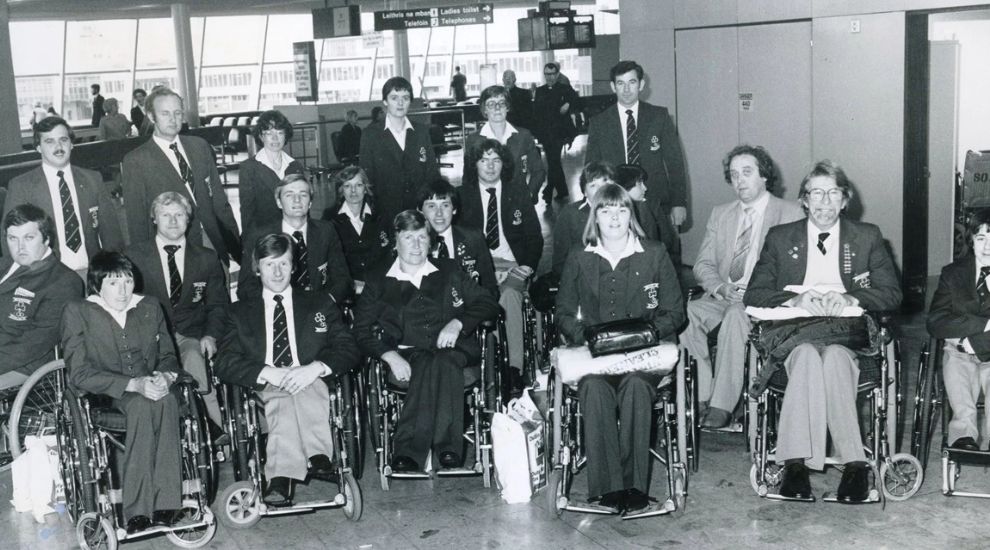
Among those honoured was Dr Oliver Murphy, the last living member of Ireland’s first Paralympic team, which competed at the 1960 Paralympic Games in Rome. After taking his award he had a conversation with fellow Paralympian and MC for the day, Ellen Keane, which was a lesson in sporting history.
Murphy represented Ireland at four Paralympic Games – Rome 1960, Tokyo 1964, Tel Aviv 1968 and Heidelberg 1972 – and played a pivotal role in establishing the foundations of disability sport in Ireland. Following the 1960 Games, he helped found the Irish Wheelchair Association alongside his teammates, creating an organisation that has since grown into a nationwide network supporting people with physical disabilities.
Reflecting on those early years, Murphy recalled how the idea of sport as rehabilitation emerged from the pioneering work of Sir Ludwig Guttmann, whose programmes at Stoke Mandeville Hospital in England helped spark the global Paralympic movement.
Ireland’s participation in the Rome Games required determination and improvisation. Travel difficulties meant the team’s flight was diverted to Switzerland before eventually reaching Italy, and facilities for wheelchair users were limited.
“We were young and active and wanted to get out,” Murphy said. “Sport was a challenge and a way forward. It was a game changer.”
Ireland’s early Paralympians were volunteers and pioneers in every sense. In the early days of disability sport in Ireland, Murphy and fellow advocates such as Father Leo Close, Jack Kerrigan and Joe Horne worked to establish structures that would allow athletes with disabilities to compete and thrive.
Their efforts led to the creation of the Irish Wheelchair Association in 1960, which began with a modest contribution of ten shillings from its founding members.
Today, Ireland is one of only 14 countries to have participated in every Paralympic Games since the movement began, a statistic highlighted during the event.
Sport Ireland CEO Dr Úna May praised the contribution of those early athletes and organisers, noting that many of their achievements predated the existence of the organisations that now support high-performance sport.
“None of those organisations existed before you were competing,” she said. “You were winning medals long before we ever existed.”
She also acknowledged the foresight of former Sport Ireland CEO John Treacy in ensuring that Paralympic athletes were included in the International Carding Scheme from its introduction in 1998, helping establish parity between Olympic and Paralympic sport in Ireland.
“The world of sport has moved on a lot, and Paralympic sport has moved on an awful lot,” May said. “You have all been a major part of that development and evolution.”
Two-time Paralympian and Chair of the Paralympics Ireland Athletes’ Commission Martin Gordon also addressed the gathering, describing the early athletes as pioneers who paved the way for the modern generation.
“In the military you have what are called pathfinder platoons – the people who go into the unknown first,” he said. “From the 1960s to the 1980s, you were our pathfinders.”
“We owe each and every one of you such a debt of gratitude for making our dreams possible.”
The event marked the beginning of a wider effort by Paralympics Ireland to document and preserve the history of the movement in Ireland. Organisers confirmed that work is under way to track down former athletes and contributors so their stories can be recorded ahead of future anniversaries.
The afternoon concluded with a celebration of the athletes whose performances and advocacy helped transform opportunities for people with disabilities in Ireland, and whose legacy continues to shape the future of Irish sport.
If you would like to be part of the Sport for Business community and see your organisation in our content, on our stages, and in the conversation happening every day around the commercial world of Irish Sport, email us today and let’s see what is possible.
Image Credit: Paralympics Ireland
ABOUT SPORT FOR BUSINESS
Sport for Business is Ireland’s leading platform focused on the commercial, strategic and societal impact of sport. It connects decision-makers across governing bodies, clubs, brands, agencies and public institutions through high-quality content, events and insight. Sport for Business explores how sport drives economic value, participation, inclusion and national identity, and how your story can be part of ours.
Through analysis, storytelling and convening the sector, it helps leaders understand trends, share best practice and make better-informed decisions. Its work positions sport not just as entertainment, but as a vital contributor to Ireland’s social and economic fabric.
Find out more about becoming a member today.
Or sign up for our twice-daily bulletins to get a flavour of the material we cover.
Sign up for our News Bulletins here.
Upcoming Events