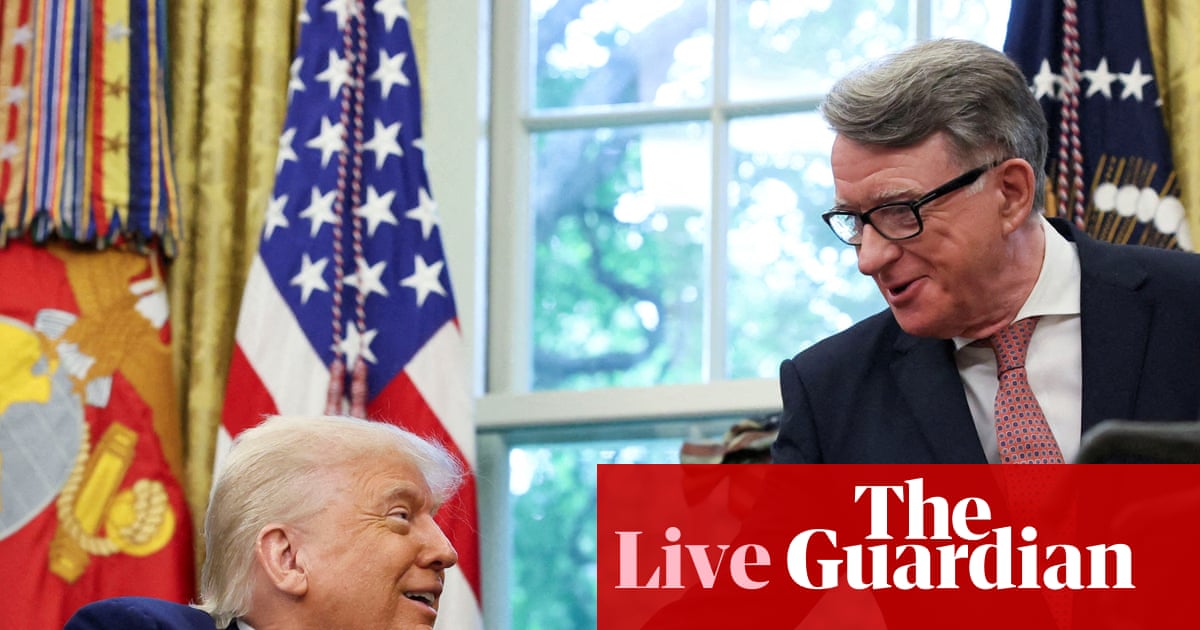
Middle East crisis live: three ships hit in strait of Hormuz as Iran calls US and allied vessels ‘legitimate targets’
Summary of today so far
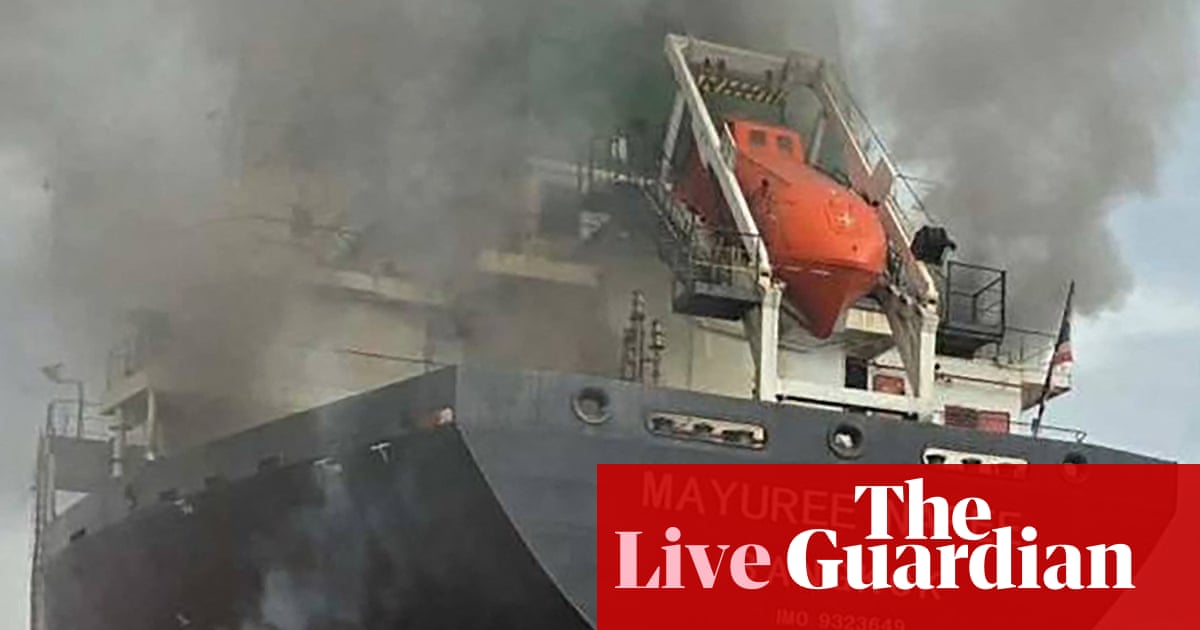
Three ships were hit by unknown projectiles in the strategic strait of Hormuz abutting Iran. Two of the ships sustained damage, while another, which the Thai navy identified as a Thai bulk carrier, caught fire, forcing the crew to evacuate.
Iran’s military on Wednesday said any ships belonging to the United States, Israel or their allies passing through the strategic strait of Hormuz could be targeted. “Any vessel whose oil cargo or the vessel itself belongs to the United States, the Zionist regime or their hostile allies will be considered legitimate targets,” said the military’s central operational command, Khatam Al-Anbiya, in a statement carried by state TV.
Iran’s new supreme leader, Mojtaba Khamenei, was injured in the 28 February attack that killed six of his family members, including his father, Tehran’s ambassador to Cyprus has confirmed. In an interview conducted at his embassy compound in Nicosia, Alireza Salarian elaborated on the circumstances in which Khamenei, 56, was injured, saying he was lucky to survive the strike, which levelled the late ayatollah’s residence.
The deadly strike on a primary school in Minab, Iran, that left at least 175 people, mostly children, dead was the result of an American missile attack, the New York Times reports. Outdated targeting data was the cause of the tragedy, with US bombs hitting the school complex which was previously part of a nearby Iranian military base, sources told the New York Times.
Iran has deployed about a dozen mines in the strait of Hormuz, two sources familiar with the matter said, in a move likely to complicate the reopening of the narrow waterway, an important route for shipping oil and liquefied natural gas. One source told Reuters that the locations of most of the mines are known but declined to say how the US planned to deal with them.
Israel pounded Lebanon with a new wave of attacks, setting an apartment block in central Beirut alight. Earlier strikes in southern Lebanon killed five people in the Nabatieh district and two in the Tyre district.
International Energy Agency has ordered the largest release of government oil reserves in its history in an effort to calm the oil price shock triggered by the US-Israeli attacks on Iran. All 32 members of the world’s energy watchdog agreed unanimously to release about 400m barrels of emergency crude, a third of the group’s total government stockpiles and more than double the IEA’s previous biggest release, the IEA said.
US forces have conducted airstrikes on more than 5,500 targets inside Iran, Admiral Brad Cooper, commander of US Central Command, said in a post on X. Cooper provided an update on Wednesday on US operations in the Middle East, in which he said US forces “continue delivering devastating combat power against the Iranian regime”.
Israeli defence minister Israel Katz said Wednesday that the joint bombing campaign with the US against Iran would go on “as long as necessary”, insisting the strikes had inflicted heavy casualties on Tehran’s forces. “This operation will continue without any time limit, as long as necessary, until we achieve all the objectives and decide the outcome of the campaign,” he said, adding that the Iranian leadership was fleeing “like mice into tunnels”.
ShareUpdated at 17.34 CETKey events27m agoSummary of today so far55m agoIran deploys a dozen mines to strait of Hormuz, sources say1h agoDeadly attack of Minab primary school was result of 'outdated' US intel, reports New York Times2h agoUK home secretary bans al-Quds Day march2h agoIEA orders largest ever release of stockpiled oil to reduce crude price3h agoReport: Trump says war with Iran will end 'soon'3h agoUS has hit 5,500 targets inside Iran, USCentcom says5h agoIran's military says ships belonging to US, Israel or allies are 'legitimate targets'5h agoToday so far5h agoKLM cancels all flights to Dubai until 28 March6h agoThai bulk carrier attacked in strait of Hormuz, Thai navy says7h agoDeath toll in Lebanon reaches 5707h agoWitkoff on Britain's support for US military action against Iran: 'too little too late'9h agoThe low-paid Filipino workers caught up in the war on Iran10h agoIran's new supreme leader safe despite injuries, president's son says10h agoSecond ship hit in Strait of Hormuz, crew evacuating - UK maritime agency11h agoIran launches wave of strikes, as Israel pounds Lebanon11h agoSouth Korea rattled by US's hasty redeployment of missiles to Middle East12h agoIran calls on regional countries and Muslims to reveal 'American-Zionist' hiding places12h agoIsraeli strike hits central Beirut - reports13h agoAustralia closes two embassies and consulate in Gulf13h agoDrone hits US diplomatic facility in Iraq15h agoIran launches missiles toward Israel15h agoDrone strikes US diplomatic facility in Iraq - reports15h agoUS destroys 16 Iranian mine-laying vessels near strait of Hormuz, military says15h agoProtesters will be treated as 'enemies' - Iran's police chief15h agoWelcome summaryShow key events onlyPlease turn on JavaScript to use this featureMore now from the French president Emmanuel Macron, who has said today that Iran’s military capabilities had been weakened but not “reduced to zero” in US and Israeli strikes.“Considerable damage has already been inflicted on Iran’s military ballistic capabilities, but it continues to attack several countries in the region, and therefore its capabilities have not been reduced to zero,” he said after a video call with G7 leaders.He added that he left it up to US president Donald Trump to “clarify both his ultimate objectives and the pace he wants to set for operations”.ShareSummary of today so far
Three ships were hit by unknown projectiles in the strategic strait of Hormuz abutting Iran. Two of the ships sustained damage, while another, which the Thai navy identified as a Thai bulk carrier, caught fire, forcing the crew to evacuate.
Iran’s military on Wednesday said any ships belonging to the United States, Israel or their allies passing through the strategic strait of Hormuz could be targeted. “Any vessel whose oil cargo or the vessel itself belongs to the United States, the Zionist regime or their hostile allies will be considered legitimate targets,” said the military’s central operational command, Khatam Al-Anbiya, in a statement carried by state TV.
Iran’s new supreme leader, Mojtaba Khamenei, was injured in the 28 February attack that killed six of his family members, including his father, Tehran’s ambassador to Cyprus has confirmed. In an interview conducted at his embassy compound in Nicosia, Alireza Salarian elaborated on the circumstances in which Khamenei, 56, was injured, saying he was lucky to survive the strike, which levelled the late ayatollah’s residence.
The deadly strike on a primary school in Minab, Iran, that left at least 175 people, mostly children, dead was the result of an American missile attack, the New York Times reports. Outdated targeting data was the cause of the tragedy, with US bombs hitting the school complex which was previously part of a nearby Iranian military base, sources told the New York Times.
Iran has deployed about a dozen mines in the strait of Hormuz, two sources familiar with the matter said, in a move likely to complicate the reopening of the narrow waterway, an important route for shipping oil and liquefied natural gas. One source told Reuters that the locations of most of the mines are known but declined to say how the US planned to deal with them.
Israel pounded Lebanon with a new wave of attacks, setting an apartment block in central Beirut alight. Earlier strikes in southern Lebanon killed five people in the Nabatieh district and two in the Tyre district.
International Energy Agency has ordered the largest release of government oil reserves in its history in an effort to calm the oil price shock triggered by the US-Israeli attacks on Iran. All 32 members of the world’s energy watchdog agreed unanimously to release about 400m barrels of emergency crude, a third of the group’s total government stockpiles and more than double the IEA’s previous biggest release, the IEA said.
US forces have conducted airstrikes on more than 5,500 targets inside Iran, Admiral Brad Cooper, commander of US Central Command, said in a post on X. Cooper provided an update on Wednesday on US operations in the Middle East, in which he said US forces “continue delivering devastating combat power against the Iranian regime”.
Israeli defence minister Israel Katz said Wednesday that the joint bombing campaign with the US against Iran would go on “as long as necessary”, insisting the strikes had inflicted heavy casualties on Tehran’s forces. “This operation will continue without any time limit, as long as necessary, until we achieve all the objectives and decide the outcome of the campaign,” he said, adding that the Iranian leadership was fleeing “like mice into tunnels”.
ShareUpdated at 17.34 CETIran deploys a dozen mines to strait of Hormuz, sources sayIran has deployed about a dozen mines in the strait of Hormuz, two sources familiar with the matter said, in a move likely to complicate the reopening of the narrow waterway, an important route for shipping oil and liquefied natural gas.One source told Reuters that the locations of most of the mines are known but declined to say how the US planned to deal with them. CNN first reported the mining of the strait on Tuesday.However, on Wednesday afternoon, French president Emmanuel Macron said there was “no confirmation” that Iran had deployed mines in straitShareUpdated at 17.12 CETHelena SmithIran’s ambassador to Cyprus, Alireza Salarian, has told the Guardian that he also thinks the US-led war will end soon but not because it is being won.“I don’t think it will go on for a long time because the US, even Israel, cannot afford this,” he said.“They have had to bring all this military equipment to the region. How long, realistically, can they stay? Soon they will need more support from headquarters. They predicted [the war taking] three or four weeks, then Mr Trump said two weeks ... every day, they say something new.”He described the US president as a diplomatic “phenomenon”, adding:
double quotation markI don’t know what to say, a special man who does not believe in the rule of law, something new in this world.
The envoy said 1,400 of Iran’s citizens had been killed by the aerial strikes and the “number is rising every day.”Asked if Tehran had a strategy to exit the conflict, he was unequivocal.He said: “To Trump’s unconditional surrender, we say resistance, unconditional resistance. There is no other option.”Estimating that the death toll from the war in Iran had reached 1,400 by Tuesday, Salarian said Tehran, a city of 14 million, had been emptied of “around half of its population”, with people fleeing to other cities as a result of the bombardment.The attacks had not only taken the country’s political and diplomatic elite by surprise – despite the military buildup in the region – but proved, he said, that unlike his predecessors, Trump did not believe in the rule of law or abide by it.ShareUpdated at 16.52 CETDeadly attack of Minab primary school was result of 'outdated' US intel, reports New York TimesThe deadly strike on a primary school in Minab, Iran, that left at least 175 people, mostly children, dead was the result of an American missile attack, the New York Times reports.Outdated targeting data was the cause of the tragedy, with US bombs hitting the school complex which was previously part of a nearby Iranian military base, sources told the New York Times.The strike is the worst mass killing of the US and Israel’s war on Iran so far – and has been described by Unesco as a “grave violation” of international law. Most of the deaths were girls aged between seven and 12.US Central Command created the target coordinates using data provided by the Defense Intelligence Agency, the New York Times reported. It added that the findings were preliminary and that questions still remain over why the outdated data was not double-checked.On Saturday, the US president, Donald Trump, declared that Iran was responsible for the attack.He said: “In my opinion, based on what I’ve seen, that was done by Iran … they’re very inaccurate, as you know, with their munitions. They have no accuracy whatsoever. It was done by Iran.”The president presented no evidence for his claim. His assertion has not been repeated by spokespeople for the US military, who have said only that they are “investigating” the bombing.For more on this, follow our US politics live blog. My colleague Shrai Popat has the latest here:ShareUpdated at 16.52 CETIraq’s prime minister Mohammed Shia al-Sudani told Iranian president Masoud Pezeshkian on Wednesday that attacks targeting Iraq were unacceptable.He told Pezeshkian that the attacks undermined efforts to end the war and return to dialogue, according to a statement by the prime minister’s office.Iraq has been among a number of countries in the region targeted by Iran in response to US and Israeli strikes.ShareUK home secretary bans al-Quds Day marchAamna MohdinOn Sunday, thousands of demonstrators were expected to march through London for al-Quds Day, an annual demonstration in support of Palestinian rights. But the march, which has taken place in the UK for more than 40 years, has been banned by home secretary, Shabana Mahmood.Announcing her decision to ban the march after a request by the Metropolitan police, Mahmood said she was “satisfied doing so is necessary to prevent serious public disorder, due to the scale of the protest and multiple counterprotests, in the context of the ongoing conflict in the Middle East”.It is the first time a protest march has been banned since 2012.More here:ShareIEA orders largest ever release of stockpiled oil to reduce crude priceThe Guardian’s Jillian Ambrose and Joanna Partridge report that International Energy Agency has ordered the largest release of government oil reserves in its history in an effort to calm the oil price shock triggered by the US-Israeli attacks on Iran.All 32 members of the world’s energy watchdog agreed unanimously to release about 400m barrels of emergency crude, a third of the group’s total government stockpiles and more than double the IEA’s previous biggest release, the IEA said.Follow along with our live coverage here.ShareReport: Trump says war with Iran will end 'soon'In a five-minute interview with Axios on Wednesday, Donald Trump said that the war with Iran will end “soon” because there is “practically nothing left to target”.“Any time I want it to end, it will end,” Trump said.The US president later said that the war “is going great”.“The war is going great,” Trump said. “We are way ahead of the timetable. We have done more damage than we thought possible, even in the original six-week period.”ShareUpdated at 15.46 CETUS has hit 5,500 targets inside Iran, USCentcom saysUS forces have conducted airstrikes on more than 5,500 targets inside Iran, Admiral Brad Cooper, commander of US Central Command, said in a post on X.Cooper provided an update on Wednesday on US operations in the Middle East, in which he said US forces “continue delivering devastating combat power against the Iranian regime”.“I’ve said this before but it bears repeating: US combat power is building. Iranian combat power is declining,” Cooper said. “We remain centreed on very clear military objectives and eliminating Iran’s ability to project power against Americans and against its neighbours.”Cooper noted that on Tuesday, US conducted strike waves nearly every hour. He characterised the strikes as “unpredictable, dynamic and decisive” and made a point to say that the US military is not just “defending against Iranian threats”. “We are methodically dismantling them,” he said.At one point, a US strike knocked out a large ballistic missile manufacturing facility in Iran, Cooper said.“It’s not just about what is shooting at us today,” Cooper said. “It’s also about eliminating the threat in the future.”Share