ASEAN Weekly Disaster Update Week 10 | 2 – 8 March 2026
REGIONAL SUMMARY:
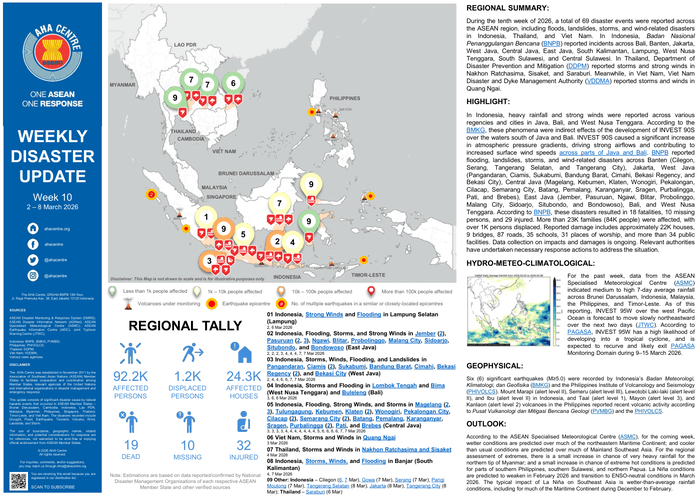
During the tenth week of 2026, a total of 69 disaster events were reported across the ASEAN region, including floods, landslides, storms, and wind-related disasters in Indonesia, Thailand, and Viet Nam. In Indonesia, Badan Nasional Penanggulangan Bencana (BNPB) reported incidents across Bali, Banten, Jakarta, West Java, Central Java, East Java, South Kalimantan, Lampung, West Nusa Tenggara, South Sulawesi, and Central Sulawesi. In Thailand, Department of Disaster Prevention and Mitigation (DDPM) reported storms and strong winds in Nakhon Ratchasima, Sisaket, and Saraburi. Meanwhile, in Viet Nam, Viet Nam Disaster and Dyke Management Authority (VDDMA) reported storms and winds in Quang Ngai.
HIGHLIGHT:
In Indonesia, heavy rainfall and strong winds were reported across various regencies and cities in Java, Bali, and West Nusa Tenggara. According to the BMKG, these phenomena were indirect effects of the development of INVEST 90S over the waters south of Java and Bali. INVEST 90S caused a significant increase in atmospheric pressure gradients, driving strong airflows and contributing to increased surface wind speeds across parts of Java and Bali. BNPB reported flooding, landslides, storms, and wind-related disasters across Banten (Cilegon, Serang, Tangerang Selatan, and Tangerang City), Jakarta, West Java (Pangandaran, Ciamis, Sukabumi, Bandung Barat, Cimahi, Bekasi Regency, and Bekasi City), Central Java (Magelang, Kebumen, Klaten, Wonogiri, Pekalongan, Cilacap, Semarang City, Batang, Pemalang, Karanganyar, Sragen, Purbalingga, Pati, and Brebes), East Java (Jember, Pasuruan, Ngawi, Blitar, Probolinggo, Malang City, Sidoarjo, Situbondo, and Bondowoso), Bali, and West Nusa Tenggara. According to BNPB, these disasters resulted in 18 fatalities, 10 missing persons, and 29 injured. More than 23K families (84K people) were affected, with over 1K persons displaced. Reported damage includes approximately 22K houses, 9 bridges, 87 roads, 35 schools, 31 places of worship, and more than 34 public facilities. Data collection on impacts and damages is ongoing. Relevant authorities have undertaken necessary response actions to address the situation.
HYDRO-METEO-CLIMATOLOGICAL:
For the past week, data from the ASEAN Specialised Meteorological Centre (ASMC) indicated medium to high 7-day average rainfall across Brunei Darussalam, Indonesia, Malaysia, the Philippines, and Timor-Leste. As of this reporting, INVEST 95W over the west Pacific Ocean is forecast to move slowly northeastward over the next two days (JTWC). According to PAGASA, INVEST 95W has a high likelihood of developing into a tropical cyclone, and is expected to recurve and likely exit PAGASA Monitoring Domain during 9–15 March 2026.
GEOPHYSICAL:
Six (6) significant earthquakes (M>5.0) were recorded by Indonesia’s Badan Meteorologi, Klimatologi, dan Geofisika (BMKG) and the Philippines Institute of Volcanology and Seismology (PHIVOLCS). Mount Marapi (alert level II), Semeru (alert level III), Lewotobi Laki-laki (alert level II), and Ibu (alert level II) in Indonesia, and Taal (alert level 1), Mayon (alert level 3), and Kanlaon (alert level 2) volcanoes in the Philippines reported recent volcanic activity according to Pusat Vulkanologi dan Mitigasi Bencana Geologi (PVMBG) and the PHIVOLCS.
OUTLOOK:
According to the ASEAN Specialised Meteorological Centre (ASMC), for the coming week, wetter conditions are predicted over much of the northeastern Maritime Continent; and cooler than usual conditions are predicted over much of Mainland Southeast Asia. For the regional assessment of extremes, there is a small increase in chance of very heavy rainfall for the northern tip of Myanmar; and a small increase in chance of extreme hot conditions is predicted for parts of southern Philippines, southern Sulawesi, and northern Papua. La Niña conditions are predicted to weaken in February 2026 and transition to ENSO-neutral conditions in March 2026. The typical impact of La Niña on Southeast Asia is wetter-than-average rainfall conditions, including for much of the Maritime Continent during December to February.
Sources:
ASEAN Disaster Monitoring & Response System (DMRS); ASEAN Disaster Information Network (ADINet); ASEAN Specialised Meteorological Centre (ASMC); ASEAN Earthquake Information Centre (AEIC); Joint Typhoon Warning Centre (JTWC);
Indonesia: BNPB, BMKG, PVMBG;
Philippines: PHIVOLCS;
Thailand: DDPM;
Viet Nam: VDDMA;
Various news agencies.