Inside the Dublin City Arts Office: ‘We meet property developers all the time now’
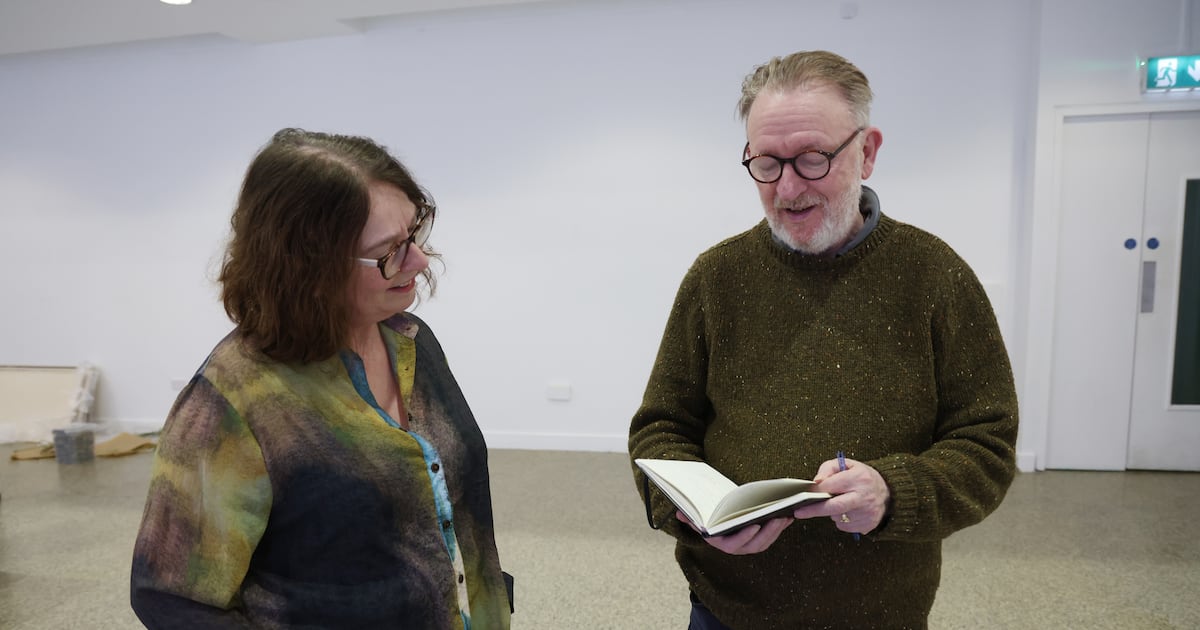
Inside a Dublin City Council office on Foley Street, a list laid out on a conference table identifies 17 districts for development and rejuvenation. These “strategic development regeneration areas” stretch from Clongriffin in the east of the city, to Naas Road in the west, and from Ballymun in the north, to Dolphin House in the south. “We were in Finglas yesterday,” says Ray Yeates. “It’s such a huge part of the city that’s going to have another 20,000 people living in it. Nobody is saying where will they go at night.” Yeates heads the council’s arts office, which is tasked with developing a thriving creative ecosystem for Dublin. Part of its work lies somewhere between art appreciation and matchmaking, brokering relationships between property developers and arts organisations, trying to secure space for community and creative use within developments. It has become a regular aspect of the job. “We meet property developers all the time now,” he says. In a period of rapid development that has seen closures of art workspaces and venues, the office has assembled an artist workspace registry, which currently has 79 entries, from a mix of early-career and long-established collectives and organisations that are seeking to rent, to lease and manage, or to purchase.READ MORE‘Most people are thinking about themselves’: Inspiring women share their life lessonsRay D’Arcy: ‘I’ve lost my job and my mother. What’s going to happen next?’Cillian Murphy: ‘It was one of the greatest weeks of my life. I haven’t talked about it much’ An Irishwoman in France: The absence of urgency is the most striking aspect of living here“We wanted to see if we could be in a position to give developers information about what people were actively looking for,” explains Sinéad Connolly, an assistant arts officer. “The majority of people who applied come from studio arts, so anything that requires small personal or group space, maybe working space for one to three people. That includes music, visual arts, design.“In terms of the performing arts, there’s been a bigger loss in terms of venues. They’re harder to re-create when they go, because they’re more expensive to get going,” says Connolly. She and Yeates are both veterans of the theatre industry. Connolly’s CV in production and stage management in the 1990s includes True Lines, John Crowley’s sensation about exiled youth during the infancy of the Celtic Tiger, at the City Arts Centre. Yeates was a breakout director in the 1980s; he staged plays by the unflinching German playwright Franz Xaver Kroetz at Andrew’s Lane Theatre. Neither venue exists any more.“Our job is to ‘opportunity-make’ a space,” says Yeates, whose appreciation for art isn’t always shared by developers who the council’s planning department refers to him. “A lot of people think cultural development shouldn’t exist. There should be housing development, factory development and office development. But culture? What is that?”Part of Yeates’s work sounds psychological, trying to enter the mindset of someone who’s yet to see the value in cultural infrastructure. “How do you relate? Sometimes it is asking, ‘Do any of your kids play music?’ We try to find a way in like that, to make the arts look like they’re just part of life.” Sinéad Connolly and Ray Yeates in The LAB, Foley Street, Dublin. Negotiating for property involves 'a different skill set than making art', says Yeates. Photograph: Bryan O’Brien That doesn’t sound unlike a case that artists have long been burdened with making for the value of what they do. “It’s hard to wind it back to something that isn’t economic. How do we talk about the thing that’s going to place-make and add value? It’s not different to talking about the arts in general. It’s just that now you’re talking about it in property,” he says.In the opposite camp, Yeates and Connolly liaise with artist organisations to try to find a good match for a potential development, separating those with financial means to contemplate renting permanently from those looking for something temporary, and encouraging some reluctant to move outside the centre. (“It’s harder for them to imagine moving to northwest of the city where there’s massive underprovision culturally,” says Connolly.) For many of them, this is unfamiliar territory. “A theatre company is not a capital developer. It does plays. Now it’s being asked to negotiate for property,” says Yeates. “It’s a different skill set than making art. It’s my experience [that] visual artists are much better at property than any other art form. They understand leases, licences. They negotiate strongly.”Developers may wince at the balance sheets of arts organisations that operate with inadequate funding to plan long term. “In one case they brought the Arts Council, who said, ‘We fund that company, so they’re able to afford the rent,’” says Yeates. “This is a great role for the State to step in and say, ‘We’re the backstop.’”Then he describes a “strange” stage in the process when initial anxieties about expense can begin to vanish. A potential tenant is lined up, and the vision comes closer to reality. “There’s a mysterious part of it where we flip from ‘How much is this going to cost?’ to ‘This is very important,’” says Yeates. “There’s something like a recording studio behind the building and they start feeling good about it.“It’s the implementation of the 5 per cent policy we’re at now, not the provision,” he says, referring to a plan that the council introduced in 2022, under which any proposed development within a strategic development regeneration area that exceeded 10,000sq m was now required to deliver 5 per cent of its floor space to “community, arts and culture”. A crucial stage of the process is the fit-out, and who should incur the cost, as commercial residents like Tesco and Lidl have long been expected to foot the bill for converting core-and-shell units. “We are evolving the models to make this work,” says Connolly. “In some instances, the developer is taking on the fit-out. In other instances, they’re not, or they can’t.“No more than the arts sector is a homogenous group, developers aren’t a homogenous group either,” she says. “Some would be interested in the idea of culture in terms of place-making and their ambition for the look and feel and integration of their space in the city. That’s probably more the case if the developer is sustaining an interest in the space rather than turning it over and selling it quickly to make a profit and move on to their next development.”Artist Alan Mongey and then minister for culture and the arts Catherine Martin at the announcement of funding to deliver artist workspaces nationwide, in Artane Place Artist Workspaces, in 2024. Photograph: Dara Mac Dónaill Over 2022 and 2023 Dublin City Council approved the roll-out of a new retail park development by Xestra, the asset-management company run by Antoine Xavier, on the site of the former Stardust nightclub in Artane, in north Dublin. Located between chain stores are three vacant office units since converted into 12 artist studios. The arts office co-ordinated an open call for applicants. The studios opened in 2024, being let to artists from visual arts, theatre and dance. In 2019 Dublin City Council approved a new office development by Iput, the property company led by Niall Gaffney, situated at Wilton Park, on the bank of the Grand Canal. The corner of one building, according to architectural drawings, was envisaged as a ground-floor cafe and bookshop – to house a new version of Parsons, the bookshop that was a landmark on Baggot Street for 40 years – with offices on the floor above. As the building sat empty, that section became three rent-free studios for visual artists, with their own entrance. The Royal Hibernian Academy – “We do advise developers to engage individuals and companies with cultural expertise,” says Connolly – was brought on board as partner to select the inhabitants (whose biographies and work are displayed on digital screens at street level). Wilton Park Studios, Dublin. Photograph: Chris McCormack Following an announcement that EY is to move into the remainder of the building, Iput confirmed that the artist studios are permanent. On the opposite side of the site, the company refurbished a Georgian apartment into another workspace, for a writer-in-residence, selected each year by the novelist Colm Tóibín. According to planning applications for the two developments, neither was subject to the 5 per cent rule. After the Department of Housing announced new design standards for apartments last July that scrapped the need for communal spaces, a Dublin City Council position document confirmed that the standards supersede the council’s development plan. Its 5 per cent policy now excludes proposals for new apartment developments.Imaginably, Yeates and Connolly will be working with developers arm-twisted into supplying cultural infrastructure. Yeates says they are having conversations across 30 sites, all at different stages, from pre-application to developments granted planning. When we speak, his focus is on developments in East Wall, where he believes that the focus is about to change from “How much is this going to cost?” to “This is very important.”“For the first time there is aspiration to have cultural infrastructure that’s a shared aspiration by the public, by elected officials, by city officials,” he says. “They did the policy. Now it has to be implemented.”