NASA changed an asteroid's orbit around the sun for the first time
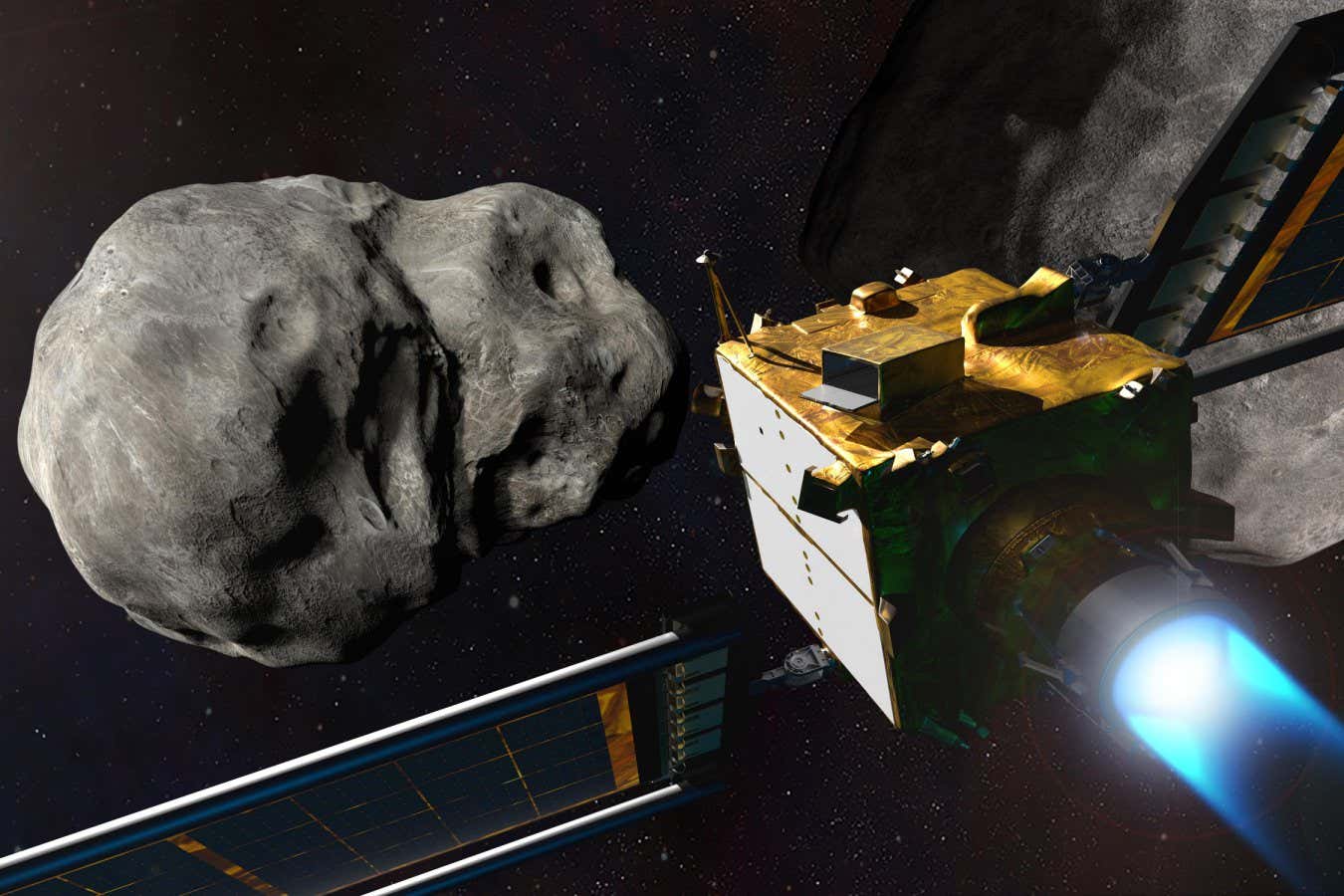
NASA gave the Didymos system a nudgeSteve Gribben/Johns Hopkins APL/NASA
Humanity has shifted an asteroid’s orbit around the sun for the first time. This was achieved by NASA’s Double Asteroid Redirection Test (DART) mission in 2022, but the effect has only now been measured.
DART’s target was a small asteroid called Dimorphos, which orbits a larger one called Didymos. The spacecraft crashed into the smaller rock in an effort to shift its orbit around the larger one, testing whether this method, called a kinetic impactor, would be an effective way to change an asteroid’s trajectory if it were heading towards Earth and send it careening past safely.
The mission was a smashing success, shortening the length of Dimorphos’s orbit by 32 minutes. In the years since then, astronomers have continued to watch the system, and with nearly 6000 observations, they have been able to calculate the change in the pair’s overall orbit around the sun: it has slowed down by 11.7 micrometres per second, or around 40 millimetres per hour. That is expected to decrease the radius of its orbit by about 360 metres.
“It doesn’t sound like a lot, but the whole idea behind these kinetic impacts is that if you do one early enough, a small impact makes a large change in the overall position,” says Rahil Makadia at the University of Illinois Urbana-Champaign, part of the team monitoring the asteroids’ orbits. “It’s a very tiny number, but if you let it accumulate over decades, then it can grow into a big one.”
The slowdown had two causes: the initial impact by the spacecraft and an additional push from the jet of debris sent up from Dimorphos’s surface in the aftermath. Makadia and his colleagues calculated that the two effects were about equal to one another, which in turn allowed them to calculate the masses and densities of the asteroids. Dimorphos is about half as dense as Didymos, which adds credence to the idea that it is a so-called rubble pile that formed from material flung off of Didymos due to its rotation.
All of this information will prove useful should we ever need to deflect a hazardous asteroid for real. “We now have one solid anchoring point to predict any future kinetic impact missions,” says Makadia. And the European Space Agency’s Hera spacecraft, which is on its way towards Didymos and is expected to arrive in November, should give us even more precise measurements that will guide any future attempts to protect Earth from incoming asteroids.
Topics: