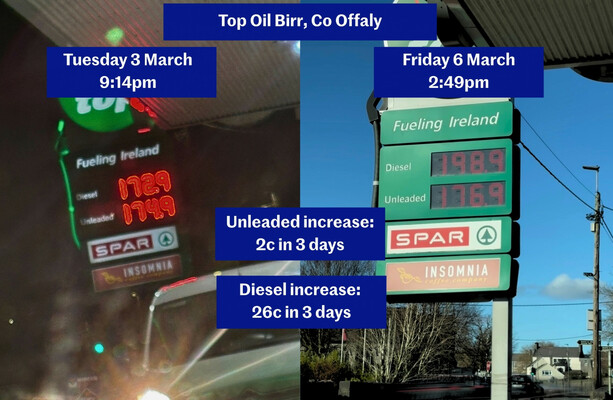
Photos show how prices at filling stations across Ireland have jumped in the past three days
NEW FIGURES SHOW just how big the jump in petrol prices has been this week, with diesel prices jumping by up to 26c per litre in just three days, The Journal has found.
However, a former forecourt owner has condemned government ministers for questioning whether forecourts are engaging in ‘price gouging’.
He said that distributors are changing their prices “twice a day” at the moment, which is badly impacting filling stations. “It’s a lunatic situation,” he said.
A representative for filling stations said that some forecourt operators are “actually losing money” on the fuel they’re selling right now.
In the six days since war in Iran began last Saturday, there has been a huge global increase in fuel and energy prices, but the government has said consumers shouldn’t be seeing a price hike at the forecourts.
The Journal found prices jumped at every filling station it examined by between 3c and 26c per litre of diesel over the past three days. This does not include any jump in prices that took place in the days before that, after the war broke out on Saturday.
The price of diesel now varies significantly between 179c and 198c per litre depending on the filling station.
Diesel increased by 26 cents per litre at Top Oil in Birr, Co Offaly between Tuesday night and Friday afternoon, where it is currently 198c.
The Journal
The Journal
Applegreen in Birr, Co Offaly, saw diesel increase by 15 cents in the same three days, from 174c on Tuesday night to 189c on Friday afternoon.
The Journal
The Journal
At a Maxol station in Leixlip, Co Kildare, the price of diesel increased by 13 cents per litre over three days, currently standing at 183c on Friday afternoon.
The Journal
The Journal
Circle K/Corrib Oil in Birr, Co Offaly, increased diesel prices by 6 cents per litre between Tuesday and Friday, from 179c to 185.
The Journal
The Journal
While all the forecourts The Journal examined saw price increases, some were smaller.
Applegreen in Ballincollig, Co Cork and Top Oil in Rush, Co Dublin both saw prices rise from 176c per litre to 179c per litre for diesel, a rise of 3 cents in three days.
The Journal
The Journal
The Journal
The Journal
Tánaiste Simon Harris has urged people to send examples of anything they believe to be ‘price gouging’ to the state competition watchdog, the Competition and Consumer Protection Commission (CCPC) , which is investigating complaints into the price increases.
The Journal contacted filling station companies for comment. A spokesperson for Maxol said that the company understood that “rising fuel prices are frustrating for customers”. They noted that the conflict in the Middle East is “changing rapidly” and fuel markets are “struggling to keep pace”.
“Maxol does not hold any reserves of petrol or diesel, and any change in pricing depends on current stock levels at individual service stations and the timing of incoming deliveries,” they said. “The timing and magnitude of any price changes also depend on the underlying commodity cost of the product.”
The company is ”continuously reviewing our prices and working closely with our suppliers to minimise the impact of these changes,” they said.
‘Micheál Martin hasn’t a clue what he’s talking about’
Vincent Jennings, CEO of the Convenience Stores and Newsagents Association and former forecourt owner, was strongly critical of comments made by Taoiseach Micheál Martin earlier this week, who said there was “no excuse” for prices going up at the pumps.
“Our oil is coming from the North Sea, and we don’t want any price gouging going on,” Martin told reporters.
Speaking to The Journal, Jennings said: “The man never worked behind a shop counter in his life. He hasn’t a clue what he’s talking about.”
Taoiseach Micheál Martin Sasko Lazarov / RollingNews.ie
Sasko Lazarov / RollingNews.ie / RollingNews.ie
Jennings said that although Ireland sources oil from the North Sea, the war impacts the international oil price, called the Platts index, on a daily basis.
Traffic through the Strait of Hormuz, through which around 20% of the world’s oil supply passes, has been badly impacted, sparking fears of shortages and sending prices soaring to levels not seen in nearly two years.
His comments were echoed by Fuels for Ireland CEO Kevin McPartland, who told RTÉ’s News at One today that the price of oil in Ireland is actually “slightly behind” the price increases of the Platts index.
“[It's] far from profiteering,” he said, adding that some forecourt operators and oil distributors are “actually losing money on the fuel that they’re selling currently”.
‘Not victimless’
Jennings said that the comments made by government ministers are “not victimless”. He said filling station owners and staff are getting verbal abuse every day at work over the prices of fuel.
“Nobody wants to go to work to be abused,” he said, adding that there is a feeling of anger among filling station owners and staff over the comments.
Minister for Enterprise Peter Burke today condemned abuse directed at staff.
“It was brought to my attention that retail workers have come under significant abuse in recent days; I want to make it clear that this behaviour is unacceptable and no one should be taking their frustration out on any retail worker,” he said.
He met with representatives from the fuel industry today to discuss the current energy market and pricing structures.
He said he highlighted the current CCPC investigation and providers expressed that they are “more than happy to cooperate fully, and will encourage their members to do the same”.
‘Don’t shoot first’
Jennings said the pricing situation is not clear-cut as the government may believe.
“They don’t know what they’re talking about,” he said. “I would have thought ‘don’t shoot first’, but that seems to be what’s happening.”
He explained that forecourt owners order fuel in bulk amounts from wholesalers who set the price. Forecourts usually only have three days before they have to pay for the fuel, which, as Jennings noted, it unlikely to be enough time to sell all the fuel.
This means owners are faced with bills for a product before they have sold it, which can impact the price they have to charge for it.
“I understand it might seem hasty but only they know what’s in their bank balance,” he said. He said that short of showing their account books and bank statements there is little fuel providers can do to defend themselves.
On top of this, he said distributors are now changing their oil prices twice a day.
“It’s a lunatic situation,” he said, adding that this means forecourt owners don’t know what price oil will be by the time the load they ordered arrives in their tanks.
“You can order a load for Monday and it will change four times by then,” he said.
The president of the Irish Farmers Association (IFA) today called on the government to suspend the carbon tax on fuel for farmers, agricultural contractors and the wider economy who require diesel to power farm machinery.
Between 60% and 65% of the cost of motor fuel is tax. The highest tax is excise, which is a fixed amount which is charged per litre and hence does not change as the price fluctuates. Carbon tax is effectively the same although it is calculated per ton of CO2 generated.
When asked about calls to reduce the tax, Jennings was critical of the taxation rate.
“The State is doing very little to nothing to earn that,” he said. “The petrol disruptor takes all the risk, the State takes none but gets a lot of profit.”
The Department of Finance and the Department of An Taoiseach have been contacted for comment.
Design: Cliodhna Travers
Additional reporting: Christine Bohan
Readers like you are keeping these stories free for everyone...
A mix of advertising and supporting contributions helps keep paywalls away from valuable information like this article.
Over 5,000 readers like you have already stepped up and support us with a monthly payment or a once-off donation.