Global warming has accelerated 'significantly' since 2015, study reveals - as scientists call for urgent action to curb CO2 emissions
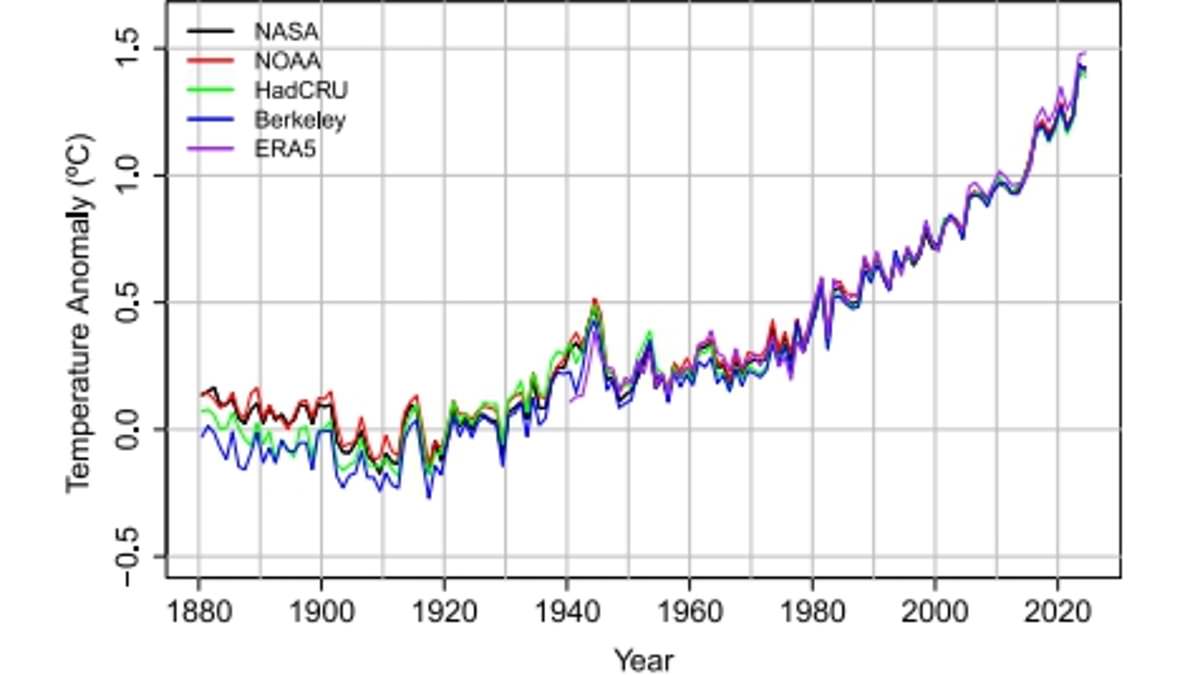
Global warming has accelerated 'significantly' since 2015, a new study has revealed. Researchers from the Potsdam Institute for Climate Impact Research used five large global temperature datasets to understand how warming has changed through the years. Their results show that from 1970 to 2015, Earth warmed at a rate of just under 0.2°C (0.36°F) per decade. However, over the past 10 years, this rate has jumped to around 0.35°C (0.63°F) per decade. This is higher than any previous decade since recording began in 1880. According to the researchers, the only way to slow global warming is to take urgent action to curb CO2 emissions. 'If the warming rate of the past 10 years continues, it would lead to a long–term exceedance of the 1.5°C limit of the Paris Agreement before 2030,' warned Stefan Rahmstorf, lead author of the study. 'How quickly the Earth continues to warm ultimately depends on how rapidly we reduce global CO2 emissions from fossil fuels to zero.' Researchers from the Potsdam Institute for Climate Impact Research used five large global temperature datasets to understand how warming has changed through the years. Their results show that from 1970 to 2015, Earth warmed at a rate of just under 0.2°C (0.36°F) per decadeWhile several previous studies have estimated the long–term rate of global warming, most have failed to account for natural influences. This includes things like El Nino (a complex weather pattern resulting from variations in ocean temperatures in the Equatorial Pacific), volcanic eruptions, and solar cycles. To get to the bottom of it, the researchers compiled measurement data from five large, established global temperature datasets – NASA, NOAA, HadCRUT, Berkeley Earth, and ERA5. 'We filter out known natural influences in the observational data, so that the "noise" is reduced, making the underlying long–term warming signal more clearly visible,' explained Grant Foster, co–author of the study. Their analysis revealed a significant acceleration of global warming over the last 10 years.In all the datasets, the acceleration began to become apparent in 2013 or 2014, while 2023 and 2024 were the two hottest years ever recorded. 'The adjusted data show an acceleration of global warming since 2015 with a statistical certainty of over 98 percent, consistent across all data sets examined and independent of the analysis method chosen,' said Professor Rahmstorf.The study did not investigate the specific causes of the acceleration. In all the datasets, the acceleration began to become apparent in 2013 or 2014, while 2023 and 2024 were the two hottest years ever recordedHowever, the researchers say that global warming will only stop 'around the time humanity reaches zero CO2 emissions'. Writing in their study, published in Geophysical Research Letters, they explained: 'Stopping this trend is in our hands: studies show that global warming will stop around the time humanity reaches zero CO2 emissions, but it can hardly be reversed.'In the current political climate, however, it is quite possible that warming may continue its fast pace or even accelerate further. 'This much is clear: if the warming rate of the past 10 years continues, the Paris Agreement 1.5°C warming limit will be breached by ∼2030.'THE PARIS AGREEMENT: A GLOBAL ACCORD TO LIMIT TEMPERATURE RISES THROUGH CARBON EMISSION REDUCTION TARGETSThe Paris Agreement, which was first signed in 2015, is an international agreement to control and limit climate change.It hopes to hold the increase in the global average temperature to below 2°C (3.6ºF) 'and to pursue efforts to limit the temperature increase to 1.5°C (2.7°F)'.It seems the more ambitious goal of restricting global warming to 1.5°C (2.7°F) may be more important than ever, according to previous research which claims 25 per cent of the world could see a significant increase in drier conditions. The Paris Agreement on Climate Change has four main goals with regards to reducing emissions:1) A long-term goal of keeping the increase in global average temperature to well below 2°C above pre-industrial levels2) To aim to limit the increase to 1.5°C, since this would significantly reduce risks and the impacts of climate change3) Governments agreed on the need for global emissions to peak as soon as possible, recognising that this will take longer for developing countries4) To undertake rapid reductions thereafter in accordance with the best available scienceSource: European Commission