Breitbart Business Digest: The Trump Economy Worked, the Fed Study Didn't, Happy Valentine's Day Anyway
Weekly Wrap: We Did Some Commerce, Prices Were Low, and Everyone Was Working
Welcome back to Friday. This is the Valentine’s Day-President’s Day-Friday the 13th edition of the Breitbart Business Digest weekly wrap-up. It’s mostly a love letter to the U.S. economy, with just a touch of horror movie action and a dash of presidential history combined with Valentine’s Day gifts.
This week, the co-authors of Breitbart Business Digest celebrated Jobs Wednesday with Commerce Secretary Howard Lutnick, the ghost of Bidenflation was exorcised from the economy, and the Federal Reserve Bank of New York was kind enough to revive a tariff study we debunked seven years ago.
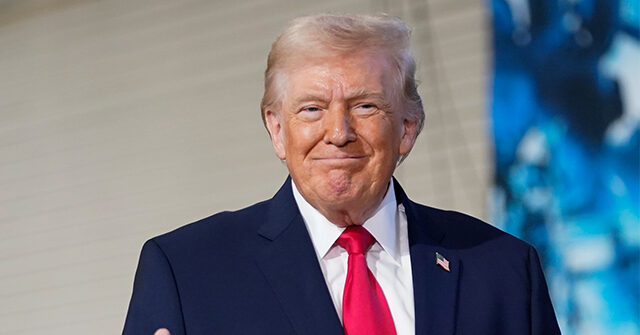
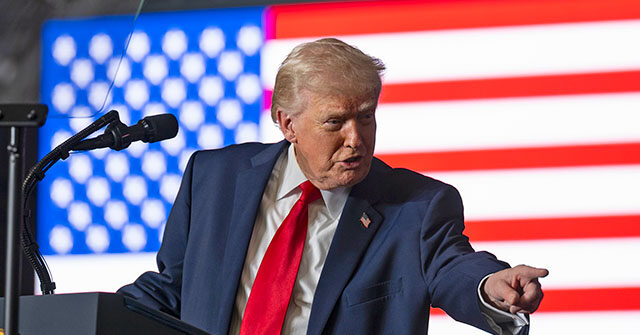
President Donald Trump visits the Fort Bragg U.S. Army base on February 13, 2026, in Fort Bragg, North Carolina. (Nathan Howard/Getty Images)
Putting Bidenflation into Its Grave
The consumer price index (CPI) climbed just 0.2 percent in January, less than the 0.3 percent forecast by analysts who are still convinced that tariffs are going to start pushing up prices any day now. That works out to an annualized rate of 2.1 percent. Compared with a year ago, consumer prices are up 2.4 percent. Core inflation climbed 0.3 percent and is up just 2.5 percent, the lowest core rate since March of 2021.
In other words, core inflation is back down to where it was before the catastrophe engineered by President Joe Biden’s reckless, far-left spending and Fed Chief Jerome Powell’s decision to monetize it. The U.S. economy is finally healing from the damage done by the ersatz 2020 election and the wildly destructive Democratic DEI-Climate Change-Social Engineering campaign against America that followed.
Goods prices fell 0.2 percent, and over the past 12 months they are up just one percent. Even if we take out energy and food, goods prices were flat for the month and are up just 1.1 percent from a year ago. The prices of major appliances—a heavily tariffed category—fell 0.7 percent for the month and are up just two percent from a year ago. So much for the idea that tariffs would squeeze the U.S. consumer by pushing up the prices of goods.
“In the movie the Social Network, there is a scene where Zuck says, ‘if you guys were the inventors of Facebook, you would have invented Facebook!’ It is sort of like that for tariffs. If tariffs were going to create inflation, they’d create inflation,” Renaissance Macro’s Neil Dutta wrote in a client note on Friday.
Our favorite measures of underlying inflation also hit the lowest year-over-year rates since 2021. The Cleveland Fed’s median CPI and 16 percent trimmed mean CPI each rose 0.2 percent for the month, down from December. For the year, median CPI is up 2.97 percent, the lowest reading since September 2021. Sixteen percent trimmed mean, which chops off the top eight percent of rising prices and the bottom eight percent of falling prices, came in at 2.72 percent, the lowest since May of 2021.
If you’ll excuse a little toldjaso bragging: we told you this was coming. When the January retail sales numbers were published at the start of this week, we pointed out that they augured for a low inflation print:
A flat December month-to-month print has tended to line up with cooling inflation more often than reheating. Looking back at every year since 2000, and focusing on years when December retail sales were flat, nearly flat, or down on a seasonally adjusted basis (excluding 2008 and 2020 for obvious reasons), headline CPI inflation in the following calendar year ran hotter than the prior year only twice. In years when December retail sales posted more than a rounding-error gain, inflation accelerated nine times. The signal is stronger in goods: goods inflation accelerated only twice after a flat or down December, versus ten times when December retail sales were firmer.
The mechanism is plain. Weak year-end demand usually means limited pricing power as the new year begins. January markdowns deepen, inventory plans get trimmed, and retailers compete harder to move goods. That pressure shows up in goods prices first, and it often bleeds into the broader inflation picture as the year unfolds.
And Now for a Commerce-ial Break
Breitbart Business Digest made the trek to our nation’s capital this week to interview Secretary of Commerce Howard Lutnick. We talked about his experiences following 9/11, the rebirth of American manufacturing, the centrality of energy to prosperity, reshoring drug manufacturing, and the Secretary’s innovative idea for improving the census. You can watch the interview here.
Shortly before we took the stage with Secretary Lutnick, the Department of Labor released the January jobs report. Normally, these things come out on the first Friday of the month (except when they come out on the second Friday of the month because the first Friday is too close to the first day of the month). There was, however, a partial government shutdown for a few days in February, which delayed a bunch of reports, including the monthly employment situation release.
The jobs figures came in explosively high, with the private sector adding 172,000 jobs in January. Even after including the ongoing contraction of government jobs, the economy added 130,000 jobs, twice as many as expected. This is all the more impressive because Trump’s crackdown on illegal immigration has lowered the break-even rate for job creation (i.e., how many jobs population growth requires to keep unemployment from rising) to somewhere south of 30,000.
The unemployment rate fell to 4.3 percent despite a rise in the labor force participation rate. The broadest measure of unemployment—which includes discouraged workers and people working part-time because they can’t find full-time jobs—fell from 8.4 percent to eight percent.
We’re at full employment and low inflation. The elusive soft-landing—bringing down high inflation without an economic slump—has been achieved.
Still Tarifflation Crazy After All These Years
Seven years ago, a group of economists published the results of a study of inflation and tariffs led by Mary Amiti, an Australian economist who is the head of a unit at the Federal Reserve Bank of New York called the labor and products market. The study looked at prices reported to U.S. customs by importers, found that they hadn’t dropped by very much, and concluded that this meant American businesses and consumers were bearing the costs of tariffs on China.
As we pointed out back when the results were first published, this is not a very good way of determining the effects of tariffs.
First, around one-quarter of imports from China are valued under special customs rules because they are transactions between related parties—foreign arms of multinational corporations. The official values of these imports tend to be sticky because they have to be estimated according to various customs rules designed to prevent companies from underpricing imports to dodge duties. This puts upward pressure on reported values and makes import prices an unreliable measure of tariff incidence.
Second, the study simply assumed that higher import costs get passed through to consumers rather than absorbed by businesses in the form of lower profit margins. There was no evidence for this. Producer price data at the time showed that businesses were absorbing tariff costs rather than passing them along, and consumer price indexes showed no signs of tariff-driven inflation.
Of course, the anti-tariff financial press breathlessly reported Amiti’s study as if it were the word of God etched in stone tablets and handed down to Moses himself.
This week, Amiti and her minions came out with a new study using the exact same flawed methodology to analyze the 2025 tariffs. Once again, they looked at reported import prices, found they hadn’t fallen much, and concluded that “nearly 90 percent of the tariffs’ economic burden fell on U.S. firms and consumers.” But this is just as wrong today as it was eight years ago.
And what do you know? Once again, the new study was immediately picked up by major media outlets. The Financial Times ran a headline declaring “US businesses and consumers pay 90% of tariff costs, New York Fed says.”
It’s like a jump scare at the end of a slasher movie. Just when you thought the psycho was vanquished, she returns for one last attempt to murder the good guys.
The real test of these studies is simple: did consumer prices rise? The answer, as it was in 2019, is a resounding nope. Goods prices, as we mentioned earlier, are up just one percent for the year and actually fell in January.
Throw another shrimp on the barbie, Mary. You’d be doing something more useful than recycling the same tarifflation nonsense.
Happy Saudi Arabian Sweetheart’s Day
The U.S. officially established diplomatic relations with Saudi Arabia when President Franklin D. Roosevelt met King Ibn Saud aboard the USS Quincy on February 14, 1945. We’re sure Eleanor was thrilled to get left behind in D.C. while FDR galavanted with the sailors and sheiks.
That was probably for the best, as daughter Anna Roosevelt Boettiger, who accompanied her father on the trip, was packed off to Cairo for the day to shop. FDR explained to her why she was required to make herself scarce: “This king is a Muslim, a true believer with lots of wives. As a Muslim he will not permit women in his presence when he is talking to other men.” Not sure that would have gone over well with Eleanor Roosevelt at all.
Perhaps trying to keep things from getting too rocky in the First Household, the Saudis showed up with gifts for the First Lady, including Arab gowns, perfumes, bracelets, anklets, rings, pearl earrings, and belts.
Here and now in America, the price index for candy fell 0.9 percent in January, flower prices tumbled 0.3 percent, and jewelry prices declined 1.4 percent, so you have no excuse not to pick up something nice for your sweetheart.
XOXO.
President Franklin D. Roosevelt and King Ibn Saud of Saudi Arabia meet aboard the USS Quincy at Great Bitter Lake, Egypt, on February 14, 1945. (Circa Images/GHI/Universal History Archive/Universal Images Group via Getty Images)