Why Bitcoin (Not Aid) Is Giving Peruvian Kids Shoes, Education, And Real Hope
In Peru’s diverse landscapes—from Andean highlands to coastal surf towns and Amazonian outposts—Bitcoin is quietly taking root, not through top-down mandates or corporate adoption but through grassroots efforts that blend humanitarian aid with Bitcoin’s sense of financial sovereignty.
At the forefront is Motiv Peru, a non-profit co-founded by Rich Swisher and Valentin Popescu, which has spent years equipping underserved and unbanked communities to use Bitcoin for everyday needs, education, and local trade. What began as a simple shoe donation program in 2019 has evolved into a network of about 10 active zones with hubs in Lima, Cusco, and Huanchaco and satellite programs in Tarapoto and Iquitos, among others, serving over 750 families weekly.
The Motiv team is 50 strong, plus volunteers, and is actively demonstrating Bitcoin’s potential as a tool for long-term empowerment in the developing nations rather than short-term foreign aid relief. Most profound of all, Motiv has developed a non-profit strategy that is having deep and lasting social impact, while bootstrapping Bitcoin circular economies, fulfilling an early Bitcoin vision, ‘banking the unbanked’.What did Motiv figure out that other fiat NGO’s have not, and what does Bitcoin have to do with it?
Alpaca Socks for Bitcoin and the Genesis of Motiv
Peru has an old and curious history with Bitcoin. One of the first documented real-world uses of Bitcoin involved Peruvian alpaca socks. In early 2011, merchants like Grass Hill Alpacas accepted Bitcoin for wool socks and other goods, exported them from the South American country to the U.S., as noted in Bitcoin Wiki entries and contemporary forum discussions on Bitcointalk. This paralleled legendary moments in Bitcoin history like the famous Laszlo Hanyecz pizza purchase in May 2010.
By 2025 the Peru’s crypto landscape had grown amid regional trends, emerging as one of the largest hubs of Bitcoin adoption in the world. Chainalysis data from 2025 shows Latin America handling significant volumes, with Peru recording around $28 billion in crypto transaction value—part of a broader regional surge driven by remittances, inflation hedging, and smartphone access enabling wallets.
Motiv’s origins trace to 2019. Founded by Swisher, a retired U.S. military and police officer with experience in international business, and Valentin, a Romanian expat with experience in non-profit work and logistics, who had lived in Peru since 2007.
They met while building a playground in a remote Cusco highland village. While Valentin was approached by Jonathan, a seven-year-old orphan living in dire conditions—a mud hut with few possessions, malnourished, and isolated. His mother had passed away months earlier, and his father was the town drunk. “I carried him on my shoulders, and all the kids came around shouting ‘Jonathan, Jonathan!’ He was the star,” Valentin told Bitcoin Magazine in an exclusive interview. When offered a granola bar, Jonathan started sharing it with the other kids despite his own hunger. “This is the orphan of the village, the most looked-down-on kid… and he’s thinking about others. My mind, my heart exploded.”
Seeing the extreme need Jonathan was in, Swisher and Valentin called in some donors and managed to buy him a full outfit, a jacket, shoes, pants, and a hat, essential protection from the punishing cold of the Andes highlands. But there was a problem, seeing the gifts brought to Jonathan, the other kids were jealous, they too needed shoes and much more, in this isolated village of Peru.
Valentin promised the rest of the kids they, too, would get shoes, good shoes. In the rough terrain of the Andes, high-quality footwear is like a 4×4; for many kids, it means the difference between going to school or not, because the journey they need to make is that rough. That’s when the Happy Steps program was born, and for all intents and purposes, when Motiv found its purpose. Two months later, they returned to the village with shoes for everyone, bought with donations from Swisher’s network, establishing a yearly program to support similar villages upgrading their footwear.
As part of the program, the Motiv team and other adults who volunteer wash the children’s feet, often tattered by the elements and rough terrains. Then they give the child the new pair of shoes. Valentin’s experience in this remote village taught him an important lesson, which he shared in the interview: “I understood that the story isn’t me, a foreigner, coming to feel good about doing this. But what we are trying to do is push so that Peruvians can serve and be leaders in the community. Being a leader isn’t talking; it’s serving.”
Next year came around, and Motiv was getting ready to release another batch of shoes, but the year was 2020, and COVID-19 and the corresponding lockdowns were ravaging the country’s health and economy. Valentin called Swisher, “Look, we have this situation; we had planned this amount for shoes, so I’m going to do one thing. Why don’t you talk to the donors instead of buying shoes now? Well, we have to buy food.”Right as Valentin might have been, non-profit donations don’t quite work that way. Swisher talked to the donors but returned with bad news. When donations are made for a specific program or purpose, you can’t just pivot at the last minute; the donors refused. But there was another option; Swisher mentioned that “he knows someone who knows someone who knows someone who has Bitcoin” that could buy shoes and food. Valentin recalled his reaction: “This isn’t the time for jokes, Rich.”But the Bitcoin donor was serious. He would fund the shoes program this year and cover other essential supplies like food for the village, to help them survive COVID. But there was one condition. Everything had to be paid for in Bitcoin.
“I started looking for a store, but I didn’t find any. I was looking for a big store or something. ” Recalled Valentin, “eventually, I found a kiosk that accepted Bitcoin, crypto, everything. And the guy told me, ‘I don’t have many things.’ We bought some little things from him, but it wasn’t what we needed… We’re talking hundreads of people, right?” At this point, Motiv was looking to provide supplies to 50 families, a triple-digit number of people. The kiosk merchant solved the immediate food supplies mission, but he realized he was going to have to orange pill some vendors to get scale.
The second merchant was Olger the shoemaker. Olger had supplied Motiv in previous shoe donation campaigns, so a relationship already existed, but COVID had hit him hard. He lost his wife and job during the pandemic and was left with three kids to take care of alone. Olger, rather than turn to alcoholism as many did during those hard times, doubled down on his vocation and started teaching people to make shoes, while also accepting Bitcoin from Motiv and becoming a crucial partner of the Happy Steps program.
From there, Motiv began organizing a list of merchants and educating them about Bitcoin. They quickly faced negative responses, financial scams of many kinds, crypto included, had savaged the country a few times by this point, so a very simple and different approach to Bitcoin evangelism was needed. Rather than promise financial independence or preach the cypherpunk utopia, Valentin simply sold Bitcoin as a payments tool and taught these merchants to use it as they wished. From this premise, Motiv started to snowball.
Motiv Peru 2026
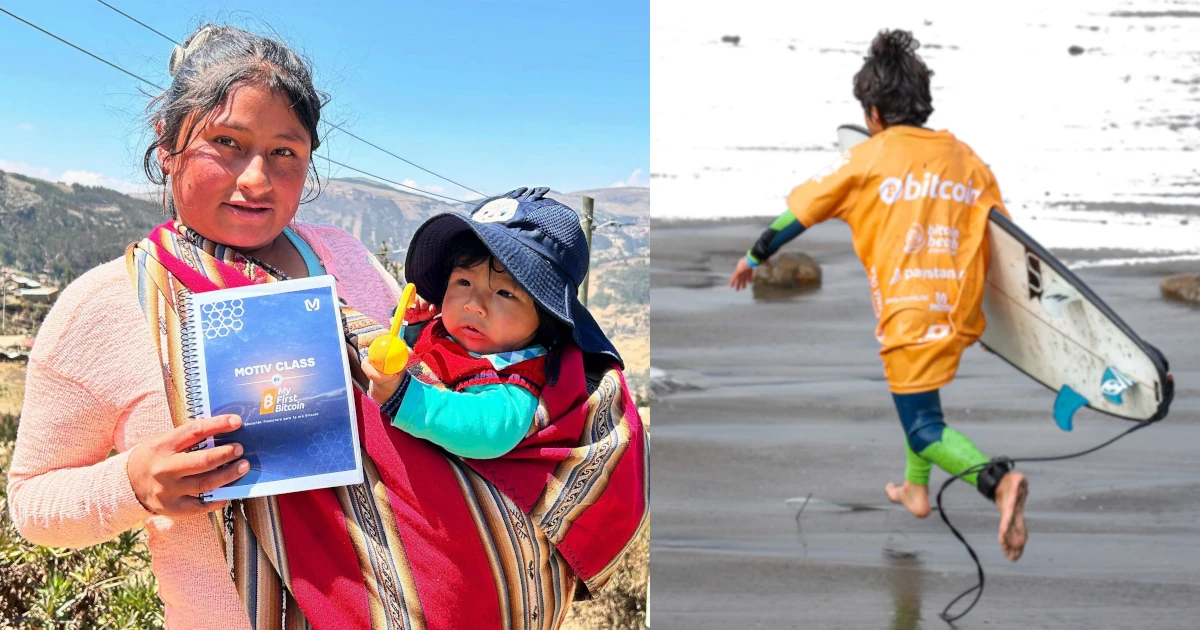
Fast forward a few years, and Motivn Peru is a well-oiled machine. As merchants got introduced to Bitcoin as a payment method, they began getting interested in it as a technology, and basic Bitcoin and financial literacy education programs followed, hosted at Motiv centers in major locations across Peru. Various education programs were developed to answer the questions of merchants and users alike in an organized manner.
Valentin tells us that today Motiv teaches Peruvians about Bitcoin from Monday to Saturday in 15 different locations, touching over 750 families. Motiv events in 2025 reached over 6000 people of all ages, including the Copa Bitcoin soccer tournament, a Christmas event, and various fairs and educational activities. The total number of individual bitcoin transactions made as a result of these efforts ranges between 25 and 30 thousand, with Blink as their entry level go to wallet.