Gen Z toppled Bangladesh's autocratic regime. Will it decide the next government?
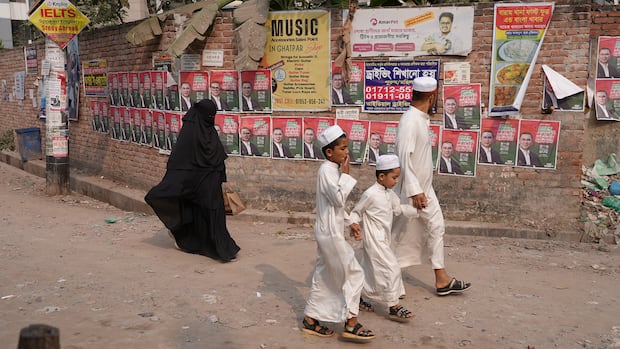
As he prepared to leave Bangladesh's capital, Dhaka, to return to his hometown to vote, Mohammad Ali couldn't quite believe he was participating in a historic election. "I'm going to vote for the first time and participate in what looks to be a fair election" after watching three successive elections that weren't legitimate, said Ali, a fourth-year political science student at Dhaka University, who had plans to vote with some childhood friends. "We're very excited." At a tea stand near a private university at the other end of the capital, Rahul Ghosh Joy also spoke of his excitement at Thursday's vote, calling it "an election for the students." "It feels like a dream come true," said Joy, 23, a life sciences student at Dhaka's Independent University. "Students worked very hard for this type of election, and now we need to work [harder] so that a fair election takes place" and the country doesn't "deteriorate" further, he told CBC News. Mohammad Ali will be voting in his first Bangladeshi election this week. (Salimah Shivji/CBC)It's been 18 months since violent student-led protests brought down Sheikh Hasina, Bangladesh's former autocratic leader, who ruled for 15 years as her government eroded democratic norms, stifled critics and jailed opponents. Hasina fled by helicopter to exile in India, but not before as many as 1,400 people died during the protests in the dying days of her regime, according to the United Nations. The vast majority were killed by security forces in a crackdown Hasina ordered — one the UN said could amount to crimes against humanity. The uprising was widely considered the world's first successful Gen Z protest. But in the months following Hasina's ouster, hopes for long-term reforms in Bangladesh dwindled.An interim government led by Nobel laureate Mohammad Yunus failed to fully implement an ambitious reform agenda, and many Bangladeshis became frustrated with the slow pace of change. A mural seen on the streets of Dhaka, Bangladesh, in February 2025. (Salimah Shivji/CBC)Excitement aside, Ali, who was part of the protests, expressed worry that this week's election might lead to instability and said he was no longer convinced sweeping reforms were in his country's future."I fear many might remain on paper and not be fully executed," he said.Still a fight between the old guardThe country has traditionally seesawed between two main political parties, Hasina's Awami League and the Bangladesh Nationalist Party (BNP), but this election is different. The 2024 uprising transformed the political landscape, even if it is still a fight between familiar faces of the old guard.The absence of Awami League, which was banned by the caretaker government last year after public pressure, has left a vacuum that Bangladesh's main Islamist party, Jamaat-e-Islami, has capitalized on, analysts say. BNP — whose leader, Tarique Rahman, returned to the country in December after 17 years in self-imposed exile in Britain — is still considered the front-runner, but the election could be more hotly contested than many anticipated several months ago. Shafiqur Rahman, the 67-year-old doctor who leads Jamaat-e-Islami, is now a serious contender after spending years on the margins of Bangladeshi politics. His party was banned when Hasina was in power.Shafiqur Rahman, leader of Bangladesh's resurgent Jamaat-e-Islami party, waves to his supporters at a rally in Dhaka on Feb. 9. (Salimah Shivji/CBC)The country's students are a powerful voting bloc, with turnout on Thursday expected to be high. "We have almost more than 35 per cent new voters and young voters, Gen Z voters," said Tawfique Haque, professor of political science at Dhaka's North South University, and many of them are voters who were also targeted by the regime.Jamaat-e-Islami's conservatismA party created by student leaders last year, the National Citizen Party, failed to gain much traction and made the controversial decision to join an alliance led by Jamaat. But Jamaat's socially conservative views have alarmed some moderates in the country; for example, the party is not fielding a single female candidate. Shafiqur Rahman himself sparked controversy last fall after declaring that women should only work five hours a day so they could focus more on their families. In a recent post on social media, he stated that pushing women out of the home in the name of modernity amounted to a “form of prostitution.”After the statement sparked protests, Jamaat claimed their leader's account had been hacked. Bangladesh is a parliamentary republic, where voters select candidates in their districts and the leader of the party or alliance that wins a majority becomes prime minister.WATCH | Bangladeshi protesters and counter-protesters clash (2024):Armed activists of Bangladesh's ruling Awami League, along with its associated student wings, took to the streets nationwide on Tuesday to counter protesters demanding the removal of the quota system in government jobs.Haque says the more contested the election and each seat is, the higher the potential for violence or clashes at polling stations.Security has been stepped up around voting booths across the country, with some 108,000 members of the armed forces deployed — the highest deployment in Bangladesh's electoral history. There will be immense pressure on the winning party to produce results fast. "Maybe within six months, the government will have to show some tangible outputs to the people, especially the young generation," Haque said, stressing that the electorate is low on patience. Geopolitical effectsAnother reason to watch Bangladesh's election closely is the effect the results could have on geopolitics and regional alliances. Ties between neighbouring India and Bangladesh are "at the lowest level" in years, according to Haque, while relations with China are friendlier than ever. India and Bangladesh have accused each other of destabilizing relations. New Delhi has repeatedly expressed concern over a rise in attacks against Bangladesh's Hindu minority, and is generally wary of the possibility of an Islamist party in power. Tawfique Haque, a professor of political science at Dhaka's North South University, says this week's election in Bangladesh will have reverberations outside its borders. For example, he said neighbour India will probably not look too kindly on a win by the party Jamaat-e-Islami. (Salimah Shivji/CBC)Meanwhile, authorities in Indian states led by the Hindu nationalist BJP along the border have been cracking down on Bengali-speaking Muslims accused of being illegal immigrants. "If Jamaat wins, I don't know what will happen, because India is still probably not ready to accept a Jamaat-led government," Haque said, pointing to the current tensions between the two countries over religious minorities. Anti-India sentiment in Bangladesh is at an all-time high, with deep resentment over the fact that New Delhi has sheltered Hasina and ignored repeated requests for her extradition. Late last year, a Bangladeshi war crimes tribunal sentenced the deposed leader to death for crimes against humanity linked to the violence against protesters as her regime was falling. Hasina has denied wrongdoing and called the trial that sentenced her "a farce," while also continuing to mobilize supporters from exile and plot her return. 'Why didn't I stop him?'For those still grieving family members killed in the protests, the current election campaign is an emotional drain. Zartaj Parveen wakes up every morning in disbelief that her eldest son is gone. Shafiquddin Ahmed Ahnaf was only 17 when he was shot in the chest by security forces at the height of the protests, which he insisted on joining. "Why didn't I stop him?" Parveen asked herself, in a low voice cracking with emotion, in an interview with CBC News. "He had his whole life ahead of him." Zartaj Parveen wakes up every morning in disbelief that her eldest son is gone. Shafiquddin Ahmed Ahnaf was only 17 when he was shot in the chest by security forces at the height of the 2024 protests. (Salimah Shivji/CBC)"These kids gave their lives, gave their blood, and it feels like it meant nothing," she said. Parveen called the 18-month interim government led by Mohammad Yunus "a failed government" and said she has little hope that either of the front-runners in the current election will work to ensure those responsible for the protest deaths are brought to justice.She believes her son would have wanted "a fair and beautiful election" and worries constantly about how her younger boy, Iftekhar Ahmed Arvin, is coping. He's not yet 14, and idolized his older brother. Arvin "doesn't like any political party now. Since his brother was killed, he thinks whoever comes will be the same-old."