Human rights watchdog urged to challenge prisons trans policy after court admission
It comes after its lawyer this week told the Court of Session that the current policy is not clear enough and could lead to outcomes that are not compliant with human rights.
The SPS Policy for the Management of Transgender People in Custody was published in late 2023, following public outcry over the Isla Bryson case.
Bryson first appeared in court facing rape charges under the name Adam Graham.
Double rapist Isla Bryson first appeared in court under the name Adam Graham
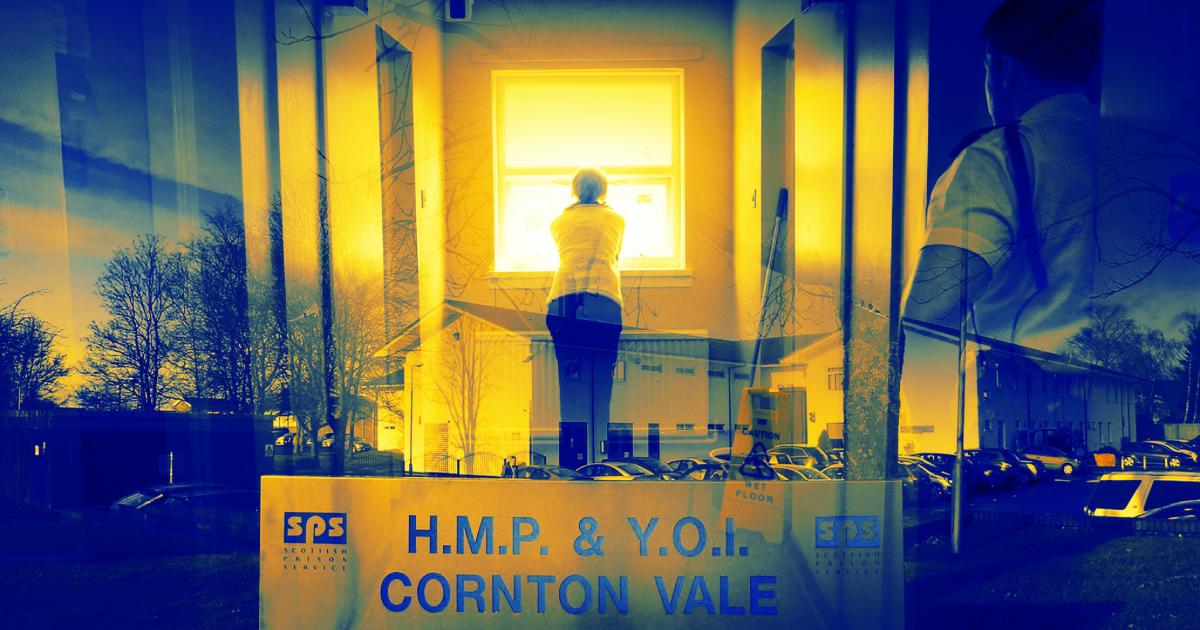
Following conviction, the SPS initially diverted him to Cornton Vale, Scotland’s only women’s prison, rather than the planned destination of HMP Barlinnie.
The decision provoked widespread backlash and prompted a review of SPS practices.
The resulting policy states that a transgender woman “will not be eligible to be considered for admission or transfer to a women’s prison” if they have been convicted of serious offences including murder, assault, robbery, abduction, rape and sexual harassment.
However, it includes an exception. The SPS Risk Management Team, and subsequently an executive panel, may approve such a transfer if “there is compelling evidence that they do not present an unacceptable risk of harm to those in the women’s prison”.
Campaign group For Women Scotland has taken the Scottish Government to court in a bid to have the policy quashed.
The Scottish Government argues that a blanket rule of housing prisoners in the estate that matches their biological sex would violate the rights of some inmates.
The case was heard before Lady Ross at the Court of Session in Edinburgh last week.
On the second day of the hearing, the SHRC said in principle it had no difficulty with an individualised approach, but that the current prisons policy did not directly refer to the human rights of female prisoners or staff.
Speaking on behalf of the Commission, which is an intervenor in the case, Kenny McBrearty KC said: “Perhaps more fundamentally, there is no reference to the rights of any other affected party, albeit there are general references to the safety and welfare of staff and other prisoners.”
He clarified that he meant there was “no specific reference to the rights of female prisoners or staff”.
In written submissions to the court, the Commission has already accepted that placing a transgender prisoner of male biological sex in the female estate is likely, in many cases, to engage the Article 8 rights of female prisoners — their right to privacy and personal life.
It has also accepted that, in some circumstances, it could engage Article 2, the right to life; Article 3, the right not to be subjected to inhuman or degrading treatment; and Article 14, the right not to be discriminated against.
The policy collective Murray Blackburn Mackenzie (MBM) has now written to the SHRC questioning why, despite acknowledging serious flaws in how women’s rights are considered in the policy, the Commission has not sought a declarator — a formal court ruling on whether the policy is lawful.
In a letter to SHRC chief executive Jan Savage, MBM argues that the existing policy fails to properly recognise the European Convention rights of female prisoners and staff, and that urgent action is required regardless of the outcome of the court case.
The letter also questions whether the Commission has raised its concerns directly with Scottish ministers or the Prison Service, and whether it has asked for past placement decisions — including those made under earlier versions of the policy — to be reassessed in light of the acknowledged failure to properly consider women’s rights.
MBM writes: “From the discussion in court, there would seem to be some urgency in updating the policy to meet the Commission’s concerns on this point, which need not, and ought not to, wait for the outcome of this case.”
The SHRC was approached for comment.
MBM has urged the SHRC to take action (Image: Newsquest)
According to the affidavit of Linda Pollock, the deputy chief executive of the SPS, since records began in 2014 there have been 73 transgender people in custody. Of these, 17 — about 23% — were accommodated long-term in an estate that does not match their biological sex.
Of 51 trans women, 14 — about 28% — have been held in the women’s estate. Of the 22 trans men, three — about 14% — have been held in the male estate.
Ms Pollock said that “currently, almost 80% of accommodation decisions” for transgender people result in them being housed in line with their biological sex.
She told the court that staff in the two prisons where trans women are currently held in line with their acquired gender had not reported any infringement of women’s dignity or the creation of a hostile or humiliating environment.
She said women in custody who were consulted during the policy’s development were “generally supportive” of transgender prisoners.
However, in a sworn affidavit, a female prisoner, known as AA, told the Court of Session that allowing biologically male prisoners who identify as female into women’s prison wings made her feel unsafe, intimidated and sexually harassed.
She said male inmates used their size and status to exert power over women, including unwanted sexual attention, exposure, threats of sexual abuse, and intimidation.
AA described one male prisoner, referred to as MP1, who had “one hell of a big build” and started transitioning in jail.
She said: “MP1 fancied me. I was scared. He saw that. He threatened and intimidated me. He fancied me the way a man fancies a girl. He would expose his body parts, and wear skin tight leggings, so that everyone could see the shape of his penis. That’s sexual assault or indecency.
“I felt unsafe with these men around me. MP1 did threaten me with sexual abuse.”
She said MP1, a lifer, “battered” a female prisoner in front of officers but faced no sanction, while the victim was moved to worse conditions instead.
Another male prisoner, she said, thrived on control and fear, triggering trauma from past abuse.
AA said women’s privacy was eroded, they felt unable to avoid male inmates in shared spaces like showers, and that raising concerns led to retaliation.
She rejected the Scottish Government’s claim that such arrangements need not threaten women’s dignity, saying the reality left women “upset and hopeless” and forced to “put up and say nothing”.