Russia and U.S. Agree on Need for New Nuclear Arms Treaty, Kremlin Says
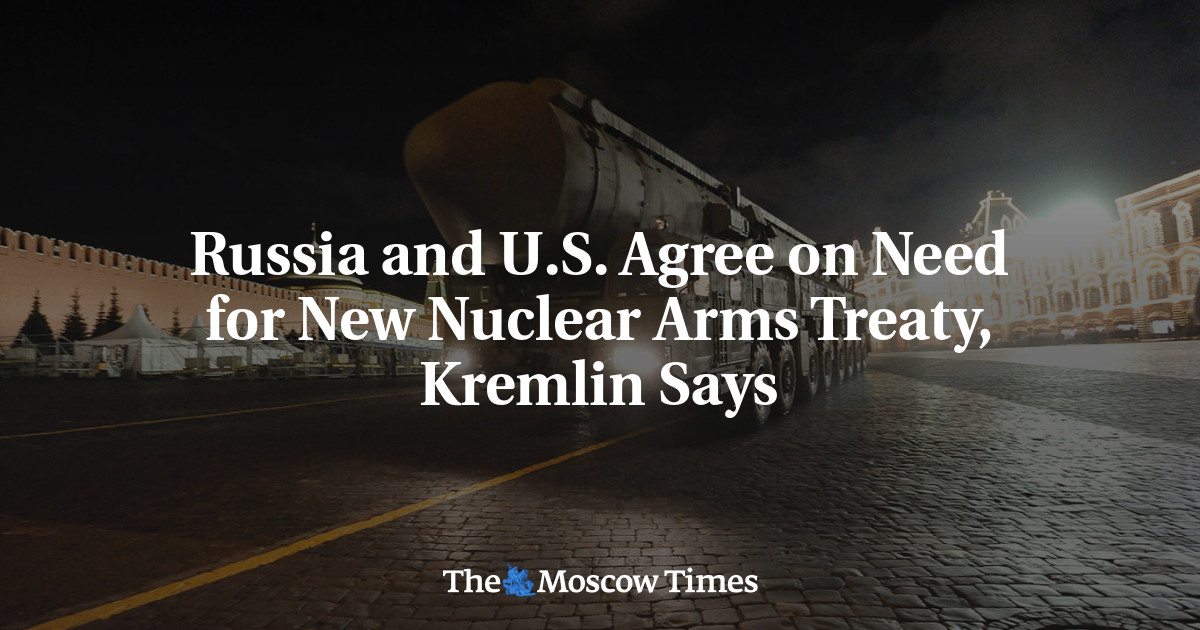
Officials from Russia and the United States agree that they must negotiate a new nuclear weapons reduction treaty, the Kremlin said Friday, a day after the last such agreement between the two superpowers expired, sparking concerns about a global arms race.
"There is an understanding, which was discussed in Abu Dhabi, that both sides will act responsibly and will recognize the need to begin discussions on this issue as soon as possible," spokesman Dmitry Peskov told reporters when asked about the end of the New START treaty.
New START, signed in Prague in 2010 by former U.S. President Barack Obama and his Russian counterpart at the time, Dmitri Medvedev, restricted each side to 1,550 deployed warheads and 800 launchers and bombers. It also provided for a series of mutual onsite inspections.
In 2023, President Vladimir Putin accused NATO of seeking to attack Russia’s nuclear facilities and declared that Moscow would suspend its role in the pact. Officials later clarified that Russia would still abide by the numerical limits but would discontinue other parts of the agreement.
Despite that partial suspension, Putin had called on the United States to extend New START for one more year, saying it would be "a mistake" to "completely abandon the treaty's legacy."
U.S. President Donald Trump said last year that an extension "sounds like a good idea," but indicated that he wanted to include China in a new deal. So, too, had Putin called on France and the United Kingdom to be involved in a follow-up treaty.
"If it expires, it expires," Trump told The New York Times in an interview last month. "We'll just do a better agreement."
On Thursday, New START officially ended, marking the first time since the Reagan Administration nearly 40 years ago that the United States has been without a nuclear arms control treaty with Russia.
That same day, Axios, citing anonymous U.S. officials, reported that Washington and Moscow were close to reaching a deal that would see both countries observe New START beyond its expiration. One source suggested the extension would not be legally formalized.
Peskov told reporters on Friday that it would be unrealistic to expect Russia to sign on to an agreement that is not legally binding.
"The provisions [in New START] can be extended formally, but it's difficult to imagine how something like that could be done informally," he said.
Meanwhile, Russian and U.S. officials agreed Thursday to reestablish high-level military-to-military dialogue, which was suspended in 2021.