Cahair O’Kane: The zonal defence is dead and individual responsibility is back
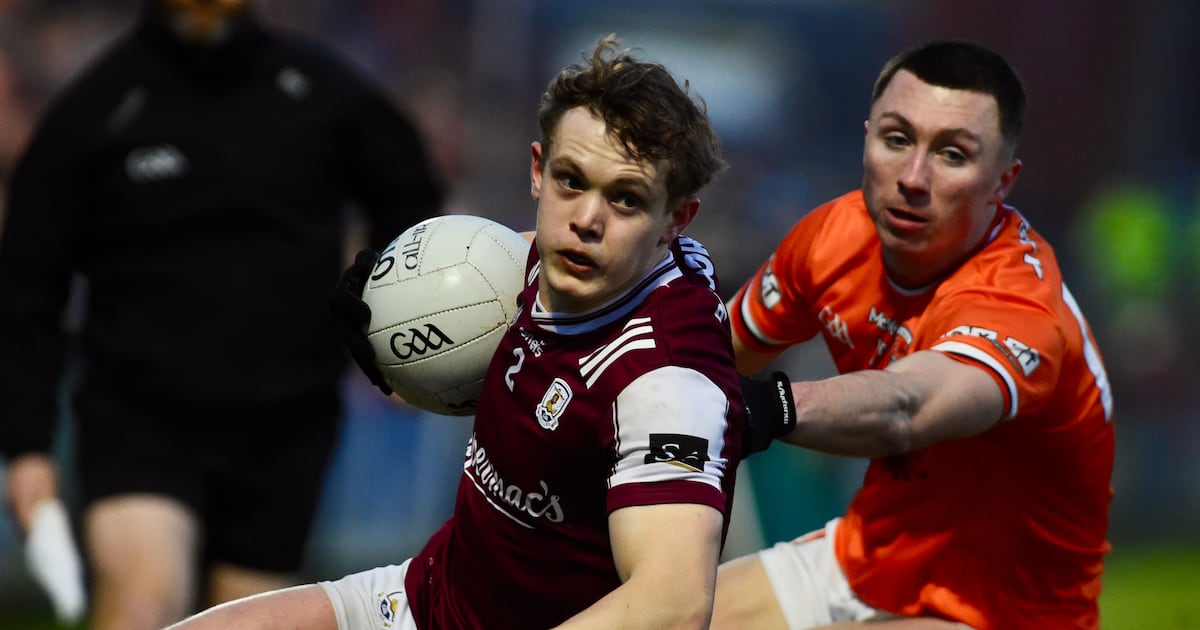
ZONAL defending is no more. It has ceased to be. Expired and gone to meet its maker, to paraphrase the famous John Cleese sketch.If you needed any further evidence of its demise, the weekend provided an ample sufficiency of it.When it came to the 3v3 breach and the absence of a black card for Kieran Molloy, Armagh had very genuine cause for complaint about Saturday evening’s defeat with Galway.Kieran McGeeney’s men played almost all the football.But they contributed to their own downfall in a massive way too.Matthew Tierney’s 64th minute goal that put Galway a point up was a direct result of Armagh trying to defend zonally.Jason Duffy was tracking Tierney when he was initially in possession.And after shaping to stay with his run, Duffy changed his mind halfway through and swivelled instead to meet Rob Finnerty, who now had the ball.By the time he’d signalled his intentions to Gareth Murphy, who was going with Finnerty, Tierney had the run on the young full-back and was in behind.Louis Kelly’s goal early on for Monaghan down in the Hyde was a brilliant finish, right in the stanchion.It happened because, you guessed it, Roscommon were trying to defend zonally.As Ryan O’Toole carried the ball around the arc in a position where there was no real threat, Kelly cut a good angle off the line.It was still such a manageable situation for Roscommon.But Diarmuid Murtagh had decided he was going to leave Kelly go and that he’d pick up O’Toole once he’d popped it off.Problem was that by the time Enda Smith knew he wasn’t tracking O’Toole any more, Kelly was gone through the gap and had the ball in the top corner.In Breffni, Jack Flynn might have had a goal inside three minutes for Meath off pretty much the same problem.When Ruairi Kinsella flashed the ball out wide to Jordan Morris, he was being tailed by Niall Carolan.Cormac Brady was in Flynn’s vicinity at that stage but Flynn kept on moving in behind as Brady instead took up a position the other side of Carolan, leaving the Meath midfielder a clear run at goal. Liam Brady made a good save to deny him.A zonal defence is just too susceptible to momentary lapses that can be so costly.Even from a technical point of view, you see defenders passing a man on by pointing to a team-mate and by doing so, leaving themselves wide open to be attacked because their body is in no position to cope with it.Winners write the story every year but the part of Kerry’s success that got overlooked was that they had easily the best defensive system of any team in Ireland last year.The flaws in a zonal setup are now too obvious to ignore.It just seems impossible to defend like that and win serious trophies.Nor is full on man-to-man the answer either.For all the good about Mayo in the opening two rounds of the league, look at Dublin’s first goal on Sunday.Their defence had decided early on to engage the Dubs’ attack wherever they were on a man-to-man basis, something similar to how Tyrone defended against Kerry last year.Dublin manipulated it very well. Long kick into the corner to Costello and then a late run from Luke Breathnach in to completely open water that the rest of the forwards created simply by staying out of the way for long enough.Their line of engagement stayed pretty high all day. That style of high pressing has traditionally suited Mayo. It remains to be seen if they have the man markers to carry it off this year.Almost every team in the top two divisions has moved quickly on to the Kerry model.The good thing for club managers wishing to mimic it is that it is very easy to adopt.To explain it in simple terms, you have your nominated man-marking jobs where your best two or three defenders stay on their best forwards.When you don’t have the ball, everyone else retreats to where you want to engage, whether that be the edge of your arc or 55m from goal. And once an opposition player comes your length, that’s your man until the end of that attack.The bad news for players, particularly forwards, is that it places individual responsibility above the collective.If your man is the one that scores, it’s a very easy spot on the video.The worst thing the blanket defence did in all its years was give cover to bluffers.In a system where you just load 13 men back inside your own 45, nothing was anyone’s fault any more.Individual responsibility for defending ceased to exist.If you didn’t fancy tackling, it was pretty easy to hide in plain sight.A bit of pointing here, the odd roar there, occasionally gesticulate to your team-mates after conceding a score and head away back up to paradise at the other end.One of the knock-on effects of teams moving to the ‘hybrid’ defensive system, as it’s being termed, you’re seeing more pressing higher up the pitch.Having watched Shane O’Donnell force Sean O’Shea to over-carry the ball on his own 13m line because Donegal were squeezed so high that he had no out-ball, Jim McGuinness noted it.“I think there’s a lot more going on this year than last year, definitely,” he said.“Teams are getting more switched on to what’s a full-court press in basketball. You’ve got to get there. You’ve got to be intensive.“You’ve got to be disciplined as well. There’s no point then getting people in a really good spot and giving away free kicks. We were overzealous a couple of times in the first half when we felt we could have got turnovers.“And then we did get them in the second half. I think that’s happening across all the games, to be honest with you,” the Donegal boss added.We have heard a lot about how football would have evolved naturally had it not been for the FRC’s meddling.But even compared to the opening two rounds of last year’s league, we’re not seeing the massive wind-dictated swings in games.Rather than complaining about the futility of it, coaches have spent the winter trying to find ways of playing through those tougher periods.It is a sport evolving in the right direction.And it does not appear to have any space in its future for a zonal defence.