Judge Denies Trump Bid to End Protected Status for Haitians as ICE Fears Loom
A federal judge on Monday rejected the Trump administration’s attempt to end the temporary protected immigration status of hundreds of thousands of Haitians living in America. The government’s move would have cleared the way for Immigration and Customs Enforcement agents to begin mass deportations of people from the island nation.
In a scathing 83-page ruling issued Monday evening, U.S. District Judge Ana C. Reyes sided with a group of five young Haitian adults who sued the government, claiming officials sought to end temporary protected status for them without adequately determining whether conditions had improved in Haiti, which is wracked with political and economic instability, along with gang violence.
The judge’s ruling had harsh words for President Donald Trump and Department of Homeland Security Secretary Kristi Noem. Reyes said that it was likely that Noem had predetermined to end the protected status for Haitians “because of hostility to nonwhite immigrants.”
“The record strongly suggests that Secretary Noem’s decision to terminate Haiti’s TPS designation was motivated, at least in part, by racial animus,” Reyes wrote.
In Reyes’ analysis, she said Noem failed to account for the $1.3 billion that Haitian TPS holders pay in taxes every year. She also outlined Trump’s previous statements denigrating Haiti and suggesting that Haitian immigrants “probably have AIDS.”
Department of Homeland Security officials on Monday spoke out against Reyes’ ruling. Spokeswoman Tricia McLaughlin in a statement on X predicted the case would be headed to the Supreme Court.
“This is lawless activism that we will be vindicated on,” McLaughlin said
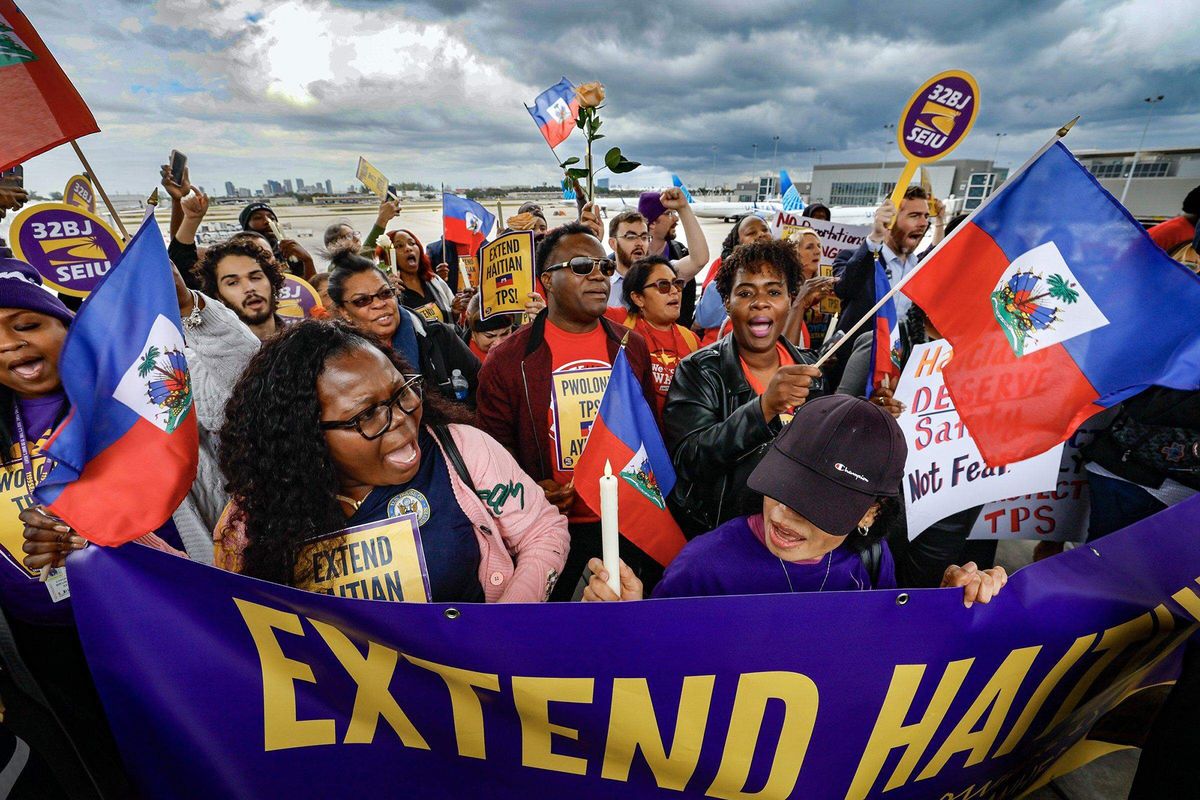
Haitians in places like South Florida and Western Ohio celebrated the decision Monday, even as some expressed fears that ICE would still try to round up as many Haitians as they could to deport.
The ruling affects an estimated 350,000 Haitians here on temporary protected status, a program that allows immigrants to live and work in the United States legally due to conditions like natural disasters or ongoing armed conflict in their home countries. In recent months, federal officials have also sought to end protected status for immigrants from countries such as Venezuela, Ethiopia, Honduras, Nepal and Somalia.
The decision by Reyes, an appointee of President Joe Biden, is the latest example of federal judges castigating Trump’s immigration practices in immigration cases around the country.
McLaughlin on Monday said temporary protected status for immigrants was never intended to be a license to stay in the U.S. indefinitely. Some Haitian TPS holders have been in the country since 2010, after a massive earthquake destroyed parts of Haiti.
Reyes in the ruling rejected claims that Haitians had legally overstayed their welcome.
“The statutory design is straightforward,” Reyes wrote of temporary protected status. “TPS exists because threats to life exist; when the threat persists, so should TPS protection, unless the Secretary articulates a well-reasoned and well-supported national interest to the contrary.”
At least for now, the decision stops Trump from fulfilling a campaign promise he made in 2024 to end protected status for Haitians, after Vice President JD Vance spread false claims that Haitian immigrants were eating the pets of residents in Springfield, Ohio.
In an interview with NewsNation during his presidential campaign, Trump said that his stance had nothing to do with the immigrants being Haitian, but that they had “overrun” the small city, which had more than 50,000 residents at the time.
“They have to be removed,” Trump said then, nodding when a reporter asked if he’d seek to end temporary protected status for Haitians if he won the election. “Absolutely, I’d revoke it, and I’d bring them back to their country.”
In a sign that may have signaled how Reyes was going to rule, she last week told attorneys on both sides of the case that as part of her decision, she would be considering remarks that Trump made at the 2025 Conservative Political Action Conference in Maryland. In the speech, Trump described immigrants from Haiti and parts of Africa and South America as “pouring into our country” from prisons and mental institutions in their homelands.
Reyes rejected depictions of Haitians as criminals in her ruling Monday, writing that “Haitian immigrants are overwhelmingly law-abiding, with incarceration rates lower than those of native-born Americans.”
Miami immigration attorney Frandley Julien was among the lawyers around the country who have been watching the case. He said the fact that Reyes was considering Trump’s words, along with the harsh questions she had for government attorneys during hearings in the case, made him almost certain that she would rule for the Haitian plaintiffs, who included a neuroscience Ph.D. candidate, a software engineer, and a nurse who was a doctor in Haiti before he fled the violence there.
“We know the ruling is going to be good for us,” Julien concluded on Sunday. “That doesn’t mean this is over.”
Over the weekend, Noem promised that even if Reyes ruled in favor of the government and temporary protected status ended for Haitians, they would have had other opportunities to stay in the country.
Join the community that keeps criminal justice on the front page.
“Any individual who is from a country where TPS is expired has an opportunity to appeal that, and to look at other programs that they may qualify for, and they have a number of months to do that,” Noem told reporters in a news conference at Miami International Airport. “They should reach out to the State Department, they should reach out to the Department of Homeland Security, and we will help them with that.”
Julien and others told The Marshall Project before the judge’s decision that they doubted Noem’s agency would help Haitians under those circumstances.
Reyes’ ruling follows a decision from a U.S. appellate court last week that upheld a lower court ruling in a separate case that Noem had illegally tried to bring an early end to temporary protected status for Venezuelans and Haitians.
In anticipation of Reyes’ ruling, dozens of clergy members from around the country traveled over the weekend to Springfield for a rally. Leaders of Springfield’s Haitian community said more than 1,200 people attended the rally. Marian Stewart, a member of the community group Springfield Neighbors United, attended both Monday’s rally and a church service on Sunday where she says the anxiety amongst Springfield’s Haitians and their American friends was palpable.
“You can just see people looking at each other with the feeling of ‘Am I going to see you again?’” she said.
Ohio Immigrant Alliance's Executive Director, Lynn Tramonte, worried about the lingering effects of that uncertainty, calling Reyes’ decision a welcome reprieve before adding “but people can’t live their lives like this.”
MS Now reported last week that four people with knowledge of discussions within the Trump administration said that immigration agents were planning to mobilize in Springfield as soon as this week.
Leaders in south Florida, meanwhile, were still waiting to see if ICE agents would conduct an operation there in spite of Monday’s ruling, noting that there are other Haitians in America who were still waiting to receive protected status. An ICE sweep in Florida would mark the agency’s latest large-scale operations in the wake of Operation Metro Surge, a mass deportation campaign that began in December in Minneapolis and sparked national outrage after federal agents killed two protesters and detained several people whom judges later ruled were being held illegally.
Since then, ICE agents made 200 arrests in Maine as part of an immigration sweep they called “Operation Catch of the Day,” but reports surfaced late last week that federal agents had ended the operation after a week.
This story was updated to include additional reporting, including reactions to the ruling.