Buyers can drive a hard bargain on unsold late model cars
Auto dealerships last fall welcomed the new 2026 model year cars and trucks, even as some of them were trying to figure out what to do with all the 2025 and even 2024 models still lingering around like overstaying party guests who refuse to take the hint to leave.
Nationally, there are 22 models from the 2025 vintage that have unsold inventory of 60% or higher, and among 2024 models, 23 still have 5.3% or more inventory left behind, according to an analysis from iSeeCars.com, an online auto sales and research site. To put that in perspective, only a fifth of all 2025 models are still available, and only 0.4% of 2024 models.
“If you are looking to get a new car with a new car warranty, but you want as low a price as possible, a 2024 model may not be a bad way to go,” said iSeeCars Executive Analyst Karl Brauer.
Popular models still command a premium and are harder to secure. But for the models that aren’t selling, and there are several of them, buyers are in the driver’s seat.
“Forget what the dealer is asking. If you know it is a 2024 model, and it is still on their lot, it is costing them money every day. Tell them ‘I’m willing to help you out’ and then bargain hard,” he added.
Brauer recommends holding any still-new 2024 vehicles for the long term, given the age discount they face on the resale market regardless of what the odometer shows. Languishing models aren’t for flipping or even selling in a couple of years. But they do come with a full warranty, unlike used versions.
Stellantis, formed from the 2021 merger of Fiat Chrysler Automobiles and French automaker Groupe PSA, built a majority of the unsold 2024 models — Dodge, Jeep and Alfa Romeo.
The leftover list is also heavy on hybrid and electric vehicles, which were already peaking in demand before the Trump administration pushed to eliminate the federal tax credits for their purchase. The timing couldn’t have been worse for manufacturers, who had been aggressively ramping up those power systems and now face a surplus that will be hard to clear.
Languishing 2024 green models include the Genesis GV60 at 21.8% unsold; the Dodge Charger at 20.9% unsold; the Chevrolet Silverado EV at 11.9%, and the GMC HUMMER EV at 7.1%. Even more EVs populate the non-selling 2025 models and they face an uphill battle in 2026 without federal tax credits.
The most unloved car out there is the 2024 Dodge Hornet plug-in hybrid, with an average price of $41,166. It has 82% of its inventory still unsold. Even the conventional engine models, priced at $31,799, have 26.3% of inventory available.
Brauer, who test-drove the Hornet when it came out, describes it as an attractive-looking, fast-moving and competitively priced SUV in the low $30,000s. It should have received a warmer reception, but he believes it was marketed to the wrong audience.
“It should have been branded as a Chrysler,” Brauer said. “It doesn’t resonate with Dodge buyers.”
Reliability scores have been low, especially on the infotainment and electrical systems, and parts have been hard to find. The Hornet was built at an Alfa Romeo plant in Naples, Italy, where the Tonale was built. Critics also complain that Dodge, known for its muscle cars, muffed its transition to hybrid power systems.
Add in a new 25% tariff on European auto imports on top of the huge backlog, and it is easy to understand why Dodge pulled the plug on production of the 2026 Hornet.
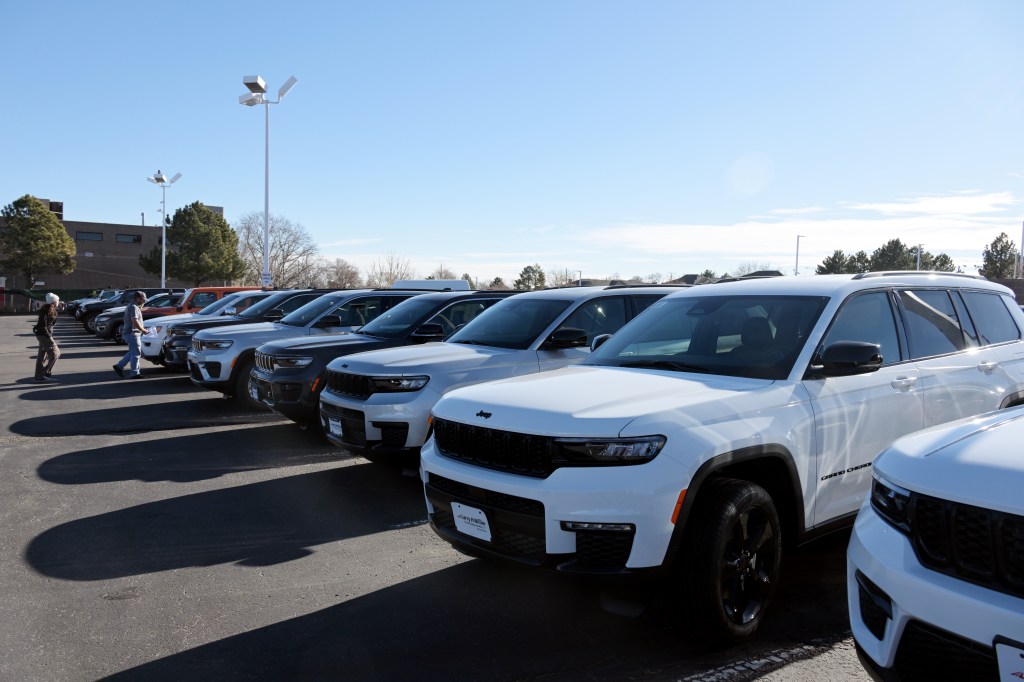
The 2024 Jeep Grand Cherokee, with 70.8% of its supply waiting on lots for buyers to emerge, has also been rejected in a big way, according to iSeeCars. It has an average price of $64,014. The 2024 Jeep Wagoneer L, a more expensive relative at $92,497, has an unsold inventory of 24.1%; the plug-in hybrid Jeep Wrangler, at $60,740, has 18.2% of its inventory remaining; and the Jeep Grand Wagoneer, at $83,928, has an overhang of 12.9%.
After big price increases during the pandemic, when vehicles were in short supply, Stellantis kept on going, misjudging how much consumers would be willing to pay, Brauer said. The Jeep brand is iconic, but there are limits to what its fan base can afford. Some of the problems at Dodge and Jeep reflect Stellantis executives who were out of touch with the U.S. market. One example is the push to sell Alfa Romeo models that struggled to catch on in the U.S. because of their smaller size and reliability issues.
The Alfa Romeo Tonale Hybrid, at an average price of $51,917, had 46.8% of its 2024 inventory still left in December. It is no surprise that the Tonale, like the Hornet, is being discontinued.
Surplus models represent both an opportunity and a potential trap for consumers looking to secure a bargain on a new vehicle, and brokers urged treading carefully. There is usually a reason why the vehicles aren’t selling, and the lack of interest likely won’t change when it comes time to resell or trade in the vehicle.
Local auto brokers said they aren’t running into a lot of new 2024 models as they locate vehicles for the clients. But then again, people aren’t requesting them. That would be like asking someone to binge-watch “Yellowstone” when “Landman” is all the rage.
“Nobody is out there searching for 2024 new car. They shouldn’t exist,” said Chris Nelson, an auto broker at JFR & Associates in Littleton.
Dealers typically pay “floorplan” interest on a loan backed by the new vehicle, which avoids fronting cash to the manufacturer. The longer a car or truck doesn’t sell, the more interest accrues and the lower the profits. Lingering vehicles also take up space and require maintenance, such as keeping batteries charged. And as time passes, manufacturer incentives fade away.
One strategy to move stale vehicles is to put them up for auction, essentially offloading them to other dealers who think they can sell them. Another strategy is to put some miles on the odometer and sell them as used vehicles, where there is a stronger market.
“The oldest-aged inventory, where the manufacturer stops supporting the vehicle with incentives or leases, will typically be sold as a used car, or as a demo vehicle. I rarely see any brand-new 2024 vehicles in my day-to-day searches,” said Joe Scandaliato, owner of Car Brokers in Denver.
Unlike Brauer, Scandalito advises against buying a new 2024 vehicle at this point. Those who do go that route should know precisely what used versions are selling for. New cars come with higher taxes and insurance premiums than used, so that added cost needs to be taken into consideration, he said.
Jeep Wrangler 4Xe plug-in hybrids are displayed on the sales lot at Hilltop Chrysler Jeep Dodge Ram on April 5, 2024, in Richmond, California. (Photo by Justin Sullivan/Getty Images)
Brokers also favor leasing over buying when it comes to EVs because of the brutal rates of depreciation seen on those vehicles. The loss of tax credits also makes for an uncertain resale market.
“I haven’t met one Tesla owner happy with what their car is worth,” said Elizabeth Chua, auto broker with H.M. Brown & Associates in Centennial.
Chua is also not a fan of Jeeps, especially the EV and hybrid versions. Jeep has also had a problem with muddled models, which it acknowledged by discontinuing the Wagoneer and Wagoneer L lines this model year in favor of the Grand Wagoneer.
“That wouldn’t be a good investment for your money when it comes to buying,” she said of Jeeps.
Unlike Chua, Nelson is a fan of Jeep, arguing they have a strong resale market and a devoted following. His daughter was driving an older Jeep with a payment of $300 a month, but he was able to get her a new lease payment for under that amount.
Nelson said manufacturers and dealers have gotten much more aggressive with lease deals in the past six months, especially Stellantis. The manufacturer has lowered costs on some of its 2026 offerings. It has also strategically cut back production on models that aren’t selling, and for 2025, only the Jeep Renegade is on the list of top non-sellers from iSeeCars.
For those afraid to touch a new 2024 car, or unable to find one, there are plenty of 2025 models backing up behind them. The mix is more diverse than the 2024 list, with more EVs and hybrids.
At the top of the list is the BMW i4, an EV priced at $67,745. It has 89.2% of its inventory sitting around. The Lexus GX 550, which is pricer at $81,291, is not far behind with 87.8% of its inventory unsold. A model that might appeal to Colorado drivers seeking a smaller and sportier option, the Subaru BRZ, has 87.1% of its 2025 inventory left and has an average price of $38,515.
The expensive Lexus LX 600, average price of $117,757, is also on the list at 83.9% unsold. Three more affordable models struggling to find buyers are the Toyota GR Corolla, Kia Niro and Volkswagen Taos. Hybrid versions of the Toyota 4Runner and Ford Maverick are also running at around 80% unsold.
Another approach for bargain hunters is to target discontinued models, of which there are about two dozen. They range from the Porsche 718 Boxster at $141,299 down to the Kia Soul, at $23,403. The trade-off is a potentially larger depreciation and more difficulty finding parts and knowledgeable mechanics for those holding long-term.
Scandaliato said consumers will have a better chance of finding a great deal if they are willing to consider all car brands in whatever size and class of vehicle they want. They should keep an eye out for any changes in incentives, which tend to come at the start of each month.
“In aggregate, we have a slightly oversupplied market, but this seems to be correcting. The full-size, light-duty pickup truck market is very oversupplied, while the mid and full-sized SUV market is well balanced,” he said.
Get more business news by signing up for our Economy Now newsletter.