Natural wine, long hikes and history: Could Kutaisi be Georgia’s next great travel destination?
As if parting the seas, a barrel-chested priest in a black cassock strides through the crowd, a heavy leather ball stuffed with wine and dirt on his head. Moments later, fully swallowed by the mob, he fires a shotgun blast into the air, sending two entire villages into a frenzy.
Between the cheers and clouds of dust, you can sense shoulders colliding, shoes skidding on asphalt, bones and wills testing their limits as dozens of men discharge their energy in short, violent bursts, inaugurating the annual game of lelo burti, or ‘field ball’.
Once a year, on Orthodox Easter Sunday, two neighbouring villages in western Georgia, about 45 minutes from Kutaisi, face off in this loosely officiated, free-flowing contest.
Diving into Georgia’s tradition
A tradition at least since the 12th century, Georgia’s unrestrained answer to rugby can take a whole day, ending only after one team moves the ball into a stream in the other village. Afterward, the ball is placed on a grave to honour the recently departed.
I spent my Easter last year amazed not only by the spectacle, but also by the fact that such a peculiar and meaningful tradition still exists. And that, despite its apparent removal from modern life, it really wasn’t hard to reach from Kutaisi, where I was staying.
Since 2016, when it became Georgia’s hub for low-cost carrier Wizz Air, Kutaisi has quietly become one of the country’s most consequential points of entry. Even with the airport, Kutaisi has often been treated as a transit city. With infrastructure and travel experiences developing fast, that might not be the case for much longer.
Kutaisi is coming into its own
Last year, Georgia welcomed a record 5.5 million international visitors. More than a quarter of them arrived through Kutaisi Airport. Not nearly as many stayed there.
Hotel occupancy rate for regions outside Tbilisi has stayed at about 35 per cent in recent years. Part of that might be due to the makeup of travellers visiting Georgia.
Before the pandemic, the EU and the UK ranked among Georgia’s top 10 tourism source markets. That hasn’t been the case since. Most international visitors now arrive from Georgia’s neighbours, concentrating their time in Tbilisi and on the Black Sea coast.
The imbalance is easy to spot on the ground.
Only a dozen or so travellers – local TV crews aside – went to lelo burti, one of the most unique traditions I experienced in Georgia. Among them, however, was Emily Lush, the travel writer behind Wander-Lush, longtime Georgia resident and proud Kutaisi advocate.
For her, the city has always offered something Tbilisi did not. So much so that she and her husband chose to make it their home rather than settle in the capital.
“Kutaisi is a very liveable city,” she says. “Compared to Tbilisi or Batumi, it’s smaller and closer-knit. Everyone knows each other, and there’s a real sense of community.”
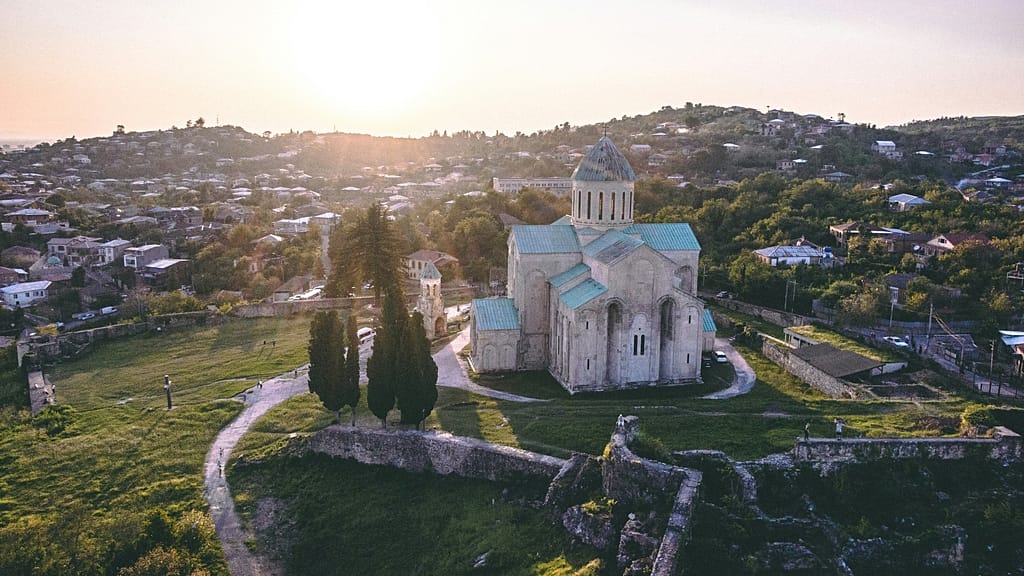
The traffic is lighter, she explains, and the city is walkable. Between landmarks like the UNESCO-listed Bagrati Cathedral, the historic Jewish and Catholic Quarters, and the Green Bazaar fresh market, there’s a lot to see and do.
“Kutaisi is one of the world’s oldest continuously inhabited cities, and there is so much history to unpack,” says Lush. That isn’t limited to its cathedrals and old buildings.
“Most people don’t know this, but Kutaisi is considered the home of Georgian punk rock. It had a huge scene in the 1990s,” she adds. New bars and live music venues – including Riff Raff, which opened late last year – are keeping that legacy alive and well.
Like all Georgia, wine and food are still at the heart of the city’s social life. Neighbourhood bars such as Wild and Amber Wine are favourites among the local creative crowds, according to Lush, and “new restaurants are constantly popping up.”
A base for adventures in western Georgia
Between its liveability and location, Kutaisi makes a practical hub for regional trips.
In a matter of hours, travellers can reach the high valleys and UNESCO-listed villages of Svaneti, the dense forests and hiking trails in Racha, and the Black Sea coast and its capital Batumi. The tea-growing region of Guria and nearby Samegrelo, with its spicy cuisine, lush canyons and rich cultural heritage, are also easy day trips, Lush says.
“Kutaisi has an unbeatable location,” she says. “Unlike in the east, there are good railway connections here that you can make use of to travel west or into Tbilisi.”
Nowhere is Kutaisi’s reach more apparent than in Svaneti, a region former president Mikheil Saakashvili once sought to transform into‘a Switzerland in the Caucasus’. It may not be on par with Switzerland today, but its infrastructure and tourism have developed quite a bit since Misha, as he’s known, ran the country in the early 2010s.
The Zagari Pass linking Kutaisi and Svaneti – what Lush calls “one of the most epic road trips in Georgia” – was remade in 2024, the same year the road between Mestia and Ushguli was paved. That has made it much easier to access the through-hike from Mestia to Ushguli, an increasingly popular four-day journey weaving past Svaneti’s medieval stone tower houses and summer villages.
Meanwhile, in winter, the Hatsvali and Tetnuldi ski areas are drawing more adventure-junkies seeking reliable snow without the crowds of Gudauriin the east.
Europe’s next great wine region could be Imereti
South of Kutaisi, city life quickly gives way to Imereti’s wild tapestry of vineyards.
While the Kakheti wine region is Georgia’s most popular, Imereti is gaining a favoured reputation for its sparkling and white wines, many fermented with grapeskins, in keeping with Georgian traditions.
Unlike Kakheti’s powerful, tannic styles, Imereti’s wines tend to be lighter and fresher. That difference reflects the region’s greener, wetter climate, limestone-rich soils and a winemaking tradition using smaller qvevri (clay amphorae), known locally as churi.
Without the same commercial pressures found in the east, Imereti’s wine industry has remained largely family-run, too. Visitors often find themselves welcomed around a garden table to have seemingly endless pours of wine and Imereti-style khachapuri, a regional spin on Georgia’s ubiquitous cheese-filled bread.
“Wine is part of every important moment in life. It’s not just a drink,” says Baia Abuladze, who runs Baia’s Wines, a natural wine estate with her family in Bagdati, just 20 minutes from Kutaisi. “Almost every household has its own small cellar.”
Baia’s is among a growing number of producers drawing attention to the region. The estate has won international awards and now receives visitors from as far afield as the US and Australia, who stay for long lunches overlooking vines framed by the Lesser Caucasus before returning to Kutaisi and homegrown boutique hotels like Communal.
“More people are discovering that western Georgia has its own charm, with green landscapes, a calm rhythm of life and wonderful local food and wine,” Abuladze says.
“We definitely see more travellers now, both Georgians from Tbilisi and foreign guests who want something more authentic and personal.”
“Still,” she adds, “it’s not overcrowded here.”
In fact, Kutaisi may never be over-crowded, but it’s increasingly difficult to dismiss it as a place to pass through. Whether it’s wild ‘rugby’ games, winery visits or evening walks by the Rioni River, the city has long had the substance to be more than a stopover.
Visitors are now beginning to treat it that way.