Game-changing tech could solve Britain’s water quality crisis
A game-changing new technology could be set to revolutionise not only fishery management, but water quality control on Britain’s rivers and lakes.
The RA BASE system has been developed by a partnership of UK scientists, initially to address the issue of spiralling oxygen crashes at fisheries due to increasingly extreme weather conditions.
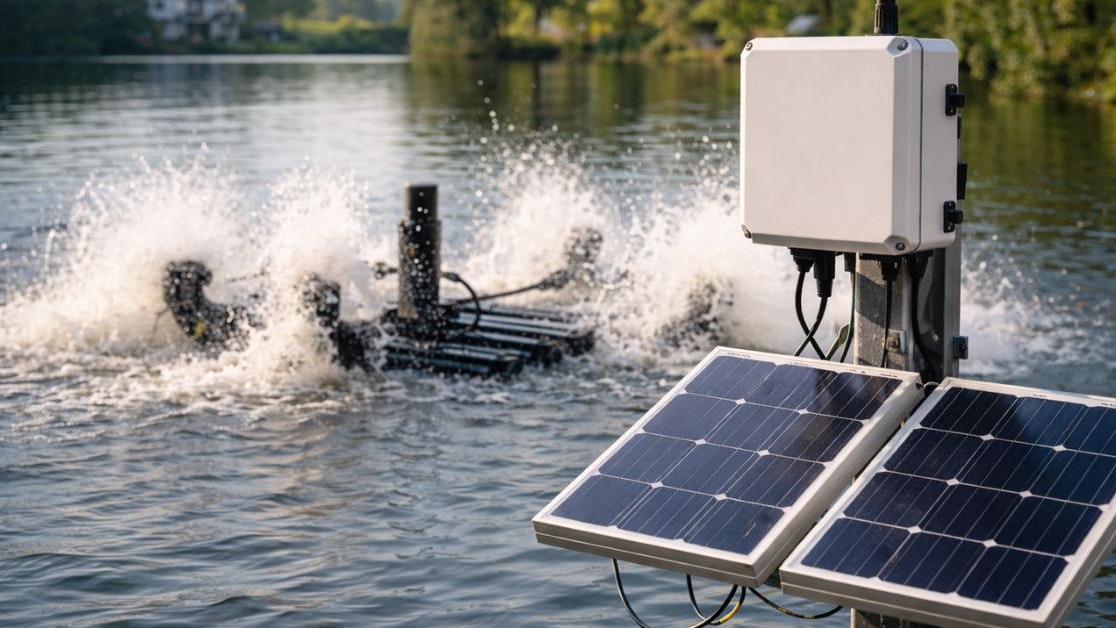
Created by innovation consultancy Parallax and aquatic tech business Remote Automation, the system is packaged into an easy-to-install box that’s ready to go the moment it’s plugged in. While unobtrusive from the outside, the RA BASE system is loaded with technology that can monitor and predict not only water quality levels, but also external factors, such as the wind direction, temperature, and air pressure.
After reading and analysing this information, the system can activate instantaneously to combat a sudden or potentially dangerous change, and mitigate its impact. For example, if a sudden drop in oxygen levels is detected, the box can activate aerators to restore the balance in a water. It does so remotely and autonomously, which not only removes many of the worries of water quality monitoring from fishery managers, but also vastly reduces their energy bills, as aerators will only run when required.
However, arguably the system’s greatest power goes beyond fishery management, as it also has the ability to detect and combat water quality issues on any river, lake or canal, including the impact of sewage discharges.
One of many sewage discharges
Addressing an issue
Nick Butterfield, the founder of Remote Automation, started work on the system back in 2018. He’s the fishery manager at the largest club in Cumbria – Windermere, Ambleside & District AA (WADAA) – and knew something had to change following a catastrophic fish kill.
“I found it embarrassing – we were totally unprepared and didn’t know the science behind it,” he told AT.
“I made a pledge to learn more, and from there embarked on a journey to create a system that would allow us to avoid scenes of such devastation.”
It wasn’t long before Nick developed a 24-hour monitoring system, but that presented its own challenges.
“I’d be up at all hours, driving to the fishery to turn aerators on if an issue was detected, which became a bit of a pain!” he added.
“The next step was to develop a remote system, through which I could turn the aeration on from my phone. But I then wanted to create something that could turn them on automatically.”
Nick went through the process of creating just such a system and eventually came up with the foundations of the RA BASE.
“With oxygen and temperature meters, I was able to set thresholds where, if met, the aerators would turn on automatically, which gave me the confidence to handle any situation.”
Another level
After building a few of the new devices for other angling clubs, Nick partnered with Parallax in the summer of last year and took the system to where it is today.
“We wrote new code and built new hardware, tailor-made for the purpose, and packaged it into the simple box,” he explained.
“It’s pre-configured, so all a fishery owner needs to do is plug it into a power supply and plug the aerator controls into the box, and it’s ready to go. There’s no programming or electrical work required.”
The system can also ‘learn’ using AI technology, as Nick explained: “It’s constantly looking for trends and understanding how to react to certain conditions. It can provide a 72-hour prediction of water quality using raw environmental data, plus risk alerts and answers to any unusual situation.
“An example of the latter ability was seen when WADAA had an oxygen issue on one of its waters recently. The AI suggested that it could be caused by high ammonia levels. As it happens, it was just that, coming from a caravan park nearby. With that information, we could rapidly find the source of the issue and address it.”
Wider ramifications
Since installing the system last year, Nick witnessed the electricity bills at WADAA waters drop from £4k annually to just £470, as his aeration systems are only running when required.
He also revealed that, alongside saving cash, the technology has abilities that could protect the health of waterways on a wider scale. “We don’t need to look far to see another news story about the water quality crisis – even the 2024 Olympics hit the headlines when the River Seine was feared to be off limits for water events, before a massive clean-up operation saved the day,” he says.
“Until our technology was developed, there was no way of remotely monitoring, predicting and responding to water quality data, so it’s truly a world first.”
Sewage discharges have caused outrage over recent years, and while some water companies are permitted to discharge during periods of heavy rain, cases of releases into vulnerable rivers during dry spells are widespread.
Nick added: “Our system can monitor the river conditions and, if installed at a sewage outflow, could stop sewage releases into low rivers overnight. Water quality issues in the Lake District, where our club is based, are well-known. I’ve already spoken to our local MP, Tim Farron, about the kit’s ability to protect water bodies in the region.
“He was blown away by its potential applications and quickly wrote to United Utilities and the Environment Agency, urging them to consider the benefits of the system and to consider rolling it out across our area. It would make a huge, and immediate, difference.”
Hopefully sights like these will become a thing of the past | credit: PDAA