This Lamp Visualizes the Perpetual Electromagnetic Storm in Which We Live
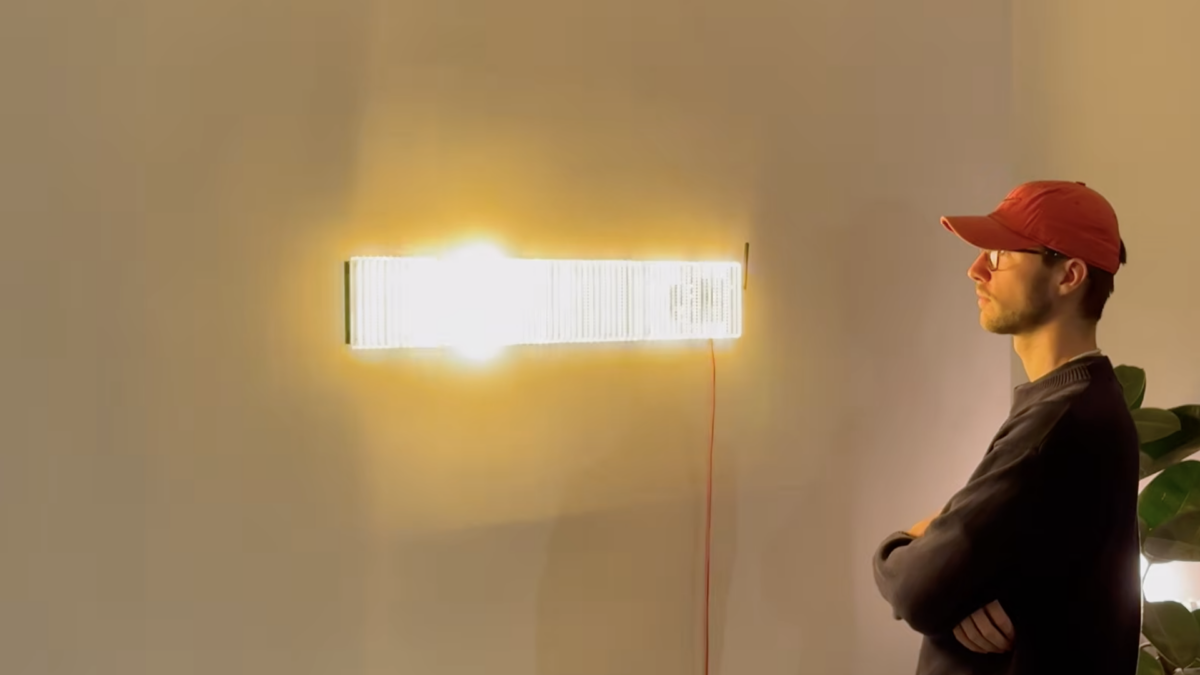
“You are standing in a storm,” says YouTuber Rootkid. “You just can’t see it. But what if you could?” He’s referring to the electromagnetic radiation given off by our electronic devices, and in particular, the portion of the spectrum that lies between 2.4 Ghz and 5 Ghz. These are the frequencies that carry data between our various wireless devices—wifi, but also cordless landline phones, Bluetooth devices, and microwave ovens, to name a few. To answer his own question—“What if we could?”— Rootkid constructed a device that he calls “Spectrum Slit,” a wall-mounted visualizer that provides a visible representation of the levels of ambient radiation in the 2.4 GHz–5 Ghz band. The signals it picks aren’t just from Rootkid’s own devices—as he explains, the device’s antenna picks up signals in a 30-meter radius.
The device is based on something called a HackRF 1, a software-controlled radio that can monitor a wide range of radio and microwave frequencies. The HackRF 1 is connected to a Raspberry Pi, which runs the accompanying software (written by Rootkid himself on a laptop that—in a delightfully French touch—has a full-screen picture of Françoise Hardy as its wallpaper.) The software monitors the 2.4 Ghz–5 Ghz band and divides it into 64 sections, each of which is set to control the brightness of a strip of warm yellow LEDs; the stronger the signal, the brighter the strip of lights. The result looks like a supersized version of a graphic equalizer from a fancy stereo. It’s also loud: Rootkid explains that the coils that contain the individual driver circuit for each row of LEDs vibrate slightly, giving off an audible hum, and the rate at which it vibrates is dependent on the LED’s brightness. This means that the pitch of the hum changes with changes in the amount of traffic in the frequency range that a given LED strip is set to monitor; as he explains in a comment, “When running, you can hear each burst of data… pretty disturbing actually.” (It must be said that in the video, at least, Rootkid seems more delighted than disturbed by this unexpected development.)
The completed Spectrum Slit is both a lovely piece of wall art and a genuinely fascinating insight into the world of wireless communication. Rootkid’s video follows him as he monitors the device over the course of a day. He watches as network traffic ebbs and flows during the day, before the arrival of various neighbors, home from work, sees the entire spectrum light up.
The video closes with Rootkid standing in a room flooded with warm yellow light, contemplating the device he’s built. “We live surrounded,” he muses, “by ghosts of our own making.”