Tesla didn’t remove the Robotaxi ‘safety monitor’ – it just moved them to a trailing car
Earlier today, Elon Musk announced on X that Tesla had “just started Tesla Robotaxi drives in Austin with no safety monitor in the car.” Tesla’s stock immediately jumped over 4% on the news. Headlines across the financial press celebrated the milestone.
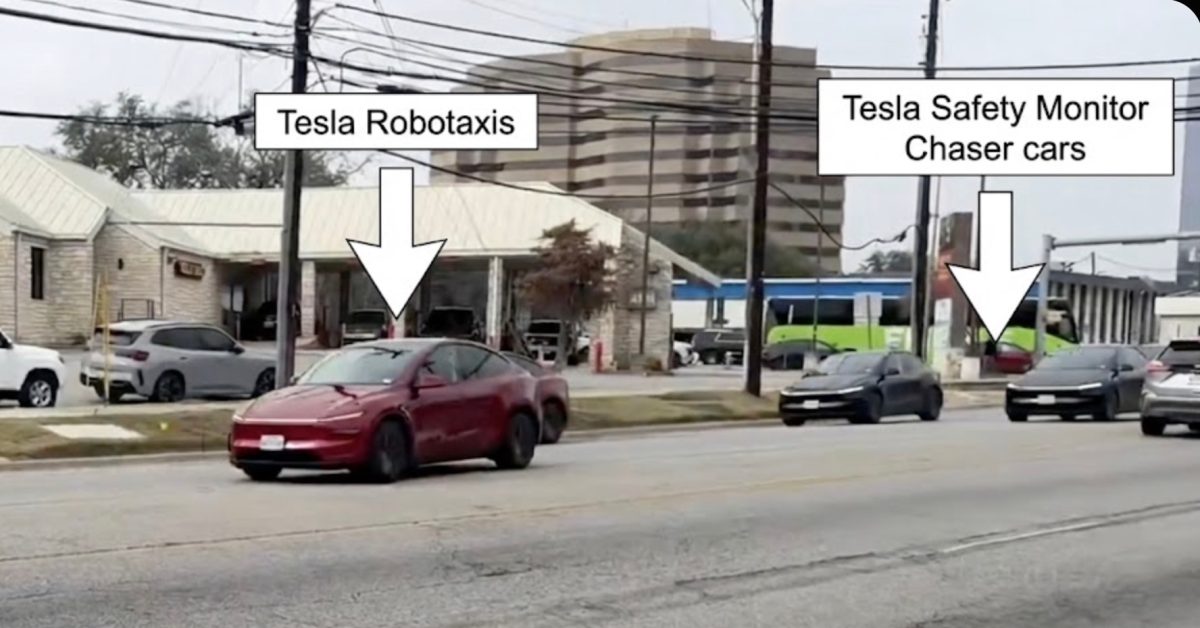
There’s just one problem: it appears to be another game of smoke and mirrors. The Robotaxi cars spotted without “safety monitor” were all being followed by a trailing black Tesla supervising the “driverless” Robotaxi.
It means Tesla didn’t “remove the safety monitor”, it just moved them to a vehicle behind them.
The trailing car problem
Earlier today, we reported that Elon Musk announced Tesla had “removed safety monitors from inside” the Robotaxis in Austin, Texas. Advertisement - scroll for more content
New video evidence posted by Joe Tegtmeyer on X shows Tesla’s “unsupervised” Robotaxis operating in Austin, and they’re not alone. In the video, two Robotaxis are visible, and both are closely followed by black Tesla vehicles. These trailing cars undoubtedly have safety monitors sitting inside, ready to intervene if something goes wrong.
Here’s the reality: Tesla didn’t remove the safety monitor. It simply moved them from inside the Robotaxi to a chase car following closely behind.
The move comes just as Musk claimed that Tesla “solved autonomy” again on stage in Davos.
Tesla’s CEO has been making this claim every year for the last 6 years.
Electrek’s Take
Let’s be very clear about what’s happening here.
When Musk says there’s “no safety monitor in the car,” he’s technically telling the truth, the monitor is in a different car, following right behind. But the implication that Tesla has achieved true unsupervised autonomy is misleading at best.
True unsupervised autonomy means the vehicle can operate safely without any human backup ready to intervene. That’s what Waymo does, their vehicles operate genuinely alone, without chase cars, across multiple cities. They’ve accumulated over 100 million fully driverless miles.
Now, there’s still some remote teleoperation when the vehicle gets into trouble, but it’s clear that Tesla is not even there yet.
Tesla’s approach is fundamentally different. Having a chase car follow your “autonomous” vehicle everywhere defeats the entire purpose of autonomy. It’s not scalable. It’s not cost-effective. And it’s certainly not the breakthrough that Musk has been promising for a decade.
Think about it: if the system were truly ready for unsupervised operation, why would you need someone in a trailing car ready to intervene? The chase car exists because Tesla knows the system isn’t ready to operate without a human safety net.
Now, of course, Elon cultists and shareholders will say that this is just temporary for testing, and while this is certainly the case, it’s not really the problem here.
The problem is Musk continuously pushing misleading statements and marketing stunts, like this or the “Tesla driverless delivery” that was done once and never replicated despite the clear value in it if it was real. All to keep the appearance of Tesla leading in autonomy and boost the stock.
Despite the questionable nature of Tesla’s claims, the stock market responded exactly as Musk presumably hoped. Tesla shares jumped over 4% today, with most of the rise coming after Musk shared the announcement, adding billions to the company’s market cap.
This is the real point of these announcements. Tesla’s entire valuation thesis depends on investors believing that full autonomy is right around the corner. Each carefully worded announcement that implies progress, even when the underlying reality hasn’t fundamentally changed, helps maintain that narrative.
FTC: We use income earning auto affiliate links. More.