Why GM's Cross-Fire Engines Earned The Nickname Cease-Fire
It's not uncommon for cars — and the engines that power them — to have nicknames awarded by their fans (and haters). General Motors V8 engines are not immune to the phenomenon, with fan-endorsed examples like the 327 small-block Chevy Mighty Mouse and the big-block V8 Chevy Rat Motors. Sometimes, however, these nicknames come from frustration that was evidently common among owners. That's the case with the early 1980s GM Cross-Fire, which became (un)affectionately known as the Cease-Fire in some circles.
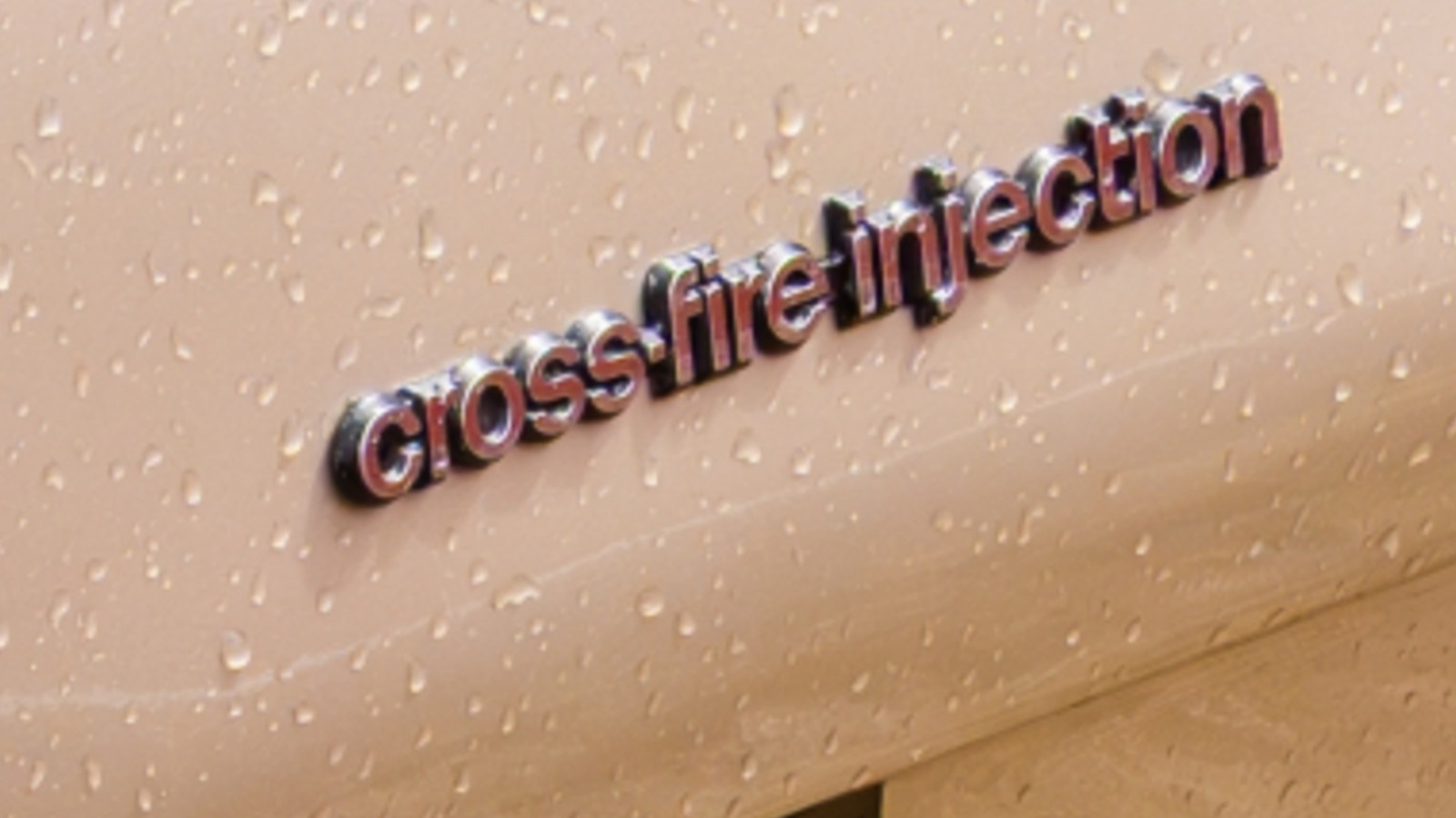
General Motors coined the Cross-Fire name to describe the dual 48 millimeter Rochester throttle-body fuel injection system found in its especially-sporty engines. However, the design was primarily intended to save fuel and meet the emissions mandates of the 1980s. General Motors engineers hoped that the advanced capabilities of the carburetor's Computer Command Control and the 750 cubic-feet-per-minute flow-rate of the dual throttle bodies would deliver on all fronts. Instead, the Cross-Fire V8 became known as arguably the worst engine to ever power a Corvette — which is a bold statement when considering the Blue Flame Six that powered the original Corvette.
Problems with Cross-Fire injection that prompted the Cease-Fire nickname arose primarily from a compromise involving the intake system. In order to accommodate the limited clearance of the low hoods used in early 1980s sport cars, the intake was lowered and the runners were shortened to fit underneath. This left the Cross-Fire injected LU5s with 165 horsepower and the L83 with 205, and those relatively-low outputs came without really improving fuel economy.
The Cross-Fire Injection system made its debut atop the 350 cubic-inch L83 small-block V8, which was standard in the 1982 and 1984 Chevrolet Corvette. The 305 cubic-inch LU5, an option for Chevy Camaros and Pontiac Firebirds in 1982 and 1983, also received it. The gap in the Corvette model years is there not because there's a different engine at play, but because there's technically no such thing as a 1983 Chevy Corvette.
The Cross-Fire design was a call-back of sorts to the legendary 302 Cross-Ram engine. While the Cross-Ram design worked well for the high-revving, race-focused 302, the Cross-Fire Injection system failed to provide significant benefits to the 1980s GM lineup. The dual throttle bodies, one designated for each bank of cylinders, struggled to deliver enough fuel to feed either engine. The issue was the low-velocity airflow through the lowered intake, leading to poor fuel distribution between cylinders.
Two solutions were devised as improvements. Adding more fuel to the mix allowed all cylinders to receive an adequate fuel charge. However, that solution negated any fuel economy gains promised by the new electronics. Another solution was decreasing the intake runner volume to accelerate airflow. With intake manifold ports roughly two-thirds the size of their mating ports on the cylinder heads, the system had better manners around town, but it limited performance above 4,000 rpm. The limited rpm and concessions to accommodate the weak 700-R4 automatic transmission left the 1984 Corvette with a top speed of just 128 mph.