Syrian army extends hold over north Syria
Syria's army took control of swathes of the country's north, dislodging Kurdish forces from territory over which they held effective autonomy for more than a decade.
The government appeared to be extending its grip on parts of the country under Kurdish control a day after President Ahmed al-Sharaa issued a decree declaring Kurdish a "national language" and granting the minority group official recognition.
The Kurds have said the announcement fell short of their aspirations.
The army moved forward after implementation of a March deal - intended to see Kurdish forces integrated into the state - stalled.
Members of the Kurdish forces in a pick-up truck are seen at the entrance to the city of Tabqa
Government troops drove Kurdish forces from two Aleppo neighbourhoods last week and took control of an area east of the city.
Yesterday, the Syrian army entered Tabqa in Raqa province and drove Kurdish fighters from the city's military airport, the official SANA news agency reported. Authorities also announced the capture of two oil fields in the area.
An AFP correspondent in Deir Hafer, some 50km east of Aleppo city, saw several fighters from the Kurdish-led Syrian Democratic Forces (SDF) leaving the town and residents returning under heavy army presence.
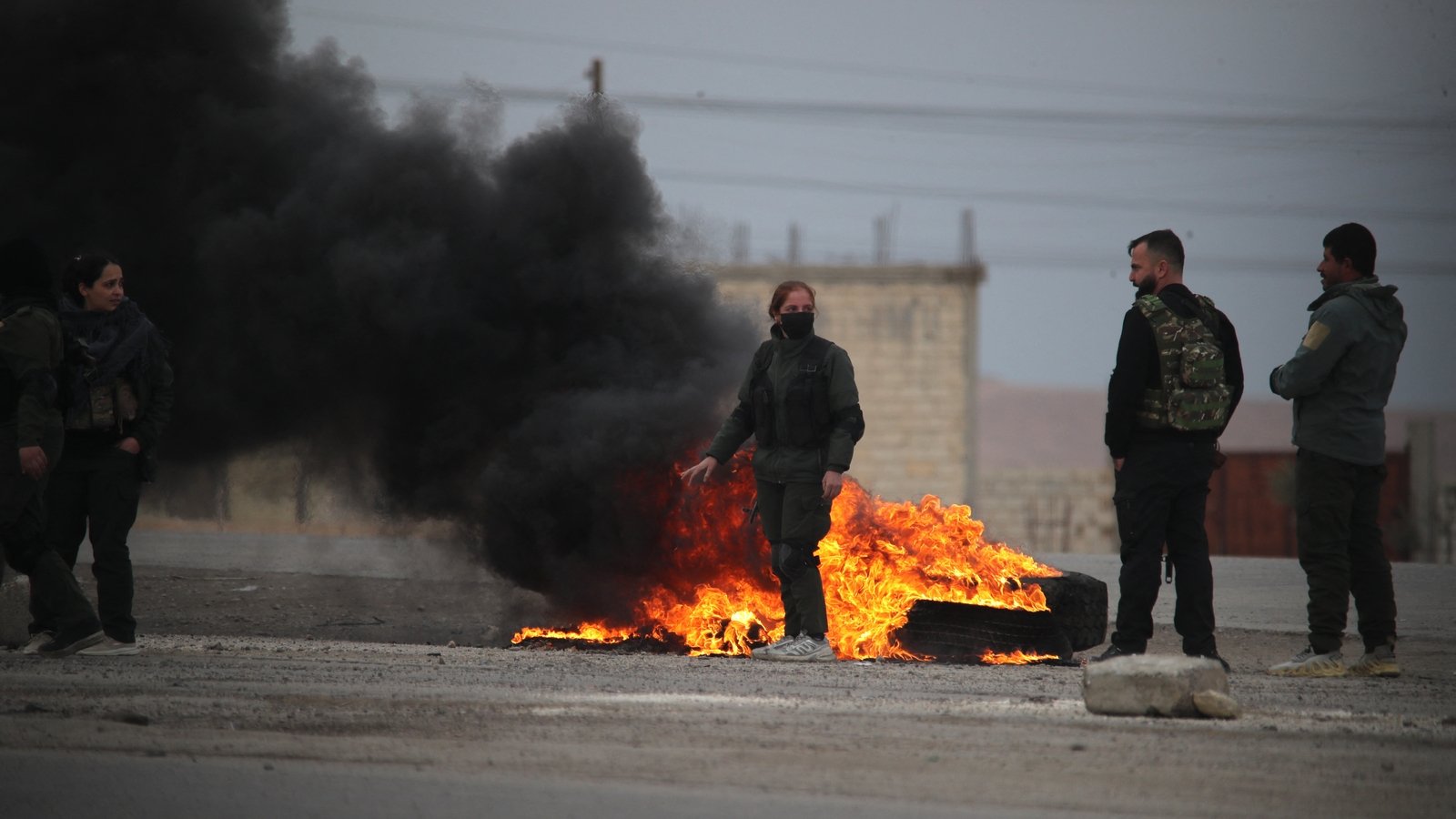
Syria's army said four soldiers had been killed, while Kurdish forces reported several fighters dead. Both sides traded blame for violating a withdrawal deal.
Kurdish authorities ordered a curfew in the Raqa region after the army designated a swathe of territory southwest of the Euphrates River a "closed military zone", warning it would target what it said were several military sites.
Syrian Kurdish leader and SDF chief Mazloum Abdi had committed to redeploying his forces from outside Aleppo to east of the Euphrates.
But the SDF said yesterday that Syria had "violated the recent agreements and betrayed our forces," with Kurdish forces clashing with troops south of Tabqa.
The army urged the SDF to "immediately fulfil its announced commitments and fully withdraw to the east of the Euphrates River".
Syrian government military reinforcements arrive via the international M4 highway at Al-Jarrah Military Airport, east of Aleppo city
The SDF controls swathes of Syria's oil-rich north and northeast, much of it captured during the country's civil war and the fight against the Islamic State group over the past decade.
US envoy Tom Barrack met Abdi in Erbil yesterday, the presidency of Iraq's autonomous Kurdistan region said in a statement.
While the United States for years has supported the Kurds, it also backs Syria's new authorities.
The US military's Central Command urged "Syrian government forces to cease any offensive actions in the areas between Aleppo and al-Tabqa".
France's President Emmanuel Macron and the president of Iraqi Kurdistan, Nechirvan Barzani, called for deescalation and a ceasefire, the French presidency said.
Presidential decree
Mr Sharaa's announcement on Friday was the first formal recognition of Kurdish rights since Syria's independence in 1946.
The decree stated that Kurds are "an essential and integral part" of Syria, where they have suffered decades of marginalisation and oppression.
It made Kurdish a "national language" and granted nationality to all Kurds, 20% of whom had been stripped of it under a controversial 1962 census.
The Kurdish administration in Syria's northeast said the decree was "a first step" but "does not satisfy the aspirations and hopes of the Syrian people."
Read more: US announces 'large-scale' strikes against IS in Syria
"Rights are not protected by temporary decrees, but through permanent constitutions that express the will of the people and all components" of society, it said in a statement.
In Qamishli, the main Kurdish city in the country's northeast, Shebal Ali, 35, told AFP that "we want constitutional recognition of the Kurdish people's rights".
Nanar Hawach, senior Syria analyst at the International Crisis Group, told AFP that the decree "offers cultural concessions while consolidating military control."
"It does not address the northeast's calls for self-governance," he said, adding: "Sharaa is comfortable granting cultural rights, but draws the line at power-sharing".
Syria appeared to be seeking "to drive a wedge between Kurdish civilians and the armed forces that have governed them for a decade," he argued.
Meanwhile, the US military said a strike in northwest Syria a day earlier had killed a militant linked to a deadly attack on three Americans last month