Jan. 13 Business Watch: Plants close in Brazil and the UK; Lilly to pay $1.2 billion for Ventyx
Sometimes it seems cliché to point out that the world is rife with uncertainty, but not this month.
The year began with the US military capturing Venezuelan president Nicolás Maduro. The consequences for Venezuela’s oil and chemical sectors have yet to play out, but it’s likely that an appreciable ramp up in oil production, which the Trump administration desires, won’t happen soon.
Iran may be a different story. Street protests have created possibly the greatest challenge to the Islamic Republic since 1979. Regime change in Iran seems possible. From an industrial perspective, such a change in that country could be more consequential than in Venezuela. Iran produces several times more oil. It is also a large petrochemical producer. And beyond Iran, the Persian Gulf region includes Iraq, Kuwait, Saudi Arabia, Qatar, and the United Arab Emirates. Instability caused by a political crisis in Iran could cripple the world’s economy.
Not to be outdone, the US has been increasingly hectic. The Donald J. Trump administration has pulled out of more than 60 international organizations, including the Intergovernmental Panel on Climate Change. And Trump’s Department of Justice is investigating the Federal Reserve chairman, a move that is being interpreted as an escalation of a row over interest rates.
The life sciences world presents its own confusion. Thankfully, to help sort that out, C&EN life sciences reporter Rowan Walrath is attending the JP Morgan Healthcare conference in San Francisco this week and has filed a report.
Questions? Comments? Tips? Email Alex Tullo, C&EN senior correspondent for business, at a_tullo@acs.org.
Top stories from C&EN
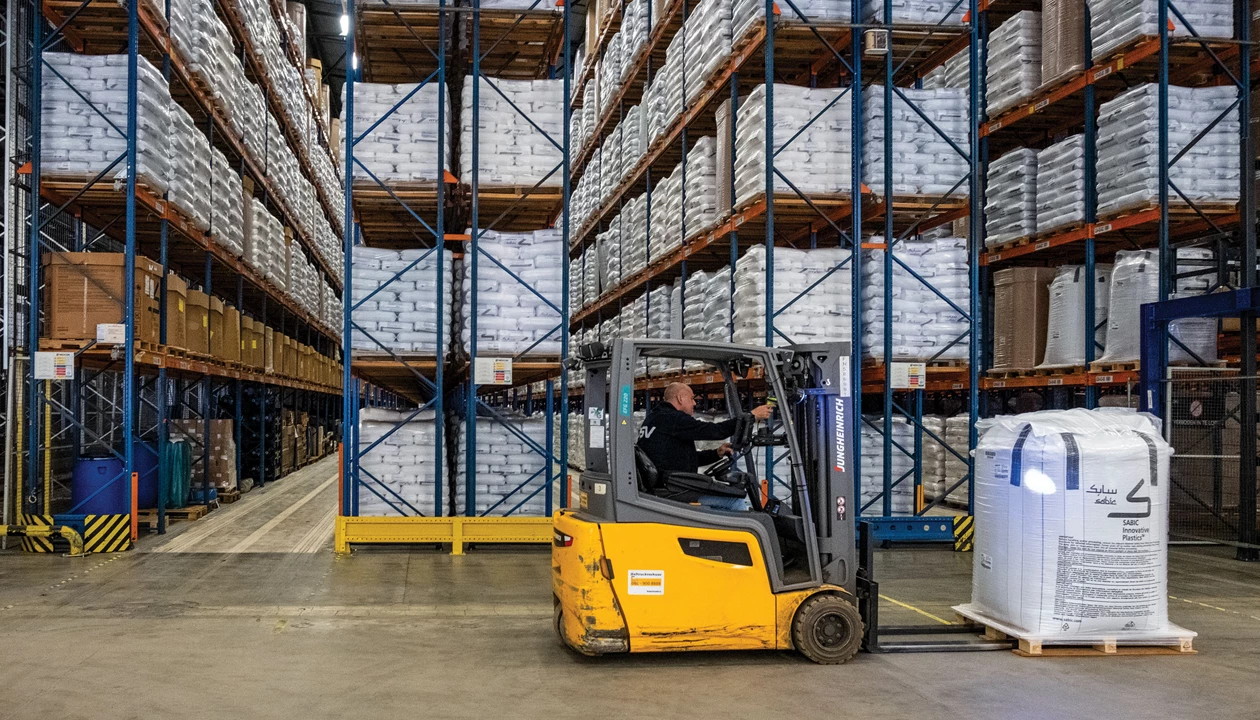
A forklift operates in a warehouse stacked with bags of plastic resins.
A Sabic warehouse in Bergen op Zoom, the Netherlands.
Credit:
Sabic
Claiming they don’t serve American interests, the Trump administration has pulled out of international bodies, including the United Nations Framework Convention on Climate Change, Intergovernmental Panel on Climate Change, and the International Energy Agency.Saudi Arabian petrochemical giant SABIC is selling off its European petrochemical assets and a chunk of the engineering polymers businesses it originally bought as part of GE Plastics.A Chinese antidumping probe into dichlorosilane imports from Japan shows that the countries’ diplomatic dispute may be boiling over into chemicals.Researchers from Tsinghua University and Peking University have unveiled an AI-driven program that can screen 10,000 proteins and 500 million compounds in a single day.The protein degrader start-up EpiBiologics has raised $107 million that it will use to launch clinical trials.The overthrow of Venezuelan president Maduro could lead to a turnaround in that country’s energy sector, but a chemical resurgence will have to wait.
Business in brief
BASF starts Zhanjiang ethylene plant
A humongous petrochemical complex that extends to the sea.
The BASF petrochemical complex in Zhanjiang, China
Credit:
BASF
BASF has hit a milestone at its integrated chemical complex in Zhanjiang, China, with the start-up of the site’s ethylene cracker. The plant has about 1 million metric tons per year of ethylene capacity and will supply raw materials to new ethylene oxide and polyethylene plants. The company boasts that it is the world’s first cracker to use entirely renewable energy to power its main compressors. The site, which will cost about €10.0 billion ($11.7 billion) to complete, will be the third-largest of the company’s Verbund, or integrated, sites, after Ludwigshafen, Germany, and Antwerp, Belgium.
—Alex Tullo
Unigel to shut down Brazilian styrene plant
Blaming an oversupplied market, the Brazilian chemical maker Unigel Participações is suspending operations at a styrene and toluene plant in Cubatão, Brazil. The site has annual capacity to make 120,000 metric tons of styrene. Unigel also operates a larger styrene plant in Camaçari, Brazil, and polystyrene plants in Guarujá and São José dos Campos, Brazil. “The Company’s decisions were taken in the context of an unprecedented downturn cycle in the global chemical industry, marked by a significant oversupply of petrochemical commodities, which has intensified since 2023 due to the expansion of international production capacity, particularly in Asia,” Unigel says in a statement (PDF). The firm says it is preserving the facilities in the event that conditions are one day right to restart operations. Unigel filed for bankruptcy in São Paulo last October.
—Alex Tullo
Invista to close 2 plants in new overhaul
Invista is closing its plants in Martinsville, Virginia, and Gloucester, England, as part of the polymer company’s latest streamlining. At Gloucester, Invista makes high-tenacity nylon 6,6 fiber for applications like automotive airbags, sewing threads, and high-strength fabrics. It will transition production to its plant in Kingston, Ontario. The company operates a machine shop in Martinsville. Some 150 jobs will be affected by the closures. Invista says it is considering expanding its site in Shanghai. Last year, the company elected to keep its nylon fiber business after evaluating strategic options for the unit. In September, the company said it was closing its site in Maitland, Ontario, where it had made specialty chemicals and nylon precursors.
—Alex Tullo
Verdant acquires Lubrizol oil drilling chemical site in Texas
Verdant Specialty Solutions has acquired a Lubrizol facility in Elmendorf, Texas, that produces chemicals used in oil and gas drilling and processing, including hydrogen sulfide scavengers, scale inhibitors, and corrosion inhibitors. The site includes a research and development laboratory, application testing capabilities, and pilot-scale facilities, Verdant says in an announcement of the deal. Lubrizol obtained the facility in 2014 when it acquired Weatherford International’s oil field chemical business. Lubrizol divested other parts of that business a few years later but held onto the Elmendorf plant. Verdant was formed in 2021 after the private equity firm OpenGate Capital bought Solvay’s amphoteric surfactant business. The South Korean firm Samyang Holdings acquired Verdant 2 years later.
—Michael McCoy
Tsubame starts up low-pressure ammonia plant in Japan
A small chemical plant dominated by scaffolding.
Tsubame BHB’s demonstration plant in Japan
Credit:
Tsubame BHB
The Japanese start-up Tsubame BHB says it has begun trials at a small commercial facility that produces ammonia in a low-temperature, low-pressure process. The Haber-Bosch process used to produce almost all ammonia today operates at high temperatures and pressures. Tsubame, a 2017 spin-off from Tokyo Institute of Technology, uses an electride catalyst technology that involves ruthenium nanoparticles. The pilot plant, capable of producing 500 metric tons of ammonia per year, was built on an Inpex site in Japan. The ammonia raw material hydrogen is also produced at that site by reforming natural gas and capturing by-product carbon dioxide.
—Michael McCoy
Syensqo and Axens form solid-state battery joint venture
The specialty chemical maker Syensqo and the chemical engineering firm Axens have launched a joint venture called Argylium to commercialize sulfide-based solid-state battery electrolytes in Europe. Firms working on solid electrolytes say that the class of materials is safer and more energy dense, and can charge faster than today’s cells, which rely on liquid electrolytes. Synesqo is bringing the chemistry to the partnership. The firm, the former specialties business of the chemical maker Solvay, has been working on solid sulfide electrolytes for more than 10 years and is already producing batteries with the technology on a pilot scale at its facilities in France. Axens, meanwhile, will provide its expertise in process scale-up, the firms say.
—Craig Bettenhausen
Critical Metals starts construction on Greenland rare earth project
The specialty mining company Critical Metals has begun building a facility in Greenland that will extract rare earth elements. The first steps are a pilot plant and storage facility in Qaqortoq, a town near the southern tip of the Danish territory. The firm’s contractor, 60° North Greenlands, is scheduled to have the buildings ready to receive production equipment by May. Rare earth elements are critical for the production of high-strength magnets and electronics used in electric vehicles, weapon systems, and a wide range of other civilian and military applications. The island’s rare earth resources are a central element in a current transatlantic crisis created by US president Donald J. Trump. Just hours after the US military captured the president of Venezuela on Jan. 3, Trump began demanding that Denmark turn Greenland over to the US and threatened to take it by military force. On Sunday, he told reporters that “one way or the other, we’re going to have Greenland.”
—Craig Bettenhausen
Quote of the week
"The Trump administration’s hostile, anti-science actions are utterly unhelpful to U.S. and global climate progress right now—and deeply against the interests of the American people."
Rachel Cleetus, senior policy director of climate and energy, Union of Concerned Scientists
Share
Basecamp and Nvidia collaborate on AI for gene therapy, antimicrobials
Basecamp Research has announced that it has developed a family of artificial intelligence models named EDEN (environmentally derived evolutionary network) that have designed entirely new enzymes for programmable gene insertion in human genomes, along with new antimicrobial peptides and a synthetic microbiome. The AI models were developed in collaboration with Nvidia, Microsoft, and several academic labs. Nvidia also funded Basecamp as part of a preseries C. The research has been released publicly as a preprint on bioRxiv but has not yet been peer-reviewed (2026, DOI: 10.64898/2026.01.12.699009).
— Max Barnhart
LNP maker and RNA firm team up
Vancouver-based lipid nanoparticle (LNP) firm Acuitas Therapeutics has acquired a majority stake in the Montreal firm RNA Technologies & Therapeutics (RNA T&T), which was founded in 2022 for the design and small-to-midscale production of RNA. But RNA needs a fatty delivery vehicle to get it where it needs to go. An Acuitas LNP technology delivered the Pfizer-BioNTech COVID-19 vaccine, for example. The companies say they have collaborated since RNA T&T launched and that the new deal will speed up the optimization of RNA payload and LNP carrier for a variety of therapeutics. But while the deal will allow third parties to easily engage experts from both companies to develop next-generation RNA-LNP therapies, the firms will continue to operate independently.
—Laura Howes
Lilly and Nvidia to invest $1 billion in a joint AI lab
Eli Lilly and Company and Nvidia have joined forces to launch an artificial intelligence–based drug discovery laboratory in the San Francisco Bay Area. The companies plan to invest $1 billion over the next 5 years in the infrastructure, talent, and computing power of what they call a “co-innovation” lab, Lilly says in a press release. The facility will enable experts from both companies to collaborate using Nvidia’s BioNeMo platform to generate AI models that accelerate drug discovery. Lilly says the laboratory’s initial focus will be to enhance its agentic AI capabilities to enable round-the-clock automated experimentation. Last year, the two companies collaborated to build the most powerful supercomputer in the pharmaceutical industry.
—Aayushi Pratap
Boltz and Pfizer announce partnership
The team behind a Massachusetts Institute of Technology artificial intelligence platform has launched Boltz, a public benefit corporation with $28 million in seed funding, and partnered with pharma giant Pfizer. Boltz’s flagship program, Boltz-2, combines protein-folding prediction and small-molecule-binding prediction. Boltz-2 was developed in partnership with Recursion Pharmaceuticals. It is open source, but under this new agreement, Boltz will train new, exclusive models on data from Pfizer, and its scientists will collaborate on Pfizer programs to create new models and workflows.
—Sarah Braner
Lilly to acquire Ventyx for $1.2 billion
The structure of tamuzimod.
Eli Lilly and Company will buy Ventyx Biosciences in a deal worth around $1.2 billion. Ventyx develops small-molecule therapeutics for inflammatory conditions, such as NLRP3 inflammasome inhibitors. It takes a wide view of inflammation, approaching the process as a driver of disease across the cardiovascular, metabolic, and neurological arenas, among others. Ventyx has two NLRP3 inflammasome inhibitor candidates in clinical trials. It also has two non-NLRP3 candidates for inflammatory bowel disease in clinical trials, including its most advanced candidate, tamuzimod.
—Sarah Braner
What we’re reading
The Donald J. Trump administration threatens Federal Reserve as feud over interest rates escalates: ReutersVenezuelan crude could cost more to produce than it will sell for: The WeekData centers will need $3 trillion in investment through 2030, the credit ratings agency Moody’s says: Bloomberg
Chemical & Engineering News
ISSN 0009-2347
Copyright ©
2026 American Chemical Society