DHS Used Neo-Nazi Anthem for Recruitment After Fatal Minneapolis ICE Shooting
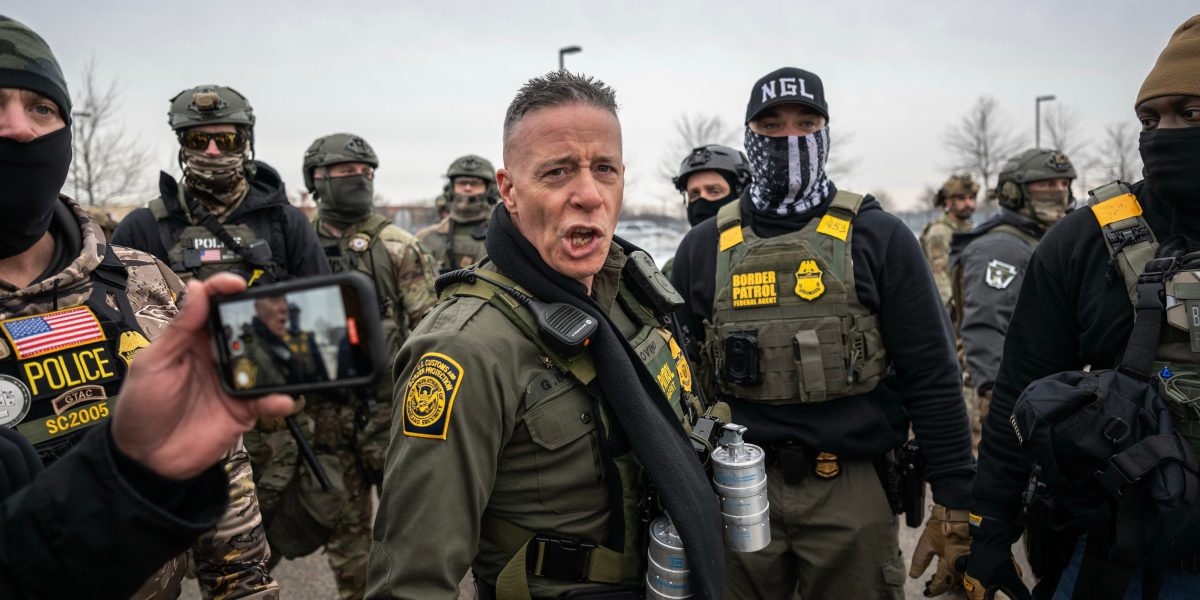
Less than two days after Immigration and Customs Enforcement agent Jonathan Ross fatally shot Renee Good in Minneapolis during a controversial enforcement operation, the Department of Homeland Security’s official Instagram account made a recruitment post proclaiming “We’ll Have Our Home Again,” attaching a song of the same name by Pine Tree Riots. Popularized in neo-Nazi spaces, the track features lines about reclaiming “our home” by “blood or sweat,” language often used in white nationalist calls for race war.
The post is part of a growing trend in which the federal government openly embraces the visual language of white supremacy and pop culture cited in instances of racial violence. Over the past year, DHS and its component agencies leaned on mainstream pop music in their social media outreach, pairing enforcement footage with recognizable songs. The approach backfired repeatedly, and the department now appears to be leaning on niche, neo-Nazi-beloved music.
“There was a sense of plausible deniability before,” said Alice Marwick, director of research at Data & Society. Anti-immigrant backers of Trump’s Make America Great Again movement have long been known to spread extremist language and media, but in the past, “those dog whistles were being done by supporters,” she said. “Now they’re being done directly by the administration.”
The Department of Homeland Security did not immediately respond to a request for comment.
Lyrics from “We’ll Have Our Home Again” opened the manifesto of Ryan Christopher Palmeter, a 21-year-old white supremacist who entered a Dollar General store in Jacksonville, Florida, in 2023, and killed three Black people. Palmeter’s 27-page document echoed the writings of other mass killers, including Brenton Tarrant, according to the Anti-Defamation League. Tarrant, who murdered 51 Muslim worshippers in Christchurch, New Zealand, in 2019, had praised the former white ethnostate of Rhodesia, now Zimbabwe, and framed his attack as part of a broader racial struggle.
Many recent attackers have been shaped by online extremist culture, Marwick pointed out. “These are young men who were embedded in online communities where memes and songs and books and slogans become part of this cultural fabric,” she said.
The decision to pair official recruitment messaging with music so closely tied to extremist identity politics, just days after one of its agents fatally shot a civilian, raises questions the department’s cultural awareness and basic judgment.
Brian Hansbury, a social media commentator who tracks far-right activity and posts through his Substack, Public Enlightenment, said the timing of the post stood out as particularly jarring. In online extremist spaces, he said, such juxtapositions are often read not as mistakes but as signals.
“When something like this appears immediately after a high-profile killing, it’s understood as intentional,” Hansbury said. “It reads as a message about who the agency is speaking to and the audience it is trying to reach.”
In other cases, the department has faced backlash for its attempts to use less controversial works of music. Pop singer Sabrina Carpenter condemned a White House/ICE video that used her song “Juno,” calling it “evil and disgusting”; the backlash prompted its removal. Olivia Rodrigo blasted DHS for using her song “All-American Bitch” to promote self-deportation, calling the move “racist, hateful propaganda.” Grammy winner SZA rebuked the Trump administration after her track “Big Boys” was used without permission in a recruitment video. And rock group MGMT had an ICE video featuring “Little Dark Age” removed from X after a copyright takedown request.
Even while making use of mainstream pop music, DHS’s official social media accounts were experimenting with language and imagery centered on national decline, territorial reclamation and cultural threat over the past year. In July 2025, the agency shared an image titled “A Heritage to be proud of, a Homeland worth Defending” alongside the 19th-century painting American Progress, a work frequently cited in white nationalist and “great replacement theory” circles for its depiction of westward expansion and Indigenous displacement. The painting is closely associated with the ideology of manifest destiny.
In December 2025, DHS shared a meme bearing a watermark from iFunny, a platform that has faced repeated criticism and removal from major app stores for hosting racist and extremist content. It mirrored themes that appear in so-called “Agartha” memes, a niche strain of far-right fantasy content that imagines a hidden, racially pure civilization beneath the Earth’s surface. Researchers who track extremist visual culture note that such narratives often romanticize white isolationism and technological superiority.
“Memes are often used to mainstream white supremacist ideas by starting with beliefs that are more socially acceptable, and then gradually pushing boundaries,” Marwick said.
Those strategies are often deployed with precision. “You see something like a micro-targeted advertising campaign where they test out messaging that they believe will be more palatable to different demographics,” Marwick said.
The imagery in the post aligns closely with “collapse and reclamation” memes that circulate in far-right online subcultures. Those memes frequently depict floating monuments, pyramids, and hidden homelands as symbols of civilizational rebirth. Researchers who track extremist visual culture have documented how such motifs are commonly used in racist and accelerationist meme ecosystems to frame narratives of decline, replacement, and territorial recovery.
Originally written by the Männerbund, a nationalist group associated with Germany’s Völkisch movement, “We’ll Have Our Home Again” has found a second life in modern far-right online culture, reposted and remixed by accounts with names like “Patriot Archive” and “Visigothia” and circulated across YouTube and platforms popular in far-right circles, where versions and videos have drawn hundreds of thousands of views with endless comments referencing Rhodesia.
Members of the Proud Boys have been recorded chanting “By God, we’ll have our home,” the song’s refrain, at rallies in Northern California.
DHS isn’t the only department in the Trump administration to openly embrace white nationalist rhetoric. Earlier this week, the Department of Labor drew flak for a post that mirrored a Nazi slogan.
It isn’t new to see extremist right-wing ideology perpetuated in online culture. What is new is seeing it echoed in official messaging from a federal law enforcement agency with the power to detain, deport, and use lethal force.
“Now there is no plausible deniability,” said Marwick. “It’s really clear that the message they’re trying to send is meant to be read one way.”